NK Chats To… Owen Knight
 Hello Owen, thank you for joining me today. Your book is called Another Life. Can you tell me about it and what inspired the story?
I had an idea for a character who, despite trying to do the best for everyone he encounters, feels his life to be one of disappointment and failure. Eventually, we discover that his decisions and actions have had a profound, beneficial effect on the lives of others. You could say it’s a modern-day interpretation of the film ‘It’s A Wonderful Life’.
I am also intrigued by quests and the twilight world of things that may or may not be. I am a great admirer of David Lynch and his ability to suggest that things are not as they seem was influential.
As for the story, it’s set in a secretive, hidden corner of Middle England, combining folklore, legends and ancient beliefs with the contemporary issue of what it means to be human in an increasingly technological world.
Thirty years ago, Oliver Merryweather is intrigued by a woman who waves to him from the window of a house in a village he discovers by accident.
In the present day, Oliver believes his life to be a series of failures and regrets. When the same woman appears to him in a dream, Oliver embarks on an obsessive quest to find her. With the village inexplicably absent from all maps, all he has to go on is the unusual mark on her wrist.
Journeying back into his past, Oliver finds himself inextricably drawn into a decades-old mystery involving missing children, pagan beliefs and the Green Man of folklore, while coming face to face with the disappointments and tragedies of his own life. As the story draws towards its unexpected and uplifting conclusion, the line between reality, dreams and memory begins to blur and Oliver gains an insight into the true purpose of his existence.
What were the challenges you faced whilst writing Another Life?
The bringing together of disparate ideas presented several difficulties. The biggest challenge was how to link my protagonist’s ordinary family life to the idea of the myths and legends associated with the Green Man.
The border between dreams and reality is a key theme in Another Life. This needed care, to avoid confusing the reader. There is the suggestion that something on the edge of the supernatural may be involved. It was essential to keep this as no more than a possibility in the mind of the reader. I’m not interested in writing pure fantasy – there has to be a grounding in reality, the possibility that the weirdest of events has a rational explanation. This was also important in creating a hidden community in Middle England, where the normal rules do not apply. I addressed this using a combination of geography and historical fact.
Finally, there was the challenge of the resolution: how to explain the mysteries and strange events encountered by the protagonist. Two-thirds of the way through the book the reader encounters a major change that makes sense of what comes before.
In summary, Another Life combines elements of family life, myths and legends, a quest and cutting-edge science. These elements are introduced in a natural, uncomplicated way, avoiding technical explanations, so as not to alienate the reader.
What’s your typical writing day like? Do you need things like coffee? Do you prefer to write in silence?
I’m an early morning person, whether it be writing and related activities, walking, running, photography. Writing comes first; it’s a passion that can never fully be satisfied.
A typical pattern is revision of the previous day’s work, followed by new words, including necessary research and then more research, finishing with a review of the current day’s progress.
I have to work in silence, other than birdsong. Music is too distracting. Any breaks have to be at a time of my choosing, usually ten minutes out of every hour. The exception is when I’m engaged in a long passage that’s going well. You have to take advantage of those occasions.
What’s your favourite word and why?
Apricot. I like the falling rhythm of the three syllables with a pause between the first and second. It’s like a musical phrase, sensuous, as is the shape and texture of the fruit.
How do you approach a writing project from idea to final draft and how long does it typically take you to get from the beginning of the process to the end?
A new book begins with a lot of thinking. A primordial soup of apparently unrelated ideas seeking to connect with the ideal partner. I write a few experimental passages, in isolation, to test whether they work, or at least have promise. Even at this early stage, I’m keen to ensure I can write engaging prose and believe in the idea. Much research follows until I’m happy that there is a story, a voyage embracing change. It is good to have an early idea for one or more endings. Much more important to let the characters lead you on a journey.
A new book takes me between nine and twelve months, including long periods of revision, particularly in the latter stages.
Which fictional world would you like to escape to for a while and why?


 by

Book Extract: One Snowy Week in Springhollow by Lucy Knott
 Hello to Lucy Knott and the blog tour for her book, One Snowy Week in Springhollow.
Tomboy Scarlett thought Devon would be her best friend forever. He was the only person in Springhollow who supported her ambitious artist dreams. But then one winter, Devon and his parents disappear without warning to start a new life in NYC and a devastated Scarlett is left alone to face her high-school bullies and overbearing mother.
Fast-forward ten years: Scarlett is playing it safe in her childhood village with a dull PA job and a wardrobe that passes her mother’s old-fashioned standards. Meanwhile, Devon is a Hollywood heartthrob, starring in the latest superhero blockbuster. And he’s finally coming home for Christmas…
Scarlett can’t help blaming her former best friend for the way her life has turned out, but Devon’s cheeky charm and gorgeous smile prove difficult to resist. Devon always did make her feel on top of the world, but Scarlett knows her heart isn’t racing just because she has her friend back – is it mistletoe madness, or is she seeing Devon in a completely new light?
Scarlett hasn’t taken a risk in years… but this Christmas of second chances could finally be her time to shine.
Lucy and Aria have shared an extract today so you know what to do.. grab that drink and that chair and enjoy.
***** beginning of extract*****
Springhollow being such a small village, Hope and I had applied to work at the magazine right out of college at the ripe old age of eighteen. Hope had always dreamt of being a journalist and overseeing the magazine one day, whereas I loved spending time with Hope and thought maybe a job at our village’s only magazine would appease my creative aspirations and my mother. I could focus on sophisticated pieces of writing, report the news and leave my silly dreams to professionals more suited to it than me. However, my previous boss didn’t quite take to my writing style, for some reason. I tended to add my own twist and inspiration when it came to facts and what was going on in our small village; that may have included the odd alien or magic power.
Giving me the top stories or putting me out in the field was not on his agenda. I was better suited for making coffee and seeing to it that the photocopier never ran out of toner, is what I was told. I take a deep breath and open up my emails. It’s better these days, I’ve gotten used to organising meetings, scheduling appointments and helping Hope assign writers to their suited articles.
Since landing our jobs here at The Village Gazette, Hope has worked her way up from editing other people’s articles to manager and she is a businesswoman to be reckoned with. I on the other hand have remained the coffee runner, only now I’m getting to do it for Hope and not Alfred, an older man who always wore a grey suit to match his grey hair, and didn’t much care for my creative flair. So really, I could take that as a win, maybe even say it was somewhat of a promotion, right?

 by
Book Extract: Christmas at the Marshmallow Café by CP Ward
 I am pleased to be welcoming CP Ward to Novel Kicks today and the one day blog blitz for Christmas at the Marshmallow Café.
When downtrodden checkout assistant Bonnie Green receives a letter from a mysterious uncle, she can hardly believe her eyes.
Gifted a hundred-year lease on a famous cafe situated in the middle of a mythical theme park, Bonnie sets off with her best friend Debbie on an adventure to a hidden valley in the Lake District where they will find new friendship, love, and happiness, all set against the magic of Christmas … and more marshmallows than they can possibly eat….
CP Ward has shared an extract today. Hot drink? Check. Comfortable chair? Check. Festive Lights? Check. Enjoy.
***** beginning of extract *****
Bonnie & Debbie
Bonnie hasn’t had the easiest of lives, as Debbie has a tendency to point out. However, things are about to change …
The DVD had loaded up its start screen, a little dog icon hovering over START MOVIE. Debbie swigged from her can of Guinness and sighed.
‘Honestly, sometimes I’m envious of you,’ she said, swinging her head to look at Bonnie, who hadn’t yet opened her can. ‘I mean, you’re what? Fifty-five, single, a homeowner, your kids leave you alone—’
Bonnie lifted a hand. ‘Just to make a couple of clarifications there … I’m fifty-two. Yes, I’m single, but I’m also divorced, which is like having a medal around your neck with “worthless” written on it. My husband ran off with a hat saleswoman he met when he was buying me a hat for Christmas because he didn’t like my hair and wanted something to cover it on the rare occasions we ever went out. I’m a homeowner only because he took all our savings in the divorce in exchange for letting me keep the house … and the mortgage I can barely pay on my pathetic Morrico salary. And both my kids took his side. Said I should have dressed better. I’m lucky if I get a card for my birthday now.’

 by
NK Chats To… Mari Jane Law
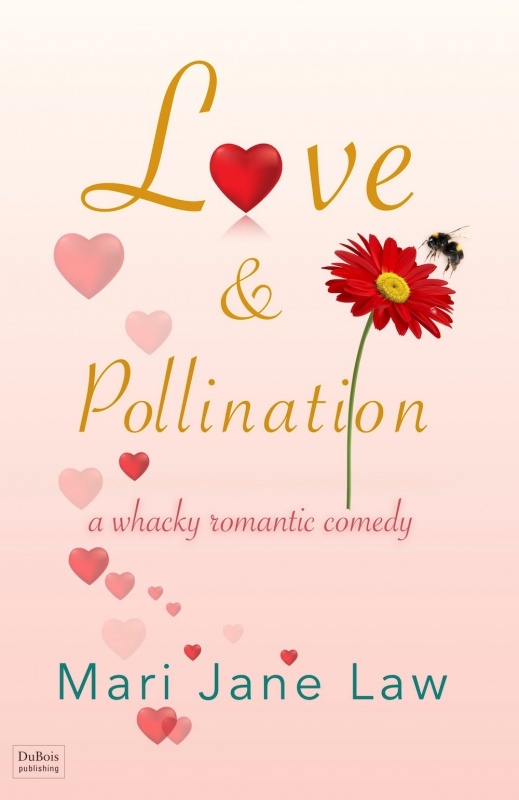 Hi Mari Jane, thank you for joining me today. Can you tell me about your novel, Love and Pollination and what inspired the story?
Hi Laura, thank you for inviting me to Novel Kicks and giving me this opportunity to talk about my book.
Love & Pollination is about an extremely naïve young woman called Perdita whose Catholic education and convent upbringing did not prepare her for having an intimate relationship. Being so innocent, she makes mistakes – and she ends up pregnant. Then she loses her job – and her home. But she’s optimistic and makes the best of things despite the intrusion of Saul Hadley into her life. She thinks that she can get the better of him – and readers will have to see if she succeeds!
The story was inspired by the fact that faith schools in the UK are not required to have Sex and Relationship Education (the government has now changed it to Relationship and Sex Education as they probably realised the revised word order was more appropriate for young people). So students in religious schools can end up being pretty ignorant about the birds and the bees – and how to spot a no-good womaniser.
I thought it would be fun to have a character who was brought up by nuns in an orphanage attached to a convent – and who had a Catholic convent education – to explain her innocence. And the plot set-up relies on her naïveté as do many of the jokes. That aside, she is still a unique character as you will see if you read the book – she has an interesting approach to problem-solving.
How long did it take you to write Love and Pollination and what’s your process like from idea to final draft?
I began the idea of the book about thirty years ago – I tried for Mills & Boon and had no luck. I worked on other things and, on and off, came back to this novel. But it wasn’t until about eight years ago that I decided to completely re-write it and change the tone of my writing. Then something seemed to click – and I started to make people laugh at the writers’ group I’d recently joined. I decided the plot worked far better as a comedy.
I bought some books on writing comedy, and I watch a lot of comedy on TV. But I didn’t labour on the book continuously over the eight years – I had other comedy romance ideas and began work on those. It took a great deal of slog to get Love & Pollination to the stage where it was finally published and I’m incredibly grateful to DuBois Publishing for giving me the opportunity to present my book to the world. I am hoping that I will be quicker getting my next book out. I just have to find a publisher…
You were a member of the Romantic Novelists’ New Writers’ Scheme. How did that help you write your novel? Is this something you’d recommend to new writers?
I belong to a writers’ group – we read out a piece of our work for ten minutes and get feedback for another ten minutes or so. This is very valuable but people giving feedback in a writers’ group can only see snippets of the novel at a time. The great thing about the New Writers’ Scheme is that the entire novel gets read by one person and they give a comprehensive critique. This gives feedback on plot and character development and can identify problems that a writers’ group can’t.
I recommend the NWS unreservedly. I think it’s fantastic. The membership fee is small compared to what it would cost to have someone from, for example, a critique company read the book – it makes getting personalised help much more affordable.
What’s your typical writing day like?
I don’t have a typical day – my writing is erratic. Sometimes I go through a fertile period and make a great deal of progress and then I can go for weeks with not being able to work on my manuscript at all for one reason or another.
What elements do you feel make a good story?

 by
Book Review: Scavenger Art by Lexi Rees
 Scavenger hunts are fun.
Drawing is fun.
Put them together for ★ SCAVENGER ART ★
This unique art-based activity book includes 52 scavenger hunts designed to
✓ encourage curious minds
✓ spark creativity
✓ practise mindfulness
✓ develop drawing skills
Perfect for ages 6 to 12.
Scavenger Art consists of a variety of drawing challenges around a selection of themes. For example, it asks the child to stand in the middle of a room, slowing turning. As they go, they are encouraged to make a list of everything they see, for example, a lamp, a chair, a bookcase.
Each section in the book comes with a page where there are nine drawn boxes. This is where they can draw their interpretation of what they have seen in the room.
This book combines two of my favourite things; a scavenger hunt and drawing (I must admit, I am much better at the former.)
Scavenger Art encourages children to not only be more creative and curious but to become more aware and mindful of their world around them and to maybe notice things that they may not have noticed before.

 by
Book Club