Book Review: The Liar’s Daughter by Claire Allan
 No one deserves to be taken before their time. Do they?
Joe McKee – pillar of the Derry community – is dead. As arrangements are made for the traditional Irish wake, friends and family are left reeling at how cancer could have taken this much-loved man so soon.
But grief is the last thing that Joe’s daughter Ciara and step-daughter Heidi feel. For they knew the real Joe – the man who was supposed to protect them and did anything but.
As the mourners gather, the police do too, with doubt being cast over whether Joe’s death was due to natural causes. Because the lies that Joe told won’t be taken to the grave after all – and the truth gives his daughters the best possible motive for killing him…
Joe McKee is popular in his Derry community. He is also dead.
Arrangements are being made for his traditional funeral. He is being remembered as a nice man and the grief is felt strongly amongst friends and family.
For his daughter, Ciara and his step daughter, Heidi however, there is a whole different set of feelings. They both hold a secret that could pull the whole family apart.
Not long after Joe’s death, the police arrive. They don’t believe Joe’s terminal cancer killed him.
The horrible truth will emerge and the people with the strongest motive to kill him… are his daughters.
The Liar’s Daughter is told from the point of view of Joe, Heidi and Ciara. I found the structure of this novel compelling. I loved how it was told in both the present with flashback chapters to the past. It really gave the plot a chance to develop whilst keeping a terrific pace and a sense of suspense and building tension.


 by

Novel Kicks Writing Room: Point of View
 Today’s exercise is changing POV for your character.
I am quite excited about today’s exercise and I think it’s great to flip the WIP on its head.
Using your current work, pick a passage featuring your main character. If you’d rather pick a character from your favourite novel, please do.
Now, change the point of view. For example, if you’ve written in first person, re-write in third person and vice versa.
If you wanted, you could also re-write from a secondary character’s point of view.
How did you find it? Did it inspire you to add more to the story and to see another aspect?

 by
Book Review: Taking a Chance on Love by Erin Green
 One question can change everything.
Meet Carmen, Polly and Dana – all happy and successful women, with very different views on relationships.
Carmen has made a life with Elliot for the past eight years. She’s ready for the next step but a proposal seems to be as far away as ever.
Polly is devoted to her family. But after her parents’ bitter divorce, she’s wary of marriage – even after sharing twenty years and one son with Fraser.
Single mother Dana longs for companionship, despite her dedication to raising her son Luke. Finding the right person to bring into their lives feels impossible – until a unique way to select a potential Mr Right comes along.
With 29th February fast approaching, will they each take the chance this Leap Year to take control of their fates?
The perfect feel-good book for a Leap-Year; albeit, with a twist.
This is the tale of three women, Carmen, Polly and Dana, all with different expectations on their relationships with their men.
We are taken on a roller-coaster of a ride with all having to endure unexpected complications along their journeys.

 by
NK Chats To… Helen Taylor
 Hello Helen, thank you for joining me today. Can you tell me about your book, Why Women Read Fiction and what inspired you to write it?
I have always been fascinated by the fact that the main readers of novels and short stories are women. Currently we buy (and also borrow) about 80% of all fiction. Women are the vast majority of members of book clubs, attendees at literary festivals, visitors to libraries and bookshops, and organisers of days out to literary heritage sites like the Brontës’ Haworth Parsonage. Many years ago, I wrote a book about Gone With the Wind, and more recently a Daphne du Maurier Companion, and while researching both these, I was struck by how many women told me of their passion for both writers and their books, and how profoundly they had wrapped words, scenes, characters and settings into their hearts and their own life stories.
They had even called their daughters, dogs and cats after the protagonists (Scarlett, Rhett, Rebecca). So I set out to ask what it is about reading fiction that appeals to women – and I found it offers escape, a special space just for us (‘me-time’), and the opportunity to spread our wings intellectually and emotionally. It helps us through the night, and gives us insights into our relationships and families, as well as the world beyond. Jackie Kay suggests ‘our lives are mapped by books’.
Fiction is important to so many people (including me.) Which fictional novel has made the most impact on you and why?
At different stages of my life, particular books have resonated. As a girl, I wanted to be like awkward, unconventional and ambitious Jo March in Little Women. As a young student, George Eliot’s Middlemarch taught me about social and intellectual pretentiousness, and warned me never to marry an emotionally stunted man.
As a middle-aged and older woman, I’ve learned about worlds very different from my own through writers such as Ralph Ellison, Eudora Welty and Hilary Mantel. Toni Morrison’s Beloved about American slavery is the most devastating novel I’ve ever read, and Kate Chopin’s The Awakening is very dear to my heart because set in a special place of mine, Louisiana.
What were the challenges you faced when writing When Women Read Fiction?
I decided to send out questionnaires to women about their reading, and to interview women writers too. The enthusiasm with which over 400 women responded to my questions and the wonderful material they provided me with, were very humbling, and I had to try to do justice to it all. Women love to tell you about what reading fiction means to them – ‘a lifeline,’ ‘my best friend,’ ‘the love of my life’ – and all the ways they have found it helped them in sorrow, joy, sickness and health.
Women writers are very aware of their responsibility to, and friendly relationship with women readers, though they gave me angry accounts of being ‘Little Womaned’, as Hilary Mantel put it – reviewed, paid and valued less than male fiction writers.
What’s your writing day like and what do you need around you? For example, coffee, tea, music, silence?
Alas, I’m not an early riser, but when I get going (after many cups of good English Breakfast tea) I like to write to music – Joni Mitchell, Kate Rusby, Mozart, Leonard Cohen)- but when I REALLY get going and the writing is flowing, I work in silence. Those are the most productive and precious times.
 What’s the first thing you do when starting a new project? What comes next?
I am a slow burn writer. I was commissioned to write a BFI book about the film of Gone With the Wind and I finished it in three months, but usually it takes me years to shape an idea and produce a book.
I had the germ of an idea for Why Women Read Fiction thirty years ago, but I worked on it seriously for about five years. I think it’s a better book for taking so much time.
How do you approach the editing process?
Editing is my favourite process of all. I find research and first drafts time-consuming and difficult, but I love to edit.
Years of teaching students have given me considerable experience here, and I love to spot my own repetitions, clichés, weak phrases and poor arguments – then brutally cut and reshape. It’s the most creative process.
What’s your favourite word and why?

 by
NK Chats To… Nicola K Smith
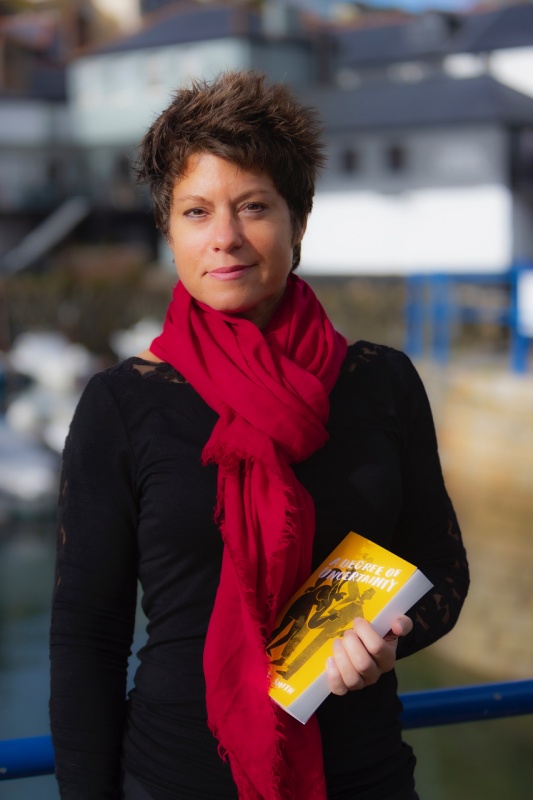 Hello Nicola, thank you so much for joining me today. Can you tell me a little about your debut novel, A Degree of Uncertainty and what inspired the story?
Thank you for inviting me to chat with Novel Kicks, Laura.
A Degree of Uncertainty explores how a Cornish community is being ripped apart by its growing university, with an influx of students upsetting the balance of things and challenging the way life has always been. Some residents — and business people — see it as progress and welcome the expansion. Others feel threatened by the change in dynamics.
Against this backdrop of small town politics, the story is very character driven, exploring love, friendship, loyalty and betrayal. The shifting community pits friends, neighbours and colleagues against each other and reopens old wounds…
Do you think character or plot is more important in a story?
I think that’s a little bit like asking which is more important, a bra or knickers… I agree that some books are weighted more in favour of one or the other, but for me, you need both. That doesn’t mean the plot has to be a rip-roaring rampage punctuated with multiple murders and endless twists, but the storyline needs to travel from A to B.
That said, I can really enjoy a book where a deeply plausible character goes on an emotional journey and, in essence, very little happens. But I don’t think the best plot in the world will stand up in the hands of characters in whom readers don’t believe or, worse, don’t care about.
What would be on a playlist for this novel?
One of the two key protagonists is Harry Manchester, a proud Cornishman and successful local businessman who vows to save his beloved community from being overrun by students and ruined by change. Harry is a keen music fan and ex-drummer and he often seeks solace in Queen music, letting the lyrics guide his mood and — in one instance — his actions. So it would have to be Queen’s Greatest Hits. (He also has an incident where his Bohemian Rhapsody ring tone goes off at an untimely moment, but that’s another story…)
What was the biggest challenge when writing your first book?
Starting a book is a challenge. I’d had the idea for a while and I began making notes and sketching out characters and plot, but actually writing those first words seemed like a terrifying leap!
I did a ‘Starting to write your novel’ course with the literary agency, Curtis Brown, which gave me the tools to plan and start the book. It also gave me a huge dose of confidence as I was chosen as ‘Most promising student’ on the course, and was rewarded with a one-to-one tutorial with one of the agents. That was a massive shove in the right direction, and the novel began…
What’s your typical writing day like? Where do you like to write? Do you prefer silence, do you need coffee?

 by
Book Club