Film Vs Book.
Can movie adaptations really do a book justice?

Summit Entertainment, Mr.Mudd, Entertainment One.
I am a fan of both film and novel. However, i am always a little sceptical when I see films that have been adapted from novels especially if it’s a novel I have read and loved.
Many films have been adapted from novels, The Silver Linings Playbook and The Perks Of Being A Wallflower are just two examples from last year.
I love reading but I find that if I see a movie before reading the book then I find it difficult to read the book on which the film is based (The Time Travellers Wife.) I also find that if I read the book and then see the film, if it’s not been adapted well, I sit there the entire time comparing the film to the book.


 by

Trisha Ashley’s advice for new writers…
I often hear people say they’re going to write a novel…eventually, when they retire, or the children have left home (do they ever, these days?) and they have the right computer, or pen, or the wind is coming from the south west…
I’ve never really understood this, because if you’re a writer, you write. You burn to write. It’s part of who you are. And its fun, too – in fact, Stephen King says writing is the most fun you can have on your own and he’s quite right.
Perhaps it’s a fear of failure or success, but you won’t experience either unless you actually get the words down on the page, so why not start today? If your writing U-bend needs unblocking first, you should read Natalie Goldberg’s Writing Down the Bones, and all will soon be flowing freely. And I’m going to quote Stephen King again (you should read his book, On Writing) when he says that you should write your first draft with the study door closed, i.e., just for yourself, then the second draft with the door opened, rewriting it with an eye to your readers. That’s great advice – write with a red-hot pen, let the words rush out onto the page, then hone and polish till it sparkles.
For those going the traditional route and submitting to agents or publishers, a little market research in the Writers and Artists’ Yearbook beforehand can work wonders, so that you’re submitting to an agent or editor who actually handles/publishes the genre of fiction you write.
Of course, to do this you actually need to know what kind of novel you’ve written and make this clear in your synopsis, because if you don’t know, then the agent/publisher certainly won’t.
And once it’s gone, don’t wait for the novel to come back, but crack on with the next one straight away.

 by
Matt Dunn talks about creating characters.
If there’s one question a novelist (well, me, at least) always gets asked (apart from “where do you get your ideas from?”, to which I always reply “there’s a great website – IdeasForNovels dot com”), it’s “is the central character based on you?”. 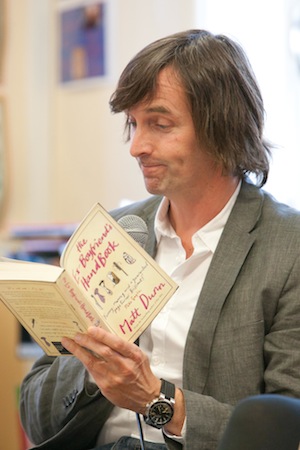 I’m never offended – after all, I don’t write books about serial killers – but though I don’t always like to admit it, the answer is quite often a resounding “yes”.
And I sometimes apply a similar approach to the supporting characters too. There’s a saying that goes something like: “when you write a novel, half your friends will be annoyed because they think they’re in it, and the other half will be even more annoyed because they’re not.” Most authors will probably smile wryly at this, but there’s a reason why, at the front of very novel, you’ll read a disclaimer that says something like ‘any similarity between characters and persons alive or dead is purely coincidental’, and that reason is, well, because any, ahem, similarity isn’t always, you know, purely coincidental. Well, at least in my books!
Of course, while most of us writers – me included – wouldn’t stoop so low as to completely and accurately reproduce our friends and family in the books we write, it’s probably fair to say that many of us do occasionally ‘borrow’ or exaggerate facets of people we know’s personalities, or pinch things they’ve said, or even the way they speak, in order to give life to characters on the page.
Certainly, the supporting characters in my first two books – Best Man and The Ex-Boyfriend’s Handbook – were based loosely on friends of mine. At the time – and it was early on in my writing career – it just seemed easier to imagine someone I knew, then just write that down. And it seemed to work.
I now know most novelists take a much more formal approach – spending ages writing full character CVs, or even question-and-answer profiles so they know exactly what a character’s like. This works well – I’ve done it myself recently. But strangely enough, I’ve found my best received characters have all had a dose of reality about them.

 by
Book Club