12 Days of Clink Street Christmas: Daisy Mae_224’s Traditional Christmas
 My next stop on the 12 days of Clink Street Christmas has arrived. Author Daisy Mae_224, the author of Dating Daisy shares her traditional Christmas. Over to you, Daisy Mae_224…
I’ve decided honesty is the best policy. If you are reading a Christmas blog, you probably expect to read how much I love Christmas. How I can’t wait for it to come round – again. How I love the preparations and the traditions etc… Well – you may just be disappointed.
I really dislike Christmas! And I am not Mrs Scrooge either!
– So now, I’ll try and explain why –
For starters, I’m not religious. I do actually like that part of Christmas however, as that is about story-telling, kindness, and involves the Nativity, children, and singing beautiful Christmas carols. It is rather magical to light candles in a church and sing Hark the Herald at the top of your voice on a cold winter’s evening.
It’s the commercial side of things which are so abhorrent. Somehow we are all caught in a trap of “finding something someone might like.” Also, even those little stocking fillers cost a fortune. And the vast majority, beautifully packaged they may be, will just end up in land fill sites. Having cleared out and downsized from my 6 bedroom house a few years ago, I am in fear of clutter. Never again will I be doing all that!
Let me say up front it’s not so much the cost. I’m a generous person and I love giving things to people and spreading a little happiness. It’s just that when the world is full of starving, poverty-stricken people, how can we the rich of the Western world, be quite so greedy. It makes me feel so uncomfortable. I don’t like opening my presents as I feel so guilty about that. I sit with a pile next to me and watch everyone else open theirs, and I just don’t want to do it.
The sad fact now is that as I am divorced and my parents have died, I can’t think of Christmas as the family occasion it used to be. I miss my parents, especially at Christmas. My children divide themselves up for a day each between myself and Voldemort. There is always a big row about which day is for who, and I dread it.
Then there’s the food. It isn’t a great Christmas to be sweating in the kitchen over an enormous and gastronomically fashionable Christmas dinner. How often have I downed a few gin and tonics one by one, stuck in the kitchen, while everyone else is laughing in the lounge. Because it’s supposed to be such an amazing dinner, it’s very stressful. Mostly they can’t all decide on one meal, so I’m trying to cook a turkey, a ham and a salmon for example, all at the same time. It just doesn’t work! And I’ve never been very good at gravy!
I have to say I like to plan the day so we don’t just “sit around looking at the tea cups!” Last year, soon after the children arrived on Christmas Eve, we went out for lunch at a New Forest pub, following a dog walk on Canada Common. When we got home, we all jumped in Edward’s amazingly hot, clean, sparklingly fresh, hot tub with a few mugs of tea.


 by

12 Days of Clink Street Christmas: Extract From The Shield by C.J. Bentley
 It’s time for the 12 Days of Clink Street Christmas and today, author C.J. Bentley joins me with her book, The Shield which is book one in the Finder Series.
People lose their belongings. That is a fact of life. It can happen by accident, but sometimes it can happen when you put them in a very safe place and forget where that safe place is. Not many people are good at finding them again.
A young, gutsy girl with a kind heart, who’s searching for her own identity growing up in the 1960s, just happens to be very good at finding things. Can she be the one to help return whatever is lost – anywhere and at any time – to its original owner?
With the help of a beautiful yet mysterious wise woman and a chivalrous knight she does just that. She finds and returns his shield, lost in battle, which unbeknown to her holds a secret that is important to his King, the safety of the Kingdom and the life of the daughter of his best friend.
The Shield is the first story in The Finder Series, taking our heroine on extraordinary journeys back in time. Her first adventure takes place in Medieval England in 1340 where she meets King Edward III, his wife Philippa and their son, who will later become the Black Prince.
C.J. Bentley has shared an extract from The Shield with us today.
“Can you lot see that dust cloud over there?” Jeanette was facing the field and had to move her head to where she meant as her hands were full. “It looks as though it’s coming this way I wonder what it could be”.
“Sometimes you get dust clouds when there hasn’t been much rain, the wind whips up and disturbs the dust, you know a bit like in the desert, mini tornados”, Richard liked his geography just as I liked my history. As we were so intent on carrying the heavy shield between us and joking as to who the first person to let go would be, we didn’t notice what was happening in the distance.
“Can you lot move around so I can see, my back is where you are looking,” Hugh turning studied the dust cloud for a while, “looks like a horse coming towards us don’t you think?”
“I think you must be eating lots of carrots if you can see a horse that far away,’ Linda moved her head round and watched the dust cloud approach, “do you know Hugh I think you are right it is a horse with somebody riding it and quite fast, looks like some sort of a flag flying too”.
“I think we should put this down and run,” Richard looked quite scared.
“Don’t be daft you lot, it’s probably one of the girls from the riding stables riding towards us trying to frighten us, if we stand our ground she will stop”. I wished I felt as confident as I sounded but something about the ‘cloud’ coming towards us reminded me of something, something, or someone, it couldn’t possibly be what I thought it was.
The way the person confidently rode the horse and looked to be encased in shiny armour which flashed as the sun hit it, the white horse moved in a colourful swathe of material in blues and reds, swirling around his legs as he galloped towards us. The shine of the rider’s metal suit of armour. The long pole from his foot to past his head, which was encased with a plumed helmet, was flying a coloured flag on the top. It all reminded me of my favourite book, ‘Ivanhoe’. What we were looking at was surely an apparition, my imagination playing tricks on me, but on the others too. Strange we could all see it, so no apparition then.

 by
Extract: The Perfect Victim by Corrie Jackson
 A big welcome and hello to Corrie Jackson and the blog tour for her new novel, The Perfect Victim which was released by Zaffre on 16th November.
Husband, friend, colleague . . . killer?
Charlie and Emily Swift are the Instagram-perfect couple: gorgeous, successful and in love. But then Charlie is named as the prime suspect in a gruesome murder and Emily’s world falls apart. Desperate for answers, she turns to Charlie’s troubled best friend, London Herald journalist, Sophie Kent. Sophie knows police have the wrong man – she trusts Charlie with her life.
Then Charlie flees. Sophie puts her reputation on the line to clear his name. But as she’s drawn deeper into Charlie and Emily’s unravelling marriage, she realises that there is nothing perfect about the Swifts. As she begins to question Charlie’s innocence, something happens that blows the investigation – and their friendship – apart.
Now Sophie isn’t just fighting for justice, she’s fighting for her life.
Corrie and Zaffre have kindly shared an extract from The Perfect Victim today. Enjoy!
CHAPTER 38
I wiped the rain from my eyes and lurched towards the hut nearest the forest. I ran my torch over the door; it was padlocked. I pressed my ear to the door but I couldn’t hear anything over the wind. I did a circuit of the building; no windows, no other way in except through the door. My fingers tightened around the rock; I’d have to bash open the padlock.
‘Kate!’ I raked the darkness with my torch but I couldn’t see her. My gaze fell on something on the ground and I crouched down for a closer look. Was that blood? I inched forwards, following the trail with my torch beam. It ran across the gravel, in the direction of the forest. I hesitated for a split-second then turned back towards the hut. As I did, my torch landed on a man, standing ten feet away from me, his hands jammed in the pockets of his waterproof.
‘What are you doing?’ The wind carried his gravelly voice towards me.
‘I – I’m looking for someone. A woman. I think she’s inside this hut.’
He edged towards me, on the tips of his toes. ‘That’s not possible, Miss. I’ve just been in that hut. Nothing but farming equipment in there.’
I tightened my grip round the rock and shone my torch in his face. I couldn’t see much; he was wearing a woolly hat, and his chin was buried in a scarf. ‘Then you won’t mind showing me.’
He cocked his head to one side. ‘And you are?’

 by
NK Chats To: Isabella Davidson
 Hi Isabella, thank you for joining me today. Can you tell me about what your typical writing day is like?
Thank you for having me on your blog! My typical writing day consists of waking up to my children’s chatting and playing, getting them dressed, preparing breakfast and taking them to school. Then, when I get back home, I sit in my office and start writing. I am most productive in the morning, when I have a clear mind, and feel the most motivation. After my children come back from nursery and school, I have to find any moment I can to continue writing; after putting them to bed, when they are at activities, and any other moment I can find – which isn’t always easy.
What’s the best and most challenging thing about writing your first novel?
The best part of writing The Beta Mum, Adventures in Alpha Land, was when I felt like I had written a really good passage, and thought people would enjoy it. I once laughed at what I wrote, which is usually a good sign. They say that if you are bored writing then your reader will be bored. You have to keep the writing alive and fun if you want your reader to continue reading. If I can move someone to feel something when they read my novel, that is success to me.
The most challenging? The entire process is challenging! Writing the book, word after word, until you finish typing the last word. Then the editing. And more editing. Then sending it off to agents and publishers. Then, once it has been published, promoting your book and trying to get sales. It is like an intense obstacle course over years.
What’s your favourite word and why?
That’s difficult for me to answer! I don’t have a favourite, I like all words, whether simple or complicated. To me, each word has a purpose, a meaning and a place, so all of them are important in their own way.
What was your writing process like from your idea to final draft? Did you plan? How did you approach the first sentence?
When I first started writing my novel, The Beta Mum, the story line was completely different than this one and it also had a completely different title. I had a general idea of what subject I wanted to write about – the Alpha mums in a nursery setting in west London – but the plot changed completely after I started the Faber Academy novel writing course. There, I received a lot of input, both positive and negative, and I found a new story to tell. I also learned about writing an outline and now in the future, I will always work with a basic outline. We also learned about writing our first line and our last line and how to make them count. It was an invaluable experience and I learned so much.
What advice do you have to keep motivated?
Sit on that chair and write. Word after word. Even if it is ‘bad’ writing, it can be edited in the future, but it gets the creative juices flowing and helps you re-enter your world. The worst you can do is not write at all. Even if on some days you don’t feel like writing, you have to push yourself to write. And your first draft is meant to be bad! So don’t worry about writing ‘badly.’
Which three fictional characters would you want round for dinner and why?
Daimyo Toranaga and John Blackthorne from the novel Shogun. It was one of my favourite novels growing up and is an encyclopedia of knowledge about Japan. It is exotic and beautiful and so foreign, I would have loved to be a part of it. I tried to learn Japanese from that book! And one final character on a completely different note, Carrie Bradshaw (from the book Sex and the City by Candace Bushnell), because I think we would be good friends!

 by
NK Chats To: Mira Tudor
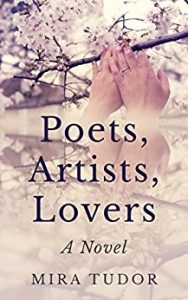 Mira Tudor, the author of Poets, Artists, Lovers is joining me today to chat about her book, her writing process and the advice she has for new writers.
PAL is a fast-paced yet poignant character-driven novel riding waves of romanticism, drama, and wit in a manner reminiscent in parts of David Nicholls’s books (One Day)—and set in the exciting world of several vibrant Romanian artists and musicians.
Henriette, an accomplished sculptor, seems to find more joy in her feminist-inspired work and her piano playing than in the people who care about her. Ela, a piano teacher turned book reviewer, hopes to discover the key to happiness and a more meaningful life through studying the workings of the mind and crafting poems about emotions she trusts will lead her to a better place. Joining them in beauty and blindness is Pamfil, a violinist who dabbles as a singer and lives mostly for the moment and his monthly parties. As they follow their passions, they find themselves on treacherous journeys to love and happiness, and are slow to figure out how to best tackle their predicaments. Fortunately, their lovers and friends are there to help . . . but then a newcomer complicates things.
Hi Mira. It’s great to have you on Novel Kicks today.
Thank you, Laura! It’s great to be on your blog with you.
Your novel is called Poets, Artists, Lovers. Can you tell me about it and what inspired it?
I’d been trying to write a novel for years, but it just wouldn’t come together. I was working too much from memories and simply couldn’t find the novel’s raison d’être. And then after putting it aside for a while, I realized in a matter of days that I had the whole story of Poets, Artists, Lovers. I couldn’t write it fast enough.
It’s a nostalgic piece, in a sense, harking back to a time when I was friends with a group of artists who used to hold parties every now and then at their office over the weekend. These parties have inspired Pamfil’s in the novel, but my characters are all imaginary. They grew out of real-life observations, of course, but I surprised myself how much they grew out of my own writing process as well. I say that because when I started writing I already had all the characters pinned down.
What’s your typical writing day like and do you have any writing rituals before and whilst you write?
I write an average of five or six hours a day (seven days a week), which includes research. I don’t have any rituals apart from drinking all sorts of coffee and tea, but I do need to take walks in order to get some distance from my writing and figure out various things that need to be changed, taken out, or added.
If you could spend time with your characters for a day, what would you do?
I can’t decide. I would like to go to San Francisco and Lake Tahoe; but also hiking through Ireland or driving along the Rhine Valley in Germany; visiting small towns and vineyards in France or Spain; exploring Paris or London; the list goes on.
Which fictional character are you most like?
I’m not much like any of these characters. Only the poetry is deeply mine.

 by
Book Club
Recent Comments