Trisha Ashley’s advice for new writers…
I often hear people say they’re going to write a novel…eventually, when they retire, or the children have left home (do they ever, these days?) and they have the right computer, or pen, or the wind is coming from the south west…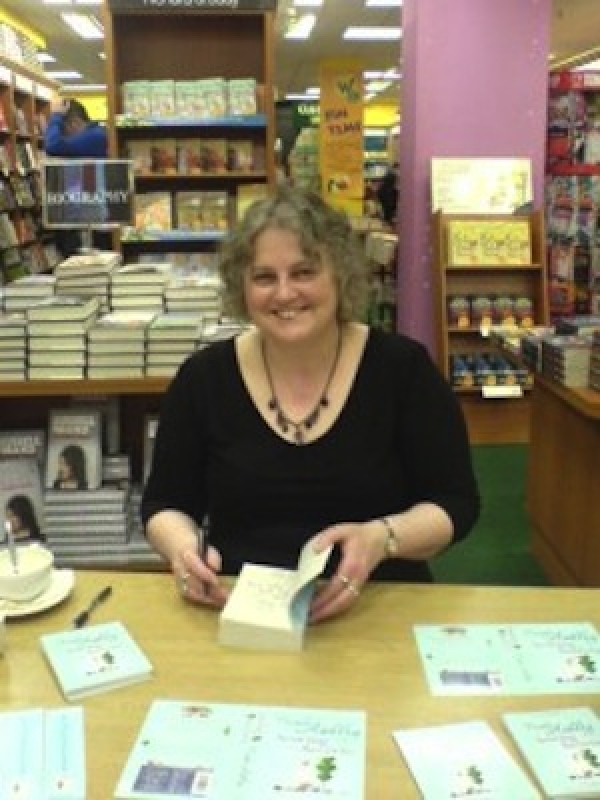
I’ve never really understood this, because if you’re a writer, you write. You burn to write. It’s part of who you are. And its fun, too – in fact, Stephen King says writing is the most fun you can have on your own and he’s quite right.
Perhaps it’s a fear of failure or success, but you won’t experience either unless you actually get the words down on the page, so why not start today? If your writing U-bend needs unblocking first, you should read Natalie Goldberg’s Writing Down the Bones, and all will soon be flowing freely. And I’m going to quote Stephen King again (you should read his book, On Writing) when he says that you should write your first draft with the study door closed, i.e., just for yourself, then the second draft with the door opened, rewriting it with an eye to your readers. That’s great advice – write with a red-hot pen, let the words rush out onto the page, then hone and polish till it sparkles.
For those going the traditional route and submitting to agents or publishers, a little market research in the Writers and Artists’ Yearbook beforehand can work wonders, so that you’re submitting to an agent or editor who actually handles/publishes the genre of fiction you write.
Of course, to do this you actually need to know what kind of novel you’ve written and make this clear in your synopsis, because if you don’t know, then the agent/publisher certainly won’t.
And once it’s gone, don’t wait for the novel to come back, but crack on with the next one straight away.


 by

NK Chats To.... : Jacqui Rose
Jacqui Rose is the author of of the novel, Trapped which has just been released by Avon (Harper Collins.) Jacqui chats to us about writing and her new book.
Can you describe your writing style in fifteen words or less.
Lyrical, passionate, intuitive and at times poetic.
What’s your typical writing day like?
I’m contracted to write two books a year which I love but instead of spacing it out sensibly, I leave actually sitting down to write the book until almost the last minute because I thrive under pressure and I think it makes my writing better. So then I’m left with long writing days. I could start early in the morning and not finish writing till midnight. This will go on for about six weeks, writing between 2-3000 words a day and on crazy days up to 7,000 words, but those days are few and far between. And as much as it becomes very intense I wouldn’t have it any other way.

 by
Book Reviews : You Had Me At Hello by Mhairi McFarlane
You Had Me At Hello by Mhairi McFarlane
Avon, 2012.
Review by Helen Jackson.
What happens when the one that got away comes back? Find out in this sparkling debut from Mhairi McFarlane.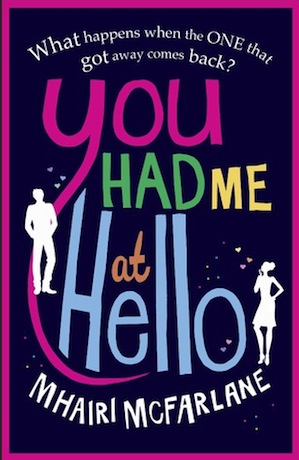
‘Think of the great duos of history. We’re just like them.’
‘You mean like Kylie and Jason? Torvill and Dean? Sonny and Cher?’
‘I think you’ve missed the point, Rachel.’
Rachel and Ben. Ben and Rachel. It was them against the world. Until it all fell apart. It’s been a decade since they last spoke, but when Rachel bumps into Ben one rainy day, the years melt away.
They’d been partners in crime and the best of friends. But life has moved on: Ben is married. Rachel is not. Yet in that split second, Rachel feels the old friendship return. And along with it, the broken heart she’s never been able to mend.
Hilarious, heartbreaking and everything in between, you’ll be hooked from their first ‘hello’. Continue reading

 by
Book Corner : March’s Book
 The HitchHiker’s Guide To The Galaxy by Douglas Adams
It’s an ordinary Thursday lunchtime for Arthur Dent until his house gets demolished. The Earth follows shortly afterwards to make way for a new hyperspace bypass and his best friend has just announced that he’s an alien. At this moment, they’re hurtling through space with nothing but their towels and an innocuous-looking book inscribed with the big, friendly words: DON’T PANIC. The weekend has only just begun….

 by
Matt Dunn talks about creating characters.
If there’s one question a novelist (well, me, at least) always gets asked (apart from “where do you get your ideas from?”, to which I always reply “there’s a great website – IdeasForNovels dot com”), it’s “is the central character based on you?”. 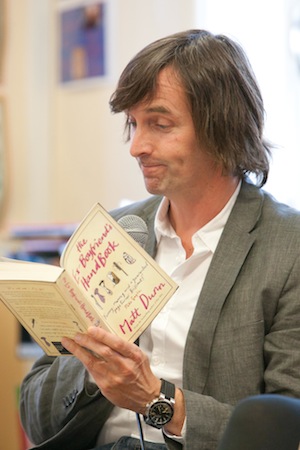 I’m never offended – after all, I don’t write books about serial killers – but though I don’t always like to admit it, the answer is quite often a resounding “yes”.
And I sometimes apply a similar approach to the supporting characters too. There’s a saying that goes something like: “when you write a novel, half your friends will be annoyed because they think they’re in it, and the other half will be even more annoyed because they’re not.” Most authors will probably smile wryly at this, but there’s a reason why, at the front of very novel, you’ll read a disclaimer that says something like ‘any similarity between characters and persons alive or dead is purely coincidental’, and that reason is, well, because any, ahem, similarity isn’t always, you know, purely coincidental. Well, at least in my books!
Of course, while most of us writers – me included – wouldn’t stoop so low as to completely and accurately reproduce our friends and family in the books we write, it’s probably fair to say that many of us do occasionally ‘borrow’ or exaggerate facets of people we know’s personalities, or pinch things they’ve said, or even the way they speak, in order to give life to characters on the page.
Certainly, the supporting characters in my first two books – Best Man and The Ex-Boyfriend’s Handbook – were based loosely on friends of mine. At the time – and it was early on in my writing career – it just seemed easier to imagine someone I knew, then just write that down. And it seemed to work.
I now know most novelists take a much more formal approach – spending ages writing full character CVs, or even question-and-answer profiles so they know exactly what a character’s like. This works well – I’ve done it myself recently. But strangely enough, I’ve found my best received characters have all had a dose of reality about them.

 by
Book Club
Recent Comments