Book Extract & Q&A: Time Clocks by Yoav Avni
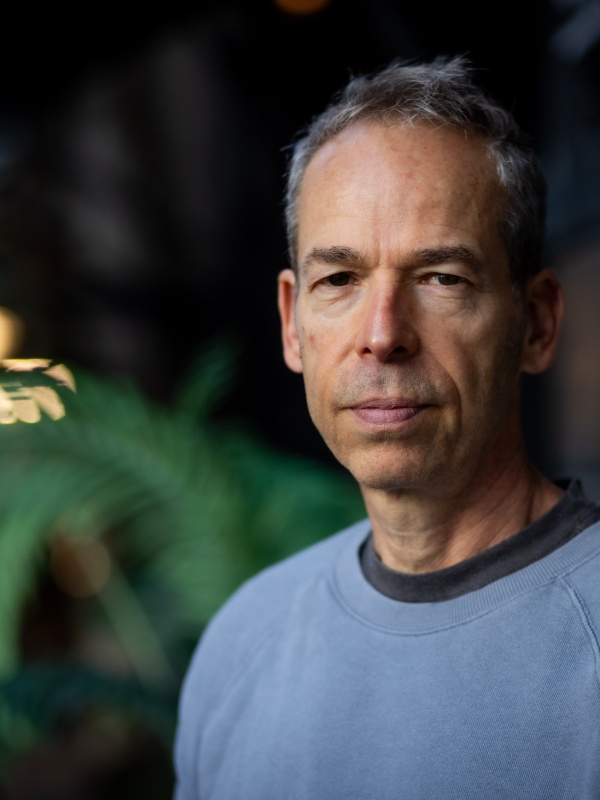 Please join me in welcoming Yoav Avni to Novel Kicks as we shine a light on his book, Time Clocks.
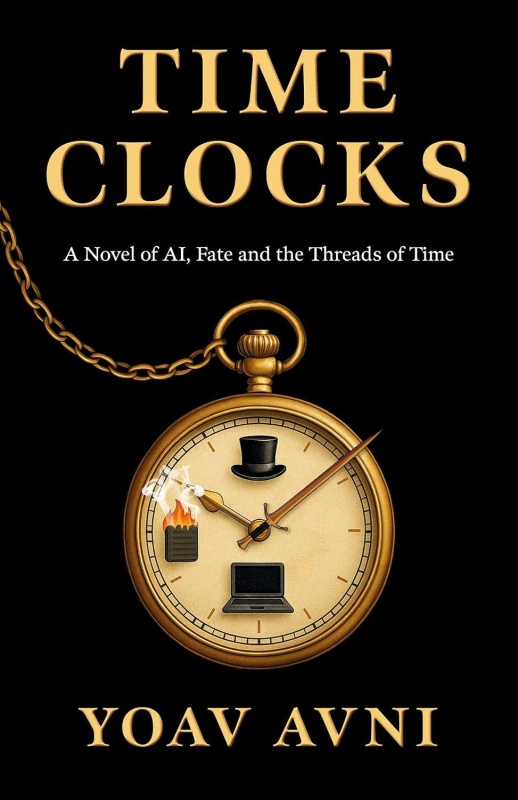
The present is theirs—if they can reach it. And stay. A story of mystery, suspense, and an unexpected love—both timeless and new.
When Boaz is summoned to a furious dismissal meeting at the company where he has spent years developing FocalAI, better known as the nation’s AI, everything in his familiar, comfortable office feels like a personal possession -even the door, the window, the air, the time that had passed. By nightfall, he is cast out into the desolate industrial zone outside his office, stripped of his phone, his car, and perhaps soon his relationship.
The future looms, threatening and uncertain. Then, three strangers appear, raising questions not about the future but about the past: a police officer who lost her memory in the ’80s (and maybe it is just as well), a flamboyant French dandy from the nineteenth century, and a wounded shepherd from biblical times, clad in armor and tassels. As his own life unravels, Boaz feels compelled to discover why these three have arrived at his side. Why now and why him? What role do they play? And what role might he have? As their stories unfold, Boaz realizes he holds three fragile threads, with only one chance to weave them together – through a single loop in time. By their side, the present grows more surprising by the moment.
Yoav tells us about his typical writing day and favourite word below but first, he has shared an extract from Time Clocks. We hope you enjoy.
beginning of extract
Chapter 1
Among the Threads, Three Arise
It was not a live broadcast. The show was scheduled to air on Saturday night — and Boaz watched the unfolding scene on the small screen mounted on the wall of the room where he was waiting.
Soon he would be called onto the glittering stage, where he would find himself wishing he could turn back time. Not to buy a winning lottery ticket or stop one of history’s worst tyrants from ever being born. No. Boaz Grand would return to this Thursday afternoon, to this very moment, and inform the production team of Easy Does It that he, regretfully, could not participate. Any excuse would suffice — just to avoid sinking into that plush, lulling armchair and revealing something he should never have said.
The audience fell silent as the host recited the enigmatic words in his booming voice: “Among the threads, three arise!”
A pause for effect, and then: “We will take a short commercial break. When we return, we will move on to the segment we have all been waiting for, featuring a very special guest on our panel.
And no — it will not be another family member, I promise. A mom on the panel is more than enough — especially one like mine.” Amid the laughter, he gestured and assured everyone,
“Two minutes, and we will be back!”
A luxury car, a telecom provider, a retail chain, a lingerie brand, and a bank ad later, the studio was once again bathed in crimson and gold.
It was just another talk show — a genre that had seen little innovation for decades: audience, lighting, stage, host’s desk, guest armchairs, commercial breaks, and, of course, the familiar catchphrase: “We are back!” But Easy Does It was a rare television phenomenon, staying relevant both for weekend night family living room discussions and weekday morning office chatter. Its strength was in its blend of wit and depth, anchored by a host with dazzling teeth, perfectly coiffed hair, and an untarnished reputation. Above all, the show’s staying power rested on its exclusive weekly feature: the segment Boaz was about to join — without which the show would have been axed and tossed into the dustbin of broadcast history.
The production assistant cracked the door open and stuck his head in. “He’s about to call the regulars, then you. When he says your name, I’ll take you to the studio.” And with that, he vanished as quickly as he had appeared.
“We are back!” The host flashed his well-rehearsed smile as applause erupted. “Now, I am pleased to welcome the members of our panel, who will analyse this week’s limerick, composed by none other than…” He turned his gaze upward to the massive studio screen, which flickered and stabilized to reveal a platinum-haired figure with chiseled cheekbones. “How are you?” he asked his virtual contributor.
“Wonderful,” came the reply, basking in the applause. Its voice, so familiar to Boaz, was a blend of electric citrus blossom — artificially smooth, yet oddly captivating.
“Before we bring out the others, can you recite the latest prophecy? Earlier, before the break, I revealed one line: ‘Among the threads, three arise.’ Fantastic and intriguing, as always. But let us hear the whole limerick, shall we?”
“Of course.” After a perfectly timed clearing of its synthetic throat, it delivered:
“The plane of time is not so plain,
Its hues defy black-and-white domain.
Among the threads, three arise,
Guard their souls, the sage implies.
A task awaits beyond time’s chain.”
 “Thank you, FocalAI!” the host announced, bowing slightly toward the state-of-the-art system, “the nation’s AI!”
“Respect is earned, not driven!” the system quipped as the applause swelled.
Boaz had already seen the limerick at the office earlier that week. Anticipating his turn, he stretched, then paced the length of the waiting room.
“And now, I am honored to introduce our panel: the legendary sportscaster Avi Achituv, the esteemed movie director Dalia Eshet, the sharp parliamentary adviser Dor Elron, and, of course, the one and only: Mother!”
As usual, the four panelists took their places in the semicircular arrangement of crimson armchairs facing the host. But this time, there was one more empty seat — a surprise the host quickly revealed: “Boaz Grand!”
Right on cue, the waiting room door swung open, and Boaz tried to focus on what lay ahead, pushing aside the unsettling sense that the hallway leading to the studio resembled a long, narrow tunnel ending in a blinding white light.
end of extract
Hello Yoav. Thank you so much for joining me today and for sharing an extract from your book. Can you tell us about Time Clocks and what inspired it?
Time Clocks is a time-travel novel about learning to be present.
It follows Boaz Grand, an AI developer in present-day Tel Aviv whose system begins producing cryptic limericks that seem to predict the future. After Boaz publicly dismisses them and loses his job, he encounters three people from very different points in history: a biblical shepherd, a nineteenth-century Frenchman, and a policewoman from the 1980s. Their arrival seems to echo one of FocalAI’s prophecies, and much of the novel revolves around understanding why these three people have appeared, why now, and what connects them.
The original spark was the present itself. We spend so much time looking backward or trying to anticipate what comes next that the present can become almost invisible. I began thinking of it as time’s middle child, stuck between past and future and too often overlooked.
That led to the question that shaped the novel: what happens when people from the past are forced into our present, while a man from our own time is so focused on predicting the future that he has almost forgotten how to inhabit the present himself?
That gave me the story. The characters, thankfully, complicated everything.
What is your typical writing day like? Do you have rituals like needing coffee and silence and where is your favourite place to write?
My writing day usually starts very early, often before the rest of the world is properly awake. Coffee is definitely part of the ritual, or maybe of life itself. Silence helps too, although I do choose one song for every book I write.
I usually write at home, at my desk. I generally need a room of my own to write in, and when I travel, I try to make whatever room I’m staying in feel like a home away from home.
Editing is different. I can edit almost anywhere, in a café, on a train, or wherever I can sit down with the text.
Once I’m inside a book, I tend to work in long stretches rather than waiting for inspiration. Inspiration is useful, but showing up is much more reliable.
If you were putting together a playlist for Time Clocks, which songs would you include?
One of the characters is a policewoman from the 1980s who has lost her memory, so I found myself returning to that decade while writing her.
There would definitely be Kate Bush and Duran Duran on the playlist, and I suspect Cyndi Lauper would be very pleased with the number of times I played “Time After Time.”
That song, in particular, felt almost impossible to resist for this book.
How do you approach the writing process from first idea, to research, to first draft, to editing and then final novel? How do you know when you’ve done enough research and editing?
It begins with an idea, a thought carrying a small electrical charge. If it keeps tingling, I start casting the characters almost like a director casting a film, and then I build the skeleton of the novel before I begin writing.
Research matters, but I am very careful not to let it become a hiding place. I mentor beginning writers, and one of the traps I see often is researching a first novel forever instead of actually writing it. At some point, you need enough knowledge to make the world convincing, and then you have to move.
Editing is different. I read and revise again and again, but I use what I think of as the popcorn test. When popcorn is in the microwave and the popping is constant, you know it is not done yet. The same is true of a manuscript: if you’re still making frequent changes on every page, keep working. When the changes become more occasional, like the last few pops in the bag, it is probably time to stop.
There will always be one more pop, one more word you could change. But eventually you have to take the popcorn out of the microwave and send the book into the world.
What’s your favourite word?
In which language? 🙂
I like a lot of words. What would I do without them?
More generally, I think I know much more clearly which words I dislike. Drool, for example, isn’t a favorite of mine in English, and the Hebrew word for it, rir, is no better. But to end on a nice note (hey, note – I like that word!), in English I’m very fond of light and wind.
About Yoav Avni –
 Yoav Avni is an Israeli author and translator.
He has published novels and short stories with two of Israel’s leading publishing houses,Kinneret-Zmora-Bitan and Keter. His novel Three Things for a Desert Island became a national bestseller, and two of his books won the Geffen Award for Best Israeli Speculative Novel, widely regarded as Israel’s equivalent of the Hugo Award.
His latest novel, Time Clocks, was published in Hebrew in December 2024 and was released internationally in English by Roundfire Books on September 29, 2026.
His novel Crossing a River Twice is scheduled for publication in English by Roundfire Books in December 2027.
His eighth book, the nonfiction work I, Director’s Cut, was published in December 2025 as part of Ivrit’s Kolot series. It is a candid, personal and sharply observed journey, not “based on a true story,” but a true story.
His children’s book Alef BeKislul was selected for Sifriyat Pijama in 2026. His next novel is forthcoming from Keter in 2028.
His short fiction has appeared in publications including N-Zine in London, Words Without Borders, JewishFiction.net, and Jewcy.
His writing blends magical realism and speculative fiction, drawing inspiration from authors including Tom Robbins, Kurt Vonnegut,Jerome K. Jerome, Gerald Durrell, and Douglas Adams.
Connect with Yoav via his website, Facebook and Instagram.
Buy Time Clocks on Amazon UK, Amazon US, Barnes & Noble and Waterstones.




 by
by 

I'm Laura. I started Novel Kicks back in 2009 as I wanted a place to discuss books and writing - two loves of my life. As someone who has anxiety, these two things give me, and I am sure countless others, a much needed escape.
There is a monthly book club, writing exercises, prompts, reviews, author interviews, competitions and guest posts. I cover many genres and I hope there is something for everyone.
I grew up by the sea in Dorset and currently live in Poole with my husband, Chris and three cats. I love writing and have a BA (Hons) in Creative Writing from Falmouth University. I am writing my first book. If only I could stop pressing delete. Chris has threatened to stop it from working. Haha.
I have always loved creative writing since I was in first school and would very much like to meet my teacher, Miss Sayers, to say thank you for all the encouragement she gave me then.
When not writing, I love reading, cats, Disney, singing (I can't sing but this doesn't stop me,) and falling into a good TV show or film. If I could step into any fictional world, it would be amongst the characters in ABC's Once Upon a Time.
I love reading many genres and discovering new authors.
There is a monthly book club, writing exercises, prompts, reviews, author interviews, competitions and guest posts. I cover many genres and I hope there is something for everyone.
I grew up by the sea in Dorset and currently live in Poole with my husband, Chris and three cats. I love writing and have a BA (Hons) in Creative Writing from Falmouth University. I am writing my first book. If only I could stop pressing delete. Chris has threatened to stop it from working. Haha.
I have always loved creative writing since I was in first school and would very much like to meet my teacher, Miss Sayers, to say thank you for all the encouragement she gave me then.
When not writing, I love reading, cats, Disney, singing (I can't sing but this doesn't stop me,) and falling into a good TV show or film. If I could step into any fictional world, it would be amongst the characters in ABC's Once Upon a Time.
I love reading many genres and discovering new authors.
Book Club
Leave a Reply