NK Chats To: N. Lombardi Jr
 Hello Nicholas. It’s great to welcome you to the blog today. Please tell me a little about your new book, Justice Gone and what inspired it?
Justice Gone was inspired by a true event, the fatal beating of a homeless man in a small Californian town. This was such an extreme case, and one which did not include any racial elements, that it exposed the utter abuse of authority in which an outraged public reaction was inevitable. The town was Fullerton, the man’s name was Kelly Thomas, and the year was 2011. Although the police officers were indicted by a grand jury, they were acquitted in their trial. So I asked myself a question: if someone felt that justice was denied the deceased, would they take it in their own hands? This became the seed for the story.
What elements do you feel need to be present in a thriller novel? What are the challenges?
Suspense, that is, the anticipation of what is going to come next, and this is usually accompanied by actions to some degree, although if you have enough skill, words alone can create this tension. Whichever way you accomplish this, the challenge is to persuade the reader to invest their interest in what is going on, and this includes sympathy for the protagonists.
This is the first part of a series featuring Dr Tessa Thorpe. What advice do you have for someone trying to develop a series and a strong character that will keep them coming back to read their story?
You need to become friends, or even love the character, knowing their faults as well as their admirable traits. In this way you know what they will say and can predict what they’ll do in any situation.
Actually Tessa first appeared in Journey Towards a Falling Sun, a story I wrote over 30 years ago, but eventually got published in 2014. It was a minor role, but one in which she was born, so to speak.
What’s your typical writing day like, where do you like to write and do you prefer silence?
I can write in the early mornings when I’m fresh, or in the evenings when I’m relaxed. usually the time between is non-productive. Silence is mandatory.
What’s your favourite word and why?
I don’t have a favourite word. I have a favourite colour, blue. Can I then say that “blue” is my favourite word?


 by

NK Chats To… Peter James
 Hi Peter, thank you for joining me on Novel Kicks. When did you start writing?
I have been writing since I was seven years old – my original ambition was to be a scriptwriter. I find the world we live in very interesting and I enjoy observing human behaviour, and that’s really my approach. I’m constantly taking note of what’s happening around me as you never know where you might find inspiration for a character or piece of plot.
How did you get your big break?
My first ‘break’ was at age seventeen, when I won a national short story competition run by the BBC and got to read my story out on air. It was hugely exciting! However, my first professional writing job came along a few years later whilst I was living in Toronto and working on a children’s television series called Polka Dot Door. I was a gopher – it was my job to basically run errands. One day we were due to film an episode, but the writer hadn’t turned in the script. The producer asked if I could write one there and then, and I said ‘okay!’
How much research do you do for each novel?
My novels tend to be very research-driven. I first had the seed of an idea for Absolute Proof when I received a mysterious call from someone claiming to have proof of the existence of god – just like Ross does – thirty years ago. In the decades that followed I did a great deal of research, ranging from speaking to religious leaders about the consequences absolute proof would have for believers, to living as a monk for five days in the extraordinary monastic commune of Mount Athos. It’s been an extraordinary journey!
Who inspires you?
When I was 14, I read Graeme Greene’s Brighton Rock, and it totally changed my life. It’s the book that made me realise I wanted to be a writer, and also the reason that my Roy Grace series is based in Brighton. Greene has a way of describing characters, in just a few sentences, which makes you feel you know them inside out, and his sense of “place” is almost palpable. Brighton Rock is for me an almost perfect novel. It has one of the most gripping opening lines ever written too – ‘Hale knew, before he had been in Brighton three hours, that they meant to kill him.’
What advice would you give to new and aspiring writers?
Reading extensively and intelligently is the most important thing – read books that have done well in the genre you want to write in and analyse what you like about the author’s style. Once you’ve started writing, make time to write every single day. Find a comfortable number of words to do each day and stick to that number. I am comfortable with 1,000 words. For some it might be 500, 200 or even 2,000 – as long as you are consistent, the number doesn’t matter.
And you must love your characters – or no one else will!

 by
NK Chats To… Emily Harvale
 Hi Emily. Thank you for joining me today. Can you tell me a little about your novel, Bells and Bows on Mistletoe Row (I love this title) and what inspired it?
It’s lovely to be here. Thank you for inviting me.
I’m so pleased you love the title. The wonderful members of my Facebook group helped me choose it. There were three options and this was the most popular.
The idea of Bells and Bows came to me as I was staring at one of the churches I can see from my office. The bells were ringing because it was a Sunday morning. I love listening to church bells, so my mind was drifting as it so often does. Juliet Bell and Harrison Bow popped up in front of me and introduced themselves. I loved the fact that their names had a Christmas ring to them (excuse the pun) and because they both had siblings, Bells and Bows was born.
I firmly believe in love at first sight. I also believe a person can love another their whole life, even if they’re not actually together. I can tell you many true stories relating to both!
Anyway, because I adore Christmas, and because of their names, I decided to put all those things together and see where it went. Both main families in this book need to learn to discuss issues and to open up about their feelings.
They believe in ‘a stiff upper lip’ and tend not to talk to one another about anything meaningful. This Christmas, that’s all about to change.
One of the secondary characters is based on a dear friend of mine who is no longer with us, and he is the cause of a few misunderstandings in the novel.
From planning to edit, what’s your writing process like and how has it changed since the first book?
I don’t plan. I never have. I get an idea and I sit down and write whatever comes into my head, or whatever appears in front of me.
I often say that the story unfolds before my eyes and I simply type what I’m seeing. I write a very quick first draft and make notes about the characters, settings etc. along the way.
Then I leave it for a few days or so, do any research that’s necessary, and then write the second draft. I write as many drafts as it takes before I feel happy with the book. After that, it goes to my editor.
Any changes or suggestions she has, are discussed and if I need to rewrite anything, I do.
Which Christmas tradition is your favourite?
That’s a difficult question because I love them all. Preparing the Christmas cake and all having a stir of the mixture and making a wish is one I’ve loved all my life. Opening one present on Christmas Eve, is another.
Finding a Yule log, bringing it home and burning it is one I can’t do at the moment because I no longer have a real fire. I miss that.
I need to move home before next year. I want a real fire again. Buying about two hundred more Christmas cards than I’ll ever need – and then doing exactly the same every year. (I’ve got boxes and boxes of cards…but I’ve already bought more this year!) Hanging wreaths on the doors, front and back.
Putting up the Christmas decorations in November. Going to a carol concert. Christmas crackers. Making mulled wine and eggnog.
Not together in the same pot, obviously. Hohoho! Setting the Christmas pud alight. Baking mince pies. Playing Christmas songs from October onwards. Yes, honestly. Ask my friends. It drives them nuts.
Ooh nuts! Spending hours trying to crack a brazil nut open and nearly losing an eye, or breaking several ornaments in the process. That’s a tradition not to be missed! Sorry. You only wanted one thing, didn’t you?

 by
NK Chats To… Pernille Meldgaard Pedersen
 Hello Pernille, thank you so much for joining me on Novel Kicks today. Your book is called Him With The Beard. Can you tell me a little about it?
Hi Laura, I´m so glad you would have me!
In Him With The Beard, we follow a little family whose life is turned upside down when the daughter Mille stops believing in Santa. We read the story from the mother´s, Stella, perspective.
It’s a sweet Christmas story about family, Santa Claus and the big question whether it’s possible to find a way back to the joy of Christmas when you discover that Santa isn’t who you thought.
What is your writing process like from planning to editing?
I always begin with a vague idea, often a funny scene, and work with the idea in my head for some while, before I begin writing it down on paper. I love the process of getting all the small pieces in the puzzle to fit.
And then I begin writing, writing, writing and writing. I´m one of those unwise people that edit and write at the same time, but I just know when something doesn’t work, and I would rather change it when I know what I can do differently than forgetting it and try to change it later.
From then on it’s off to beta readers and the editor and I do changes based on what they find. I´m not perfect, so I love getting feedback that can help me get my story better across to readers.
 Is there a certain place you like to write and are there certain things you need like coffee/tea/music/silence?
I´m pretty easy to please. I just need my computer to write 🙂
I always write late at night or very early in the morning when it’s quiet. I´m also pretty tired at this point so it’s like writing drunk which can be a good thing because then my inner critic has gone to bed. Ha!
What elements do you feel need to be present in a novel?
I really like when a book has humour and a twinkle in the eye because I feel like the book becomes your friend and you share all these inside jokes that no one else understands (Even if the author wrote them like that).
I often wonder what kind of relationship other readers have with my favourite books, and now also what my book will give people.
What’s your favourite word and why?
I love this question! And I don´t know!
I´m such kind of person that often stops up to repeat a word because it sounds funny or delicious in the way it leave my lips.
I´m a Dane so the word “Hygge” is a word I use at least ten times a day. At least!
English words I like is: Dazzle, giggle or the hilarious Flabbergasted. I feel like I have to do the flabbergasted face to say this word!
Is there a fictional character you’d like to meet? What would you both do?
I´m thinking I would have a lovely day with Lily from Pictures of Lily by Paige Toon. Just walking around in an Australian conservation park, and say hello to kangaroos, wombats and koalas (NO SPIDERS PLEASE) and then have lunch in the shade of a big eucalyptus tree. If I’m lucky I might even get the chance to say hello to Lily´s sexy husband Ben.

 by
NK Chats To… Julie Houston
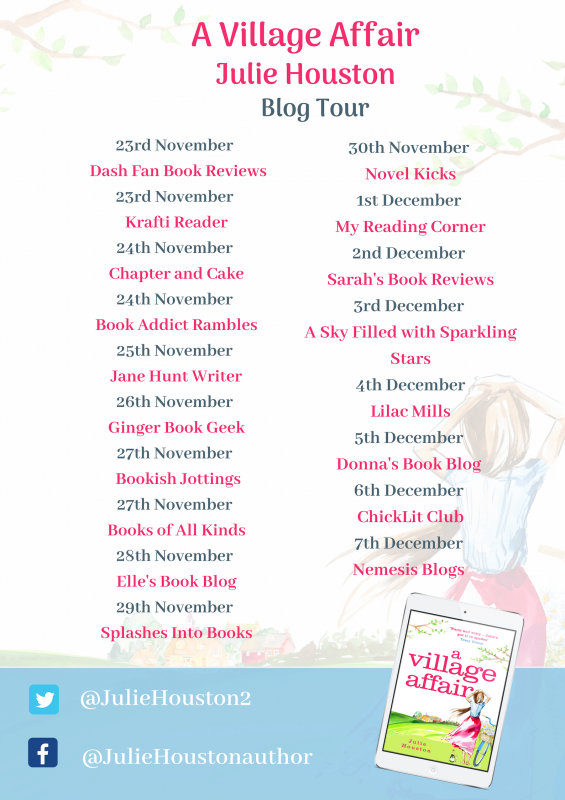
 Hi Julie. Thank you so much for joining me today. Your new novel is called A Village Affair. Can you tell me about it and what inspired it?
Hi, and thank you so much for having me on your blog today. It’s much appreciated.
As writers, we’re always advised to write about what we know and “AVillage Affair”began its life under the guise of ‘Not in My backyard’ influenced, very much, by a real-life fight in my village where acres of fields and greenbelt land were in danger of having hundreds, if not thousands, of houses built upon them. As the main focus of the plot moved and centred upon the village school, the novel took on the handle “Little Acorns” and many of the school incidents are based on real happenings in the primary schools I have taught in over the years. Eventually Aria came up with the title “A Village Affair”which I love and which, I think, encompasses the different strands of the book.
What’s your writing process like (idea, research etc.) How do you approach editing?
At the start of a new idea/novel I sit at my desk with a brand-new exercise book. I like my novels to be very much character-based and so I come up with characters’ names, write what they look like and actually give them a family tree. This is important as I’m mainly writing about the characters in one town and one village and so I have to make sure they’re not too related to each other, especially if they’re going to end up together!! With “Holly Close Farm”,as nearly half of it is set during WW2, I did a huge amount of research about the WAAFs and Bomber Command. I really enjoyed this bit and it was quite hard work leaving the reading to actually write. I love editing. I must be the only writer who enjoys this bit. I love going back over what I’ve written, tweaking and adding and crossing out. In my early days as a writer I would write one chapter and then edit it to death the next day because I was so proud that I’d actually written another chapter. Now, with deadlines, I tend to just write and edit at the end. Editing means I’ve finished, which is always wonderful.
What’s your typical writing day like? Do you have a place to write? Cup of coffee? Write in silence?
I’m a lark: I’m much better writing at 6am than later in the day. I had the most beautiful writing room at one end of the house but my husband is now working from home and has commandeered it for his office. I’m in a cupboard – not literally, but it feels like it after the lovely office with views down the valley. I actually quite like my cupboard: it’s jampacked with books, piles of papers, computer and, usually, the dog. I write, plan for school if I’m teaching a couple of days and do some private tuition in there. It does tend to get a bit cosy. One day, I’ll have my office back!
I need silence, tons of coffee (morning) and Earl Grey tea (afternoon).
So, basically, if it’s a writing day, I’ll get up early, have a mug of hot water and lemon (my mum always did and I’ve done this for the past 30 years) answer emails, decide whether it’s a swim or a run, shower, have breakfast and read the paper about eleven and then really get stuck in. If I can write 2-3000 words a day I’m more than happy.
 What’s the most challenging thing with writing a novel?
The start of any new novel. By the end of a novel I love my characters so much I can’t bear to leave them and start again. I feel very disloyal to my old friends and it takes a while to love the new ones.
How do you pick names for your characters?
Probably with names I wanted to call my own children but for which my husband didn’t share the same enthusiasm. So India, Clementine, Kit, Theadora and Fin were born! My daughter, Georgia, is really cross I didn’t stick to my guns and call her Theadora – shortened to Teddy – that Harriet names one of her twins.
In my “Work in Progress“(Book 7 and desperate for inspiration for an actual title) it’s been easy to come up with names because I have Patrick, the father – a bit of a lothario – who is a Cambridge educated Classics professor and gives all his four daughters names from Greek literature. I’ve ended up with Isolde, Pandora, Juno and Lexia.
What elements make up a good novel?
When I read, I want a thumping good story. I want to know what happens next. I want to want to go to bed read to know what’s going to happen. I do like humour in a novel. It doesn’t have to be overtly laugh out loud. I think Liane Moriarty and Kate Atkinson are both superb writers, not only at weaving good stories but at having the ability to include some quite subtle humour. I aspire to both these wonderful novelists!!

 by
Book Club