NK Chats To… Robert Whanslaw
 Hi Robert, thank you so much for joining me today and for inviting Novel Kicks onto your blog tour. Can you tell me about your book, Dark Orchid Affair and what inspired it?
It was an idea I’d had in my head for over ten years—how one event can change your life. I always knew I’d write it; it was just a question of when. I love understanding how people work: the psychology behind why a person is driven to do the things they do. The most interesting of those people are the ones with flaws in their character. We all have flaws, so my focus in my writing is on characters with major flaws.
What are the challenges of this genre. Also, what do to find the most fun about it?
Knowing the boundaries. Noir is dark, but you need a little bit of light in any story, so getting the mix right—and the importance of getting that balance—is something I worry about, and hope I get right. The fun parts are just that: pushing the boundaries.
What’s your typical writing day like? Do you have any rituals?
It depends where I am in the writing. I am a big planner. This is what I would call my creative stage, and there’s no routine to this. I can wake in the middle of the night and think of an idea. I tend to wander around the world in a daze during this time. When I have the concept of the book in place, I write intensely, but I will break every thirty minutes for five to regenerate my energy.
What’s your favourite word and why?
I bought a book a few years ago about ‘words everybody should know’. I came across the word callipygian, which means well-shaped buttocks, and thought, “That is a word I am going to have to use one day.” The Dark Orchid Affair provided that opportunity when Ben watches Maxine get up from the table and head to the exit.
In your opinion, what are the most common mistakes people make when writing a novel for the first time?


 by

NK Chats To…Leon Mitchell
 Hi Leon, thank you so much for joining me today. Can you tell me about your book, Felicity Fire: And The Forever Key and what inspired it?
Growing up I enjoyed getting lost in classic fiction like “The Never Ending Story” and “The Chronicles of Narnia” I was able to lose myself, use my imagination without boundaries and be inspired creativity. As an author, I wanted to create a new modern novel with current and relevant characters, but infused with a sense of nostalgia and magic from my childhood. I wanted to share that sense of wonder with a new audience where they feel like they are the main character in the book.
What are the challenges when writing a book in this genre and for a younger audience? What are the most important aspects to consider?
For me, I write with no fear and I generally don’t follow any kind of industry blueprint. I often tap into childhood memories and try to put myself back in that frame of mind and look at the world from that viewpoint. Children have the wonderful ability to be innocent in the world, and stories don’t have to make perfect sense. When i’m in that space I can normally create new ideas and let them flow. I think not trying to be perfect is important and it’s ok to be brave in your writing. Professionally the most important factors for me are to just keep going, keep writing, even if it’s a little bit each day.
What’s your typical writing day like? Do you have any rituals like needing coffee? Silence? What do you do to stay motivated?
I am very disciplined with my creativity. I believe a lot of this comes from my time serving in the British Army, where my grit and determination was pushed out of my comfort zone. Many of the qualities I developed in that chapter of my life still stay with me today. So I have the ability to simply just keep going and keep writing.
I do like writing in creative spaces, with a good coffee too!
What’s your route to publication and what advice do you have for someone considering a similar path?

 by
NK Chats To… Helga Jensen
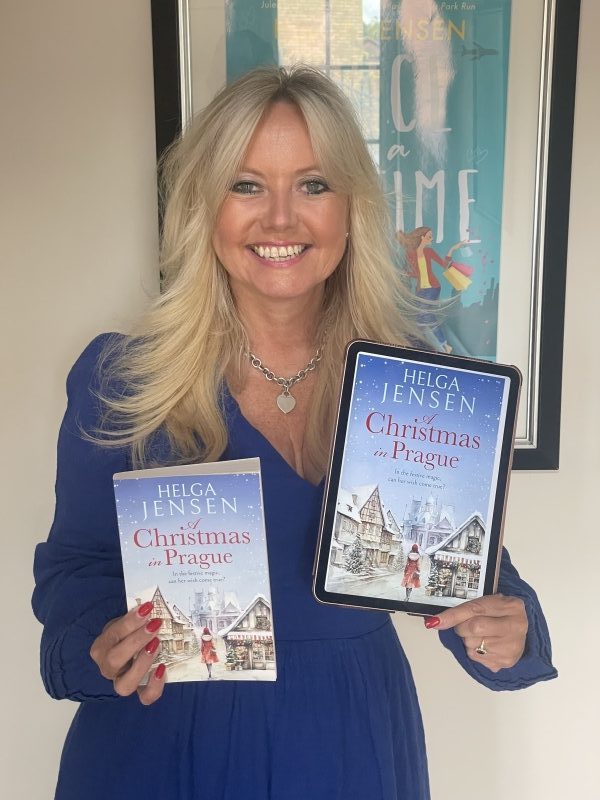 Hi Helga. Thank you so much for inviting Novel Kicks onto the blog tour for A New Life in Amsterdam. What’s your writing process like? Do you plan much?
Firstly, I think of a fabulous location and then work from there. For example, my latest book is set in Amsterdam. From there I will think of all the things that the place offers and work out a story. Naturally, A New Life in Amsterdam just had to be about a canal boat as I pictured what life would be like living on the canals of Amsterdam. Then I usually think about the characters and jot down the pivotal moments on a huge poster. From there, I just start writing. I am definitely not a planner as I start off with a seed of an idea and I literally let my characters take me on their journey as I write. I love working this way as I think if I planned anything I would be too focused on keeping to that story and it wouldn’t be natural.
Out of all the books you’ve read, which have had the most impact on you?
Oh, that’s a really good question. I always remember reading two books by Jane Green back in the early 90s. Mr Maybe and Jemima J. They appealed to me at that age and made me want to write something similar. I grew up with Jane Green and Sophie Kinsella books and I can safely say that both writers made a huge impact on me as I dreamed of being just like them.
Do you have any writing rituals? Do you prefer to work in silence?
I need complete silence. I can’t even take a laptop to a coffee shop somewhere. I have to be in my study, door closed, and nothing but silence. Any disturbance will send me off track and I will lose that line in my head. I love the idea that writers can work with music and churn out a best-seller but, for me, silence is golden!

 by
NK Chats To…Michael Wendroff
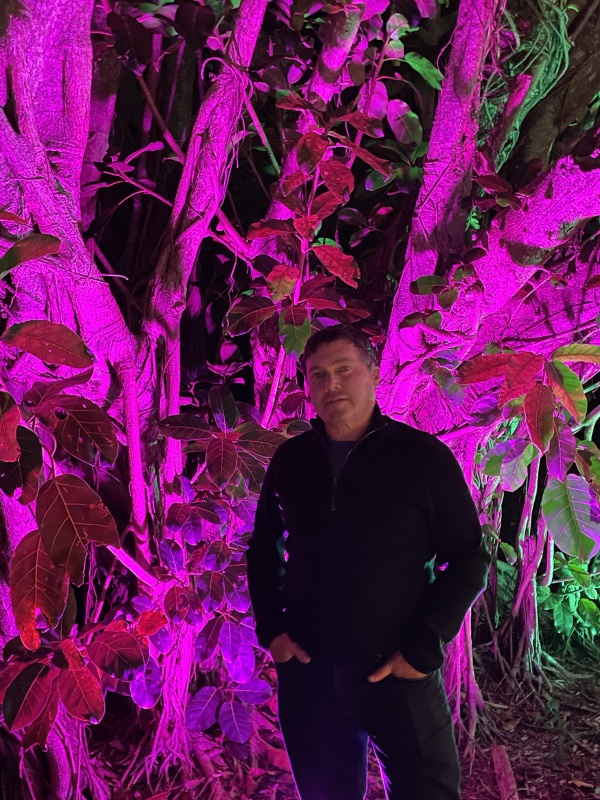 Hello Michael. Thank you for joining me today and for inviting Novel Kicks onto your blog tour. Can you tell us about What Goes Around and what inspired it?
What Goes Around is my debut thriller. It is about mysterious shootings in a small town, and two detectives, one male and one female, are assigned to the case. They hate each other, and have to find the killer before they kill each other. On the pursuit they encounter secret groups-Incels, Boogaloo Boys, supremacists. Torn in the middle is a naive boy. The ending twist is out of this world.
I was inspired by what my mother said to me the second I was born. Or so I’m told. I was put on her chest, she looked me deeply in the eyes, and said, “Oh! How nice to see you, again!” It was that “again” that always intrigued me, and I always wanted to write something about it, but life and working in business got in the way.
It was actually the Covid pandemic that got me to write my novel–there was that period when you couldn’t do anything, couldn’t go to movies, restaurants, couldn’t even go to the beach! So, I had no more excuses. Had to write it, and thankfully, got very lucky, and What Goes Around was born.
I was also “inspired” by events I didn’t understand–like the “Unite the Right” rally in Charlottesville, Virginia a few years ago. I needed to research that, to understand what was behind some of the crazy thinking, so that’s how I got into the secret world of Incels and Supremacists. Scary stuff!
What’s your typical writing day like? Do you have any writing rituals and a favourite place to write?
.
I usually write in the mornings, when I’m freshest. Water really inspires me, and I’m very fortunate that I have two places near water. In the winter months I’m in Florida, so I can sit at a beach and think up plots and scenes, and I also get to sit on my lanai and look out on a pond behind my house. Though I do sometimes get distracted by the alligators running around.
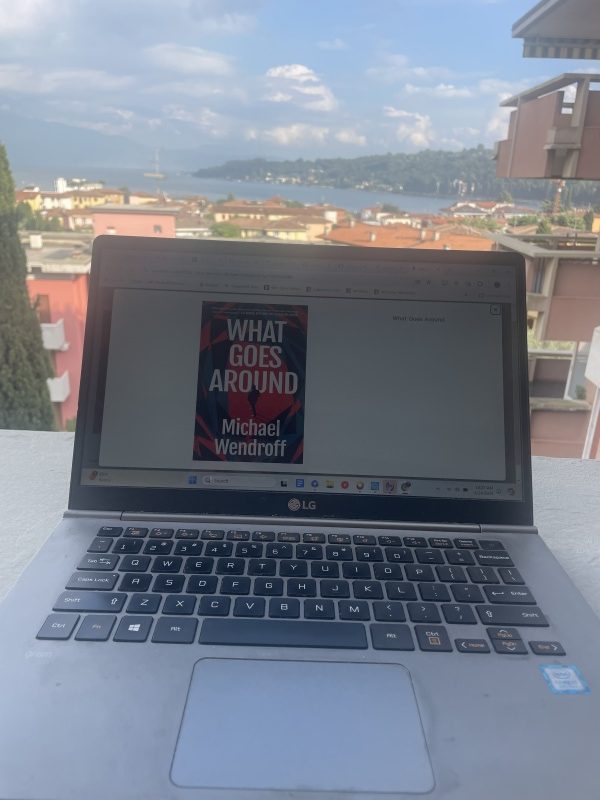
Michael’s Writing Space – Lake Garda.
In the summer months when Florida just gets too hot and humid, I head to Italy. I love Northern Italy, and get to write from a terrace overlooking Lake Garda (when I’m not eating the amazing Italian food).
I love writing, and my process is plot, research, write, and edit.
My daily ritual is to sit at my pc to get the words out, just get the story going. I don’t worry about things like grammar or even the specific words used, I just want to get the writing flowing. The next morning I will reread what I’d written, and try to make it real writing. Make sure every word is the right word and fits with the others in the sentence, make sure each sentence fits with the others in the paragraph. Add the analogies and metaphors. After that’s done, I’ll start scribbling out the next part of the story on my pc, which will be rewritten the next day. That process of write then rewrite continues everyday, until I can write my favorite two words: The End
But before I actually start the writing itself, comes the plotting. There are actually two types of writers-plotters and pantsers. Pantsers simply sit in front of their computers and write by the seat of their pants. They have no idea where the story is going. That’s not me. I have to know everything upfront, so after ideating I write a detailed plot outline. I need to know not only what the ending will be, but where I’ll plant the red herrings, and where I’ll put the twists and turns.
And it’s not like things won’t change. Once I became really attached to one of my characters, and the plot called for the character to die, but I couldn’t do it. I had to change the plot. Another time I did kill off a character I loved, but my wife yelled at me because I was walking around for a week in depression. She said “They’re not real!!” But to an author, they are real!
If you were putting together a playlist for What Goes Around, which songs would you pick?

 by
NK Chats To… Evie Jacobs
 Hi Evie, thank you so much for joining me today and for inviting Novel Kicks onto your blog tour. Can you tell me about your book, Dangerous Decisions and what inspired it?
Thanks for having me! Dangerous Decisions is the story of Nate Hughes, a pilot who shares a business with his siblings, and Angie Liu, a CIA agent who is investigating an informant’s death. The two meet at a casino in Miami and have a one-night stand. Everything is great–until Angie realizes Nate is actually the son of the man whose death she is investigating.
Dangerous Decisions is an interconnected standalone, meaning that while it is technically the second book in the Dangerous Skies Adventure series, it does not have to be read after or with the first book.
I couldn’t tell you exactly what inspired this story, but while I was writing Dangerous Descent, I always knew that Nate would investigate his father’s death in the second. Thinking back, it seems like Angie’s character came easily as well. I wrote a good chunk of this book during COVID and wasn’t happy with the result. It wasn’t until I published Dangerous Descent that I decided to revisit Dangerous Decisions and turn it into something I was proud of.
What was your route to publication?

Evie’s Main Writing Office
I queried my first book, Dangerous Descent, with no luck, and was about to shove it in the metaphorical drawer when I decided to try a few small publishers. I wasn’t expecting much, but one publisher responded within a week asking for the full manuscript. After that, things moved pretty quickly, and I had a publishing contract by the end of the month. The experience of publishing through a small press was invaluable. I learned a ton, but more importantly, the validation that someone wanted to publish my book gave me the confidence to stick with it. Despite all the positives, I also wished I’d had more control over the final product. For the second book, I went it on my own.
What elements do you feel make up a good thriller?
Tension, danger, high stakes, momentum, immediacy, and characters you care about.
What’s your typical writing day like? Do you have any writing rituals? A favourite place to write?

 by
Book Club