NK Chats To… Anne Montgomery
 Hello Anne, welcome to Novel Kicks. Can you tell me about your novel, The Castle and what inspired it?
Why write a novel about rape? For me the reason was personal. While attending college, I was sexually assaulted. I became a statistic. Today, one out of every six women in the United States will be the victim of an attempted or completed rape in her lifetime. Like 80% of those victims, I never went to the police. Why? I believed they would have blamed me. I was on a date with a sweet-faced farm boy who played for my university’s football team. I’d had a few drinks. I willingly followed him into his dorm room. What did I expect would happen? So, I said nothing.
Years later, I became a teacher at South Mountain High School in Phoenix, a position I held for 20 years. It was during this time I came to understand another sad statistic: Four out of five rapes are committed by someone the victim knows. I kept meeting young girls who’d been sexually assaulted, always by a family member or friend. Sadly, many of these teens were ostracized by their loved ones when they came forward, told they were lying, or that the assault was their fault.
This prompted me to investigate the behavior and psychology of rapists, the profile of a victim, and the ways sexual assault survivors can heal. The end result was the story of Maggie, a national park ranger who works at Montezuma Castle in Arizona’s Verde Valley. Maggie is recovering from the gang rape she suffered in the Coast Guard. We follow her through her depression, anger, and ultimate healing.
What’s your typical writing day like?
Until I retired from teaching, I only wrote during school breaks, so most of my books were produced during the summer. Now, I generally get some work done every morning and sometimes in the late afternoon, depending on what else I have going on.
What are the challenges you found when writing your novel?
I find the writing is the easy part. I like to tell stories, perhaps a hangover from my previous life as a reporter. The real challenges come when an author tries to convince others—agents, editors, publishers, reviewers, readers—to like their books.
Which fictional character would you like to meet and why?
I find Clive Cussler’s Dirk Pitt rather appealing. Not only is he pretty hot, but he’s a scuba diver. I am as well. I would love to tag along on some of his underwater adventures.
What elements make up a good story?
The setting is especially important. I consider locale as another character. Most of my stories, for example, take place in Arizona in and around the Sonoran Desert, a magical area filled with rugged, wild terrain and plants and animals that live nowhere else. The land is both magnificently beautiful and horribly treacherous, if one is not careful. Of course, a good story rides on its characters, who must be engaging, interesting, and relatable.
Which authors do you admire?
I don’t have any favorite authors. I read stories that look interesting, whether the author is a well-known for best-sellers or a first-time Indie author.
What’s your favourite word and why?
Favorite word? I don’t know. I like lots of words, but mostly ones that sound funny when you say them, like absorb and nudibranch. (The latter are strange Seussical-like creatures who live in the sea. As I mentioned, I’m a scuba diver.)
Any other advice for aspiring writers?


 by

Book Review: Codename Firefly by C. J. Daugherty
 Gray Langtry is on the run. As the only child of the British Prime Minister, Gray’s life has been in turmoil ever since her mother was chosen to lead the country.
Both she and her mother are targets of a Russian assassination plot. And what’s worse, members of her mother’s own cabinet are involved. A team of bodyguards never leaves her side. The press attention is relentless. And then there are the death threats.
Now, after an attempt on Gray’s life, she has been moved to an elite boarding school in the British countryside. Shielded by high walls and locked gates, Gray finally feels safe, but the plotters are still hunting, and soon they will find her.
Gray’s personal bodyguard, Julia, and the school’s young headmistress are determined to protect her. They both know how dangerous things are. The assassins searching for Gray are highly trained. And when they arrive they will aim to kill. Dylan, a mysterious American student, seems to know more than he should – but he’s always there when Gray needs him. Can she trust him? Can she trust anyone?
As winter closes in and darkness falls, Gray will have to think fast.
The hunters are coming.
*****
After an attempt on her life, the UK Prime Minister’s daughter, Gray has been sent to a special boarding school with elevated security. It’s somewhere she should be safe. However, her attackers are not finished with her and are back to finish what they started.
As a guy in his (cough) forties, I am not the target audience for this novel. However, that’s not to say that I didn’t find it enjoyable. This is the sequel to Number 10 (which I hadn’t read prior to starting Codename Firefly) but it’s not a problem, this can be read first or as a standalone. Enough is explained so that you can keep up with what has happened to Gray.
Gray herself was a little bit of a mystery to me but I can see her being relatable in many ways. Gray is a normal kid, trying to be as normal as she can despite her circumstances.

 by
NK Chats To: Mick Arnold
 A lovely big welcome to Mick Arnold who is here with the blog tour for the second novel in the Broken Wings series. Hi Mick. It’s brilliant to have you back on Novel Kicks. In Wild Blue Yonder, we are back with the girls at the Air Transport Auxiliary. What can we expect from book two?
Many thanks for having me back Laura. You must be a glutton for punishment!
Well, it’s about six months on from the events in ‘A Wing and a Prayer’ and as usual, fate isn’t being kind to some of the girls.
Exactly when their personal relationships seem to be trotting along nicely, an accusation of theft is laid at their door and though not a taxing mystery, it’s still an unwelcome distraction. There are bombing attacks to withstand from the Luftwaffe, POW husbands and sons to worry about, clothing is still going missing, and one of the girls is still suffering the after effects of being stabbed in books 1, ‘A Wing and a Prayer’. So, an awful lot going on for them to deal with.
How has your writing process changed between writing the first and second novel in the series?
Not a lot really. As I didn’t know if I’d be able to get a contract for the first one, I only had the barest of idea about a sequel, so when I was asked for it and after I’d recovered from the minor panic attack, I set to. I’m not a planner, so the process was the same as for the first book. Type away and see what comes to mind. Luckily, something did!
 How long does it take you to write a book?
So long as I don’t allow myself to get too distracted – damn you YouTube! – I can write a 100K story in about 3 – 4 months. As I tend to edit each chapter as I go along, my first drafts are really somewhere between 2nd and 3rd’s in reality.
What was your favourite book when you were a child?

 by
Book Review: Lil’s Bus Trip by Judy Leigh
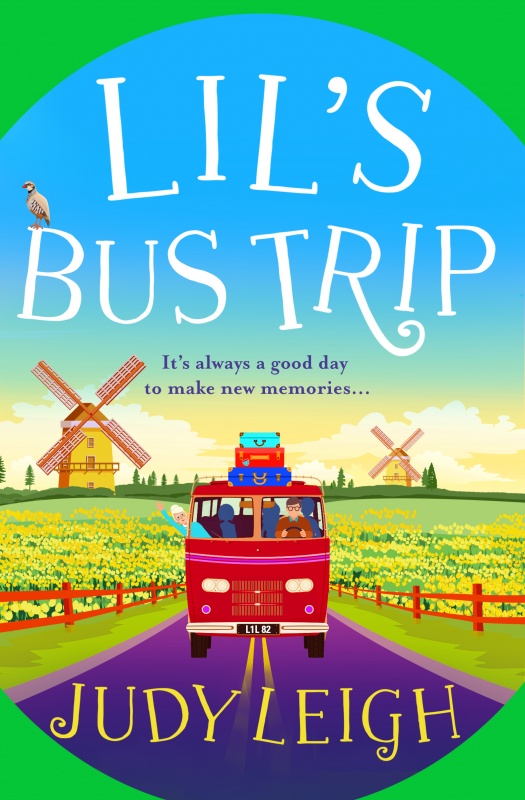 It’s always a good time for a road trip…
When 82-year-old Lil decides to book herself, her 65-year-old daughter, Cassie, and her friend Maggie on a bus trip across Europe, she hopes for a little adventure to counteract the monotony of life in sheltered accommodation.
Along with three members of the Salterley Tennis Club and the Jolly Weaver five-a side football team, whose ideas of a good time are rather different to Lil’s and strikingly at odds with each other’s, the merry band of travelers set out on their great adventure.
From moving moments on the beaches of Normandy, outrageous adventures in Amsterdam, to the beauty of Bruges and gastronomic delights of France, the holiday is just the tonic Lil, Maggie and Cassie needed.
And as the time approaches for them to head home, Lil makes an unexpected discovery – even in her advancing years, men are like buses – there isn’t one for ages then two come along at once. Is Lil ready to share her golden years, and can the ladies embrace the fresh starts that the trip has given them. Or is it just too late to change…
*****
When 82 year old Lil decides that she needs a holiday, she takes her daughter Cassie and her best friend Maggie along for the ride. Along with a variety of different people, they embark on a mini bus tour of Europe and soon discover that it’s never too late to live and love.
 This book, to begin with, was a bit of a slow burner. As there are a few people going on the holiday, it meant that quite a few characters needed to be introduced early on. However, once they actually got going on the holiday, I couldn’t put the book down.
Told mainly from the point of view of Lil and Cassie, it covers their holiday across France, Belgium and Amsterdam with many hilarious, poignant and wonderful moments along the way.
It was interesting to see how all the different personalities interacted, especially as they were all travelling in quite close proximity and were a variety of ages.

 by
Book Review: 28 Days by Sue Parritt
 Melbourne, February 2100. Emma Cartwright has 28 days left to find work, otherwise she must report to the Productive Citizens Bureau and accept any vacancy, regardless of location, pay or conditions.
Her situation becomes even more grave when the Employment Positions Portal is disabled and the government refuses to extend her unemployment period. At 70, Emma could opt for voluntary euthanasia, but she has her student son Jack to support.
After a chance meeting with the eccentric Cal Ritchie, founder of the clandestine group Citizens’ Voice and supporter of those fleeing repressive laws to live in bush camps, Emma is determined to escape her life of compliance.
When her son Jack is suddenly arrested, Emma finds herself running out of time and options, and has to take drastic measures. But can she save her son?
*****
28 Days focuses on Emma and the looming end of her government approved unemployment period. Set in the opening days of the 22nd century, she lives in an Australia which has been ravaged by climate change and rising sea levels. This has put huge pressure on population and resources.
As such, everyone needs to be a productive citizen and maintain productive employment. If you’re unable to find employment after a year, you’re allocated a job and for 70 year old Emma, that period ends in 28 days. With an 19 year old son to think about, Emma is getting desperate.
 Emma is a well rounded character who is very relatable. She reminded me of my own mother in the fact that she is stoic, resourceful and underestimated. It’s nice to read a novel centred around an active older person rather than a teenager which is something I find you often get in this genre. Emma has life experience that brings something very interesting to her character and predicament.

 by
Book Club