Blog Tour: The School Gate Survival Guide by Kerry Fisher – Review
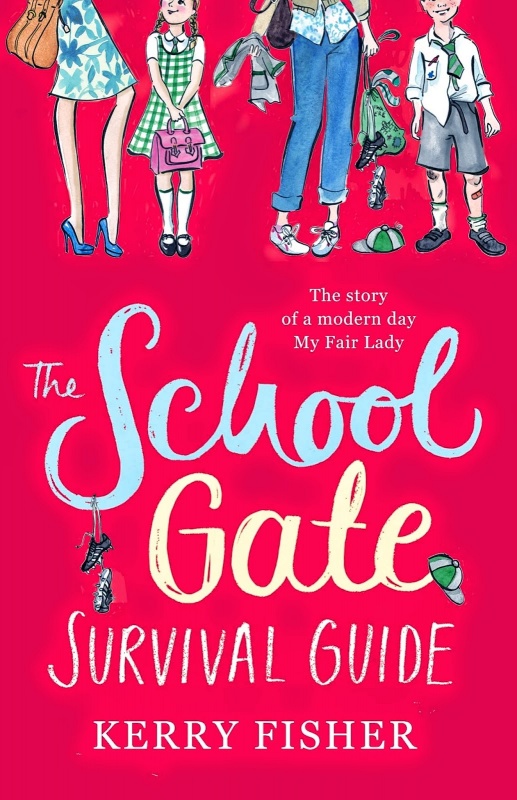 Feisty Maia Etxeleku is a cleaner for ladies who lunch. She spends her life wiping up spilt Sauvignon and hoovering around handbags before rushing back home to skivvy after her children’s feckless father on an estate where survival depends on your ability to look the other way.
But an unusual inheritance catapults her into a different world where no child can survive without organic apricots and Kumon maths classes – and no woman can contemplate a week without Pilates and pedicures.
As she blunders through a middle class minefield, dashing from coffee mornings to her mops and buckets, she is drawn to the one man who can help her family fit in. But is his interest in her purely professional or will her modern My Fair Lady experiment end in disaster?
Maia is a character with whom the reader can immediately empathise with and I liked her straight away. She had an honest feeling about her. She is a mother of two who is working hard to make a better life for herself and her two children, Harley and Bronte. Her partner, Colin, is very little help. He’s lazy, unemployed and feels entitled to sponge off Maia who struggles to make ends meet working as a cleaner.


 by

Blog Tour: No Mercy by John Burley – Review
 The peaceful town of Wintersville is a place safe from the crime and congestion of city life, where neighbours feel like family. It’s the perfect place to live.
But when a teenager is discovered brutally murdered in the woods, it becomes clear that a psychopath is roaming the streets. Dr Ben Stevenson, the town’s medical examiner, and father of two young boys, becomes entangled in the hunt for the murderer, determined to keep his family safe.
But as Ben uncovers the dark secrets of his seemingly quiet community, he confronts a truth that will haunt him forever and puts those he loves in serious danger.
I do love a good mystery so I was intrigued to read this book once I had read the book blurb. The first few pages are a little graphic but at the same time, you’re immediately plunged into the story, the action and the lives of these people portrayed in the book.
Ben works in the local CO in the small town of Wintersville – a safe place that sees very little in the way of violent crime until the body of a teenager is found mutilated near the local high school which marks the beginning of a spree of murders.

 by
Review: The Long Earth by Terry Pratchett and Stephen Baxter
 The Long Mars was released by Doubleday, June 2014.
2040-2045: In the years after the cataclysmic Yellowstone eruption there is massive economic dislocation as populations flee Datum Earth to myriad Long Earth worlds. Sally, Joshua, and Lobsang are all involved in this perilous work when, out of the blue, Sally is contacted by her long-vanished father and inventor of the original Stepper device, Willis Linsay. He tells her he is planning a fantastic voyage across the Long Mars and wants her to accompany him. But Sally soon learns that Willis has ulterior motives …
Meanwhile U. S. Navy Commander Maggie Kauffman has embarked on an incredible journey of her own, leading an expedition to the outer limits of the far Long Earth.
For Joshua, the crisis he faces is much closer to home. He becomes embroiled in the plight of the Next: the super-bright post-humans who are beginning to emerge from their ‘long childhood’ in the community called Happy Landings, located deep in the Long Earth. Ignorance and fear are causing ‘normal’ human society to turn against the Next – and a dramatic showdown seems inevitable . . .
The Long Mars is the third instalment of the Long Earth series by Terry Pratchett and Stephen Baxter.
It’s set several years after the second book. A general summary of the story is that, following a massive natural disaster on Datum earth, there is a mass relocation of people out into the stepwise worlds. It follows three main story arcs, the first is a long distance trek into the far reaches of the long earth, another across Mars and a third one to find an emerging breed of humans who exhibit intelligence far superior to our own.

 by
Before I Die by Jenny Downham

David Fickling Books.
Tessa has just a few months to live.
Fighting back against hospital visits, endless tests, drugs with excruciating side-effects, Tessa compiles a list. It’s her To Do Before I Die list. And number one is sex.
Released from the constraints of ‘normal’ life, Tessa tastes new experiences to make her feel alive while her failing body struggles to keep up.
Tessa’s feelings, her relationships with her father and brother, her estranged mother, her best friend, her new boyfriend, all are painfully crystallized in the precious weeks before Tessa’s time finally runs out.
BEFORE I DIE is a brilliantly crafted novel, heart-breaking yet astonishingly life-affirming. It will take you to the very edge.
Sometimes a book will come along that moves me, really moves me. I’m an emotional person, so it’s (reasonably) easy to make me cry, and lots of books do, especially when the subject is around death. But to really, really move me is something different. Me Before You by Jojo Moyes, The Timetraveller’s Wife by Audrey Niffenegger, The Love Verb by Jane Green, and now, Before I Die by Jenny Downham.

 by
Book Review: The Library of Unrequited Love by Sophie Divry
 The Library of Unrequited Love by Sophie Divry, published by MacLehose Press (2 Jan 2014)

Here’s the blurb:
One morning a librarian finds a reader who has been locked in overnight.
She begins to talk to him, a one-way conversation full of sharp insight and quiet outrage. As she rails against snobbish senior colleagues, an ungrateful and ignorant public, the strictures of the Dewey Decimal System and the sinister expansionist conspiracies of the books themselves, two things shine through: her unrequited passion for a researcher named Martin, and an ardent and absolute love for the arts.
A delightful divertissement for the discerning bookworm…
I had seen this in my local bookshop and nearly picked it up a few times. Translated by Siân Reynolds from the french novel, it’s not a long book at 91 pages so it didn’t take long for me to read. I wasn’t sure what to make of it at first. The main character, the librarian, is having a conversation with a man who has been locked in the library overnight and gradually, as the book progresses, you learn more about her view of the world, her thoughts and her feelings toward someone called Martin. You never hear the responses from the man – the narrative is a one way conversation; it’s all from the librarian’s point of view.

 by
Book Club