NaNoWriMo Advice: Louise Dean Says Short Sentences Can Be A Powerful Tool

 As we reach the final few days of National Novel Writing Month 2017, Louise Dean, author and founder of online writing course Kritikme.com joins me to share her insights into why using short sentences is a powerful tool when writing a novel. Thank you for joining me today Louise. Over to you.
Short Sentences. (BANG!)
Creating Impact.
We can’t always be poetic. We cannot always find a new way of saying things. But if we offer visual images in short sentences, we can create an effect on our readers that is an assault on their senses. Think Bob Dylan.
One short sentence hard on the heels of the last is a highly engaging way to write. It forces the reader into a world that is unfolding with immediacy, speed, possibly danger. Wham. Slam. Bang. Things are happening fast as in an emergency. The story is unfolding. The reader is alert.
Short & Sweet
The most economical short story writer of all time is probably Raymond Carver. With his precise, punchy prose, he conveys in a few words what many novelists take several pages to elucidate. In stories such as ‘Fat’ and ‘Are You a Doctor?’ he writes with understatement about suburban disenchantment in mid-century America.
I’d like to share with you the two things that made his short stories works of art.
- At the end of every short story – as in the first chapter of a novel – EVERYTHING HAS CHANGED.
- Carver’s genius was to incorporate here what happens in the last chapter of a novel which is the narrator is facing life after him or her – THE ANNIHILATION OF SELF.
These themes can be served, should be served, in staccato sentences for great power.
Make it shorter.
‘Remember that two great masters of language, William Shakespeare and James Joyce, wrote sentences which were almost childlike when their subjects were most profound. ‘To be or not to be?’ asks Shakespeare’s Hamlet. The longest word is three letters long.’ Kurt Vonnegut
Vonnegut employs a choral technique from the songbook of modern music too, with repetition of an almost biblical phrase ‘So it goes’ throughout Slaughterhouse-5.
When Kurt Vonnegut uses that sentence again and again throughout Slaughterhouse-5, setting it against the backdrop of one of the worst tragedies of WWII — the firebombing of Dresden — the fatalistic attitude of that short sentence provides a hard contrast to the horrific details of Dresden.


 by

A Moment With: Patricia Furstenberg – Puppy, guess who’s coming to dinner?
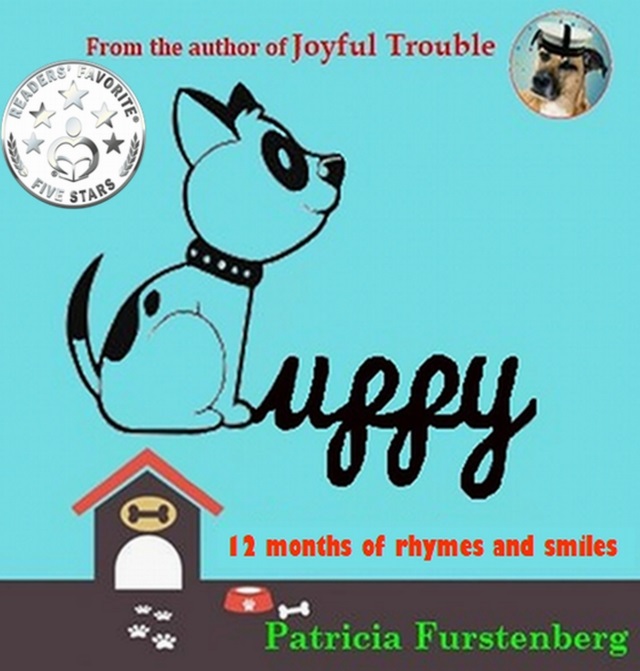 I’m happy to welcome children’s author Patricia Furstenberg to Novel Kicks. Her new book, Puppy: 12 Months of Rhymes and Smiles has been released today. Patricia joins me to chat about which characters she’d like to have around to dinner. Over to you, Patricia.
I love having a festive dinner with my family and friends! Be it Thanksgiving, Christmas or a Birthday, there is always something special about good food, in a relaxed environment, shared with the ones you love.
But what would it be like if I would invite to dinner my favorite book characters? And since Puppy will be celebrating his Grande Release in the book world today, I thought that, to celebrate him, I’ll invite six of my favorite children’s book characters to dinner.
Right next to Puppy I’ll seat Winnie-the-Pooh. I think the “silly, old bear” will be a good table companion since he is friendly and very appreciative of food, especially “hunny!” and, although forgetful, he makes a gentle pack leader. Puppy would like this, as he is used to following and sharing his meals with his “human pup”. And if Pooh happens to forget… his table manners, Puppy won’t mind at all. A.A. Milne has instilled so much love and optimist into his Winnie-the-Pooh stories and, just like Christopher Robin, so many girls and boys around the world grew up to love and rely on this bear “of very little brain”, but with a big heart.
Just to put my mind at ease I think that near Pooh I’ll be seating one of the best and most clever nannies that ever walked the pages of a book, Mary Poppins. Perhaps that P.L. Traver’s book is not that well-known, talented Julie Andrews being the one to rather instill everlasting life into this book character, but this nanny surely made many parents smile and wish they could summon her, at the drop of a hat. Besides, her typical British humor and rigor would keep any dinner plans running smoothly. Because: “just a spoonful of sugar makes the medicine go down.”
That’s why near Mary Poppins I’ll be seating Astrid Lindgren’s most beloved, yet strong-minded Pippi Longstocking. I do admire this independent little girl so very much! Her contagious optimism and passion for true values are highly commendable, as are her many talents, from cooking to fixing the house – although using unorthodox methods at times. With her freckled, contagious smile and her unusual, red plaits, Pippi has shared her passion for animals and her idealistic visions on life with so many generations of children from around the world.
I think that Pippi, although outgoing, will be a good companion to quiet but intelligent Matilda Wormwood. I’m sure that the two girls will share the same passion for travel and for stories. Roald Dahl has also given Matilda a playful side and this is what helped her overcome some of the biggest challenges headmistress Miss Trunchbull had set out for her. And just like Pippi, Matilda’s determination and optimism as well as her imagination have helped her save the day.

 by
A Moment With…Three of my Favourite Scenes by J. Paul Henderson
 J. Paul Henderson’s latest book, Larry and The Dog People was recently released by No Exit Press.
Larry MaCabe is a man who needs people more than most… The problem for Larry is that most people have little need for him.
Larry MacCabe is a retired academic, a widower, and until a chance meeting with the administrator of a care home, also friendless. At her suggestion, he adopts a Basset Hound and joins her one Saturday at the local park. He becomes a regular visitor, and for the first time in his life the member of a gang.
While his new companions prepare for the annual Blessing of the Animals service on the Feast Day of St Francis, Larry puts the finishing touches to a conference paper he’s due to present in Jerusalem and arranges a house-sitter.
Neither the service nor his visit to Israel go to plan, and on his return Larry is charged with conspiring to blow up a church and complicity in the deaths of four people. All that stands between him and conviction is a personal injury lawyer and things for Larry aren’t looking good…
Today, J Paul Henderson shares his three favourite scenes from his latest novel.
It would be good to say that I enjoyed writing all the scenes in Larry and the Dog People, but I didn’t. It’s the same with all books: there are some scenes you have to write in a story – and these you work on the hardest – and there are scenes you want to write. Fortunately, the former are far fewer in number than the latter, and it would have been easier to pinpoint three of these than choose from the ones I enjoyed writing. That said, these are three of my favourites.
Laura’s relationship with her Aunt Elizabeth (Chapter 2)
Laura Parker grows up on a small dairy farm in Vermont, where life is uncomplicated: people milk cows and that’s about it. When she’s fifteen, the family is informed that a distant relative, Elizabeth Longtoe, has been taken into care and placed in a nursing home in nearby Brattleboro.
Elizabeth is the first cousin of Laura’s deceased grandmother, an invalid and alone in the world. To all but Laura, she remains a distant and therefore unimportant relative. Although her parents do visit occasionally – more out of duty than love – it’s Laura who heads to the nursing home on a regular basis, and a bond develops between the two women. The experience of visiting her great-aunt is also the impetus for her future career in care administration.
Elizabeth Longtoe is a kindly soul and stoical. She’s had a hard life, complicated by the fact that she married outside her race, but is accepting of its hardships and has no regrets. She’s a person who counts her blessings, no matter how few they’ve been, and she appreciates that there are others in the world worse off than her. (I’d like to think that I was Elizabeth Longtoe, but needless to say I’m not.)
The conversations between Laura and her great-aunt happen over time, but are structured as a continuous monologue. Below is an excerpt.
“Children? No, we weren’t blessed that way, dear. It wasn’t meant to be. And maybe that was a good thing, because there were times when we couldn’t even afford to put food in our own mouths. I know what you’re thinking, though. You’re thinking that if we’d had children I wouldn’t be living here now, aren’t you? You’re thinking that I’d be living with them. No, I wouldn’t have wanted that, dear. You don’t give life to a person just so you can suck it out of them when you get old. They’d have lives of their own to live, children of their own to look after and there’s no way I’d have wanted to burden them. I’m an invalid, Laura. It wouldn’t have been fair.”

 by
A Moment With: Claire North Talks About Her Favourite Fictional Characters

 Claire North is the author of The End of The Day which was released by Orbit in Paperback on 24th August.
Claire is with me today to chat about her five favourite fictional characters. Over to you, Claire.
Sam Vimes, from The Discworld Novels by Terry Pratchett
Sam Vimes starts in the gutter, and ends up more or less a superhero. By the time he’s a diplomat for the city of Ankh Morpork, he can swagger into any bar on the Disc, flick ash from his cigar, tip his helmet to the troll at the door and with a casual ‘easy, boys’ seize control of a situation by his sheer grim will and excellence.
He doesn’t have magic powers. But he is a copper. No – a copper’s copper. A policeman down to the soles of his worn-down boots, a loather of paperwork, a duke despite himself, a terrible politician and a seeker-after-of-truth/justice, no matter what gets in his way. And in Vimes, Terry Pratchett came to craft a character who’s superpower is exactly that – policeman as a magic unto itself.
Vimes is also blessed by being married to Lady Sybil Ramkin, a dragon-breeder and lady of an ancient house. It is a union that gave his character even more space to bloom, as his desire to pursue the truth of increasingly tangled and dangerous cases was pulled back from the edge of darkness by Lady Ramkin’s inevitable and necessary cry – “Don’t be ridiculous, Sam!” Separately, they were already cool characters; together they are incredible.
Lessa , from the Dragons of Pern by Anne McCaffrey
There is a great deal about Lessa that’s annoying. Arguably this is in response to provocation – having your family killed, your ancestral Hold stolen from you, hiding yourself in the kitchens of your conqueror for years while planning revenge would certainly help mould you into the headstrong bundle of rage, manipulation and exasperation that Lessa absolutely is.

Corgi, June 2012
She’s also the rider of a golden queen dragon, a great leader in the fight against the deadly Thread that rains down from Pern’s sky, and the first female character I ever read who was kick-ass excellent, and fully human, and totally indispensable. Try to put yourself in the shoes of a teenage girl who up to that time was still only really encountering books about heroic men doing heroic things while women need rescuing. Try now to imagine how your world explodes when finally – finally – you find a book where not only is the woman a flawed and brilliant character who evolves with the passage of time into someone even more awesome, but who is the irrefutable saviour of Pern despite herself and her flaws.
Lessa is far from the greatest character I’ve ever read; but as a teenage girl learning to love fantasy, her existence rocked my world.
Corwin, from the Chronicles of Amber by Roger Zelazny
Corwin is arguably a far less pleasant character to spend time with than his sprog, Merlin. However, the ambition, vengeance and self-obsession that drives Corwin in book one to do some… really rather unwise things… gives way over time to one of the most interesting and evolved mostly-heroes of fantasy. With the ability to walk through reality – all realities, all that you can ever imagine – and over time acquiring responsibility for maintaining the balance between the universe’s two conflicting poles, Order and and Chaos, Corwin is a character who defies easy description, shares his feelings minimally with the reader, while providing gently humorous narrative on all he sees.
However, like all of Zelazny’s characters, responsibility doesn’t make Corwin pompous, or bad company. Like Sam in Lord of Light – a character who essentially becomes the Buddha in his quest to tear the technology of incarnation out of elitist hands – it’s excellent, go read – Corwin will spend a great deal of time enjoying whiskey and a cigarette while musing over the nature of existence, before wrapping up debate with a merry ‘that didn’t solve anything, but it was better than being impaled by a mad unicorn’. Huge ideas are gently caressed beneath the surface of Corwin’s dry wit, and Zelazny’s casually brilliant imagination.

 by
A Moment With… Beth Underdown

 Beth Underdown’s debut novel, The Witchfinder’s Sister was released by Viking in March 2017.
Beth is with me today to talk about her approach to the research process and how important it is to find your own system. Over to you, Beth….
When I started my first novel, I didn’t have a clue what I was up to. I floundered about, making a start on this scene or that subplot, interspersing writing with what began as a fairly scatter-gun approach to research – one week a book of sermons, the next an illustrated herbal, the next a broad political survey of the whole century in which my story was set. As the book progressed, my approach to research changed, and became about looking for answers to specific questions the story had raised. But to start with, my research strategy might best have been described as random.
I like to think that now, starting my second novel, some of what I learned with the first one will save me a bit of time and heartache. I’m hoping, for instance, that I’ve sharpened my instinct for which scenes and which subplots will be needed in this next book – which should be developed, and which should be allowed to die quietly before they embarrass me any further.
But what hasn’t changed, I’m realising, is that scatter-gun approach to the first weeks of research. As it turns out, scatter-gun is what I need.
Last year, after finishing my first novel, I breathed a sigh of relief. Having made it through months of active writing, during which I’d been afraid to read other people’s fiction in case I lost a grip on the voice of my own narrator, suddenly I was free. I started to read some of the great fiction that was coming out at the time: The Essex Serpent. The North Water. His Bloody Project. I also got a teaching job, so I started to read and reread a bunch of classics, to help prepare my seminars: Madame Bovary. The Hound of the Baskervilles. The Talented Mr Ripley. But despite these literary riches, I felt a bit bereft, and I didn’t know why. I was reading everything (or as much of everything as I had hours in the day to accommodate). So why did it feel like something was missing?
What I wasn’t reading, I see now, were my scatter-gun books. My weird books. Books published in the sixties and since forgotten. Books consigned to the dustiest end of the library or the forsaken corner of a second-hand bookshop.

 by
Book Club