Blogival: Laura Gascoigne Reads From Her Novel
 I’m back with Blogival and today, I’d like to welcome a fellow Laura to Novel Kicks. Laura Gascoigne is the author of The Horse’s Arse.
Patrick Phelan is an ageing artist who has never made it big but who somehow manages to live on air in a North London suburb.
When not running art classes for amateurs, Patrick wrestles in the shed at the bottom of his garden with his life’s work: a series of visionary canvases of The Seven Seals.
When his wheeler-dealer son Marty turns up with a commission from a rich client for some copies of paintings by modern masters, Phelan reluctantly agrees; it means money for his ex-wife Moira. However the deal with Marty is, typically, not what it seems.
What follows is a complex chain of events involving fakery, fraud, kidnapping, murder, the Russian Mafia and a cast of dubious art world characters. A contemporary spin on Joyce Cary’s classic satire The Horse’s Mouth, The Horse’s Arse by Laura Gascoigne is a crime thriller-cum-comic-fable that poses the serious question: where does art go from here?
Today, Laura is reading a section from her novel. Enjoy!


 by

Blogival: Extract of The Expansion by Christoph Martin
 It’s August and the first day of Blogival; a month of bloggers and authors combining to offer reviews, guest posts and more. I am very happy to be part of this fantastic online event.
Today, I welcome Christoph Martin, author of The Expansion to Novel Kicks.
In politics and big business, truth is a matter of opinion.
Straddling the storyworlds of Panama, Washington and London, The Expansion follows British-born geomatic engineer Max Burns, whose revolutionary water-saving system wins him the esteemed position of head engineer for one of the 21st century’s most politically contested megaprojects: the expansion of the Panama Canal.
For Max it is a dream come true: not only is he able to work closely with construction giant and old high-school friend Godfredo Roco in one of the most beautiful tropical environments, but it’s the kind of job Max has been working toward his entire career.
Yet in the arena of global trade and diplomacy, stakes are high, and when a senior official of the Panama Canal Administration is found dead, Max finds himself in the frame for sabotage and murder, and at the centre of a web of political intrigue and betrayal that reaches far beyond the idyllic shores of Central America. The only person Max can trust is his new-found love, Karis Deen, a scientist with the Smithsonian Tropical Research Institute. Except Karis herself holds a secret that could not only destroy Max, but could change the entire balance of world power.
Today, thanks to Clink Street Publishing and Christoph, I have an extract from The Expansion to share with you. Enjoy!
N.B: This is the scene that changes Max Burns life forever! Losing his parents and with them also the family fortune and a very comfortable and prosperous future.
They had reached a flying altitude of three thousand feet.
His fingers found what they were searching for: the smooth, plastic sheath that guarded the engine’s idle shut-off valve.
It would only take a moment.
Numb, he turned to his wife. She had covered her lips with her hand, and he heard a sob. In the darkness, the diamonds at her throat had lost their fire.
“It’s the best way. I can’t let them put you in jail,” he said. “Max will be able to make a clean start. One day, I hope he’ll forgive me—”

 by
Novel Kicks Chats to …Caroline Beecham
 Maggie’s Kitchen is the latest novel from Caroline Beecham (which is due to be released by Ebury Press on 27th July 2017) and I am happy to be welcoming her to Novel Kicks today.
When the British Ministry of Food urgently calls for the opening of restaurants to feed tired and hungry Londoners during WWII, aspiring cook Maggie Johnson seems close to realising a long-held dream. After overcoming a tangle of red tape, Maggie’s Kitchen finally opens its doors to the public and Maggie finds that she has an unexpected problem – her restaurant is too popular, and there’s not enough food to go round.
Then Maggie takes twelve-year-old street urchin Robbie under her wing and, through him, is introduced to a dashing Polish refugee, digging for victory on London’s allotments. Between them they will have to break the rules in order to put food on the table, and, perhaps, find love into the bargain…
Thank you for joining me today, Caroline. Can you tell me a little about your book, Maggie’s Kitchen and what inspired it?
‘Maggie’s Kitchen’ is a novel that follows the fortunes of Maggie Johnson as she sets up and runs a British Restaurant in London during the Second World War. The story focuses on the relationships that she develops with the community and in particular with Robbie, a twelve-year-old runaway, and Janek, a Polish refugee. Together they struggle through government red-tape to open the restaurant and then battle food shortages and community crisis to keep their doors open.
The novel is inspired by real events and I was intrigued by the fact these restaurants were created to help with the food shortages during the war. It seemed timely to write a story about them given the renewed interest in ‘paddock-to-plate’ and ‘nose-to-tail’ eating and our obsession with food.
The novel includes excerpts from the original Ministry of Food’s War Cookery Leaflets together with recipes that have been updated to suit contemporary tastes. The story is ultimately about hope and finding courage in the most unlikely of places.
What are the challenges of writing historical fiction?
Being inspired to write fiction based on real events and/or people and their achievements feels like a real privilege but there is also the danger of becoming too obsessed with your research and wanting to include everything in your book.
The key is to recognise how much detail to use to create the setting and as signposts to make the era authentic, but also remember you are creating a fictional work that needs to be real for your characters.
I’ve learnt that the first step is to recognise when to stop researching and start writing. The next is to know when to leave the research behind and just write freely, knowing that you can go back and check facts and details later; the most important thing is story and character.
That said, I was surprised at how strict the editors were in their fact checking with places, street names, and bus routes from the time for instance, but I suppose that’s good news for readers!
What is the best and hardest thing about being a writer?
The best thing about writing is being able to immerse yourself in fascinating subjects and people and different and interesting worlds; and your imagination of course. Initially I had wanted to write non-fiction because of my background working in television as well as to carry on storytelling in a different way after stopping fulltime work when I had children, but then I found myself drawn to fiction because it seemed to offer up more opportunities.
That’s what happened with ‘Maggie’s Kitchen’; I could have developed a documentary about these British Restaurants that few people had heard about but the characters of Maggie, Janek and Robbie emerged quite quickly, and the rest they say is history!
The hardest thing about being a writer is having the space and time to write. Everyone is very busy these days and juggling a family with other work commitments can be challenging.
When people asked what I did before I was published, I used to apologetically explain that I was writing a novel and they either rolled their eyes or were genuinely interested, but I didn’t feel as if I could legitimately say that was my work, even though I was totally committed to it and quite disciplined about spending time writing because I knew the novel wouldn’t write itself and that was what I had to do.
Now I realise that I need space around writing, not just the physical sitting down at the desk or doing research space but real headspace and that’s not always easy to get. I understand now why there are so many writers’ retreats and I think I need to apply for one!

 by
Novel Kicks Chats To: Kevin Dickson
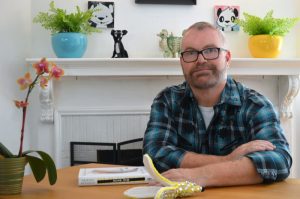
Kevin Dickson
Hello Kevin, thank you for joining me t0day on Novel Kicks. Your novel (which you’ve co-written with Jack Ketsoyan) is called Blind Item. Can you tell me about it?
Sure! The idea for Blind Item came out of conversations that Jack Ketsoyan and I had when I was a tabloid editor and he was a publicist with chaotic clients that I needed to do stories on.
After he came to trust me, we would share the darkest things we’d seen in our jobs, and we swore one day that we’d fold them all into a novel.
With Blind Item, we set out to write a dark romance that was set in the real Hollywood, the city were fame is just another job, and being famous is the worst job of all. We wanted to tell a funny, touching and truthful story that used our experiences as a springboard, and we threw in a generous sprinkling of the scandals that we’d seen over the years.
You’ve been an entertainment journalist for over twenty five years. How did this help with writing the novel? How much in the book is based on true events? (If you’re allowed to say… obviously.)
For a lot of entertainment journalists, their job entails showing up to interviews and spending very formal time around celebrities. I used to do that job. Once I entered the tabloid world, things became lot more informal.
I’ve always believed in journalistic integrity and if someone says something is off record, it’s off record. I think this surprised a lot of celebrities, but as they came to trust me, I began to get invited to private parties at their houses, and I never sold them out.
For many years, I was able to see a side of Hollywood that doesn’t get reported on. It was fun for a while but like anything that you have to do for work, it got old. But the behavior and the ridiculous excess that I saw definitely informed Blind Item.
The book is a fiction, it’s the story of a group of friends who live a life that’s very similar to both Jack’s and my own, when we were starting out in this town. We then saddled our poor characters with a lot of the lurid things that we saw happen, but I’d imagine that this is something that most writers do, go with what you know, write from your experience, but transform it into something more.
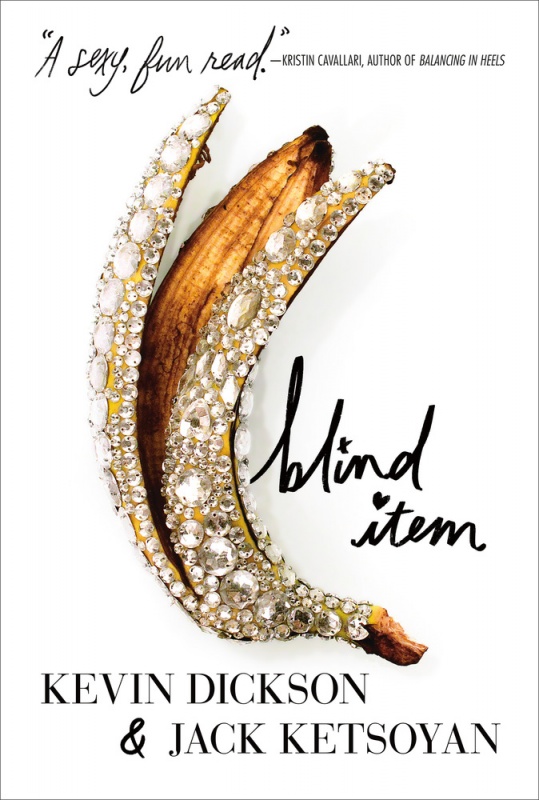
Imprint, July 2017
What was your typical writing day like when writing Blind Item? Do you have any rituals before sitting down to write (needing coffee, music, silence, etc?)
It’s all about ritual for me. On the days that I was writing Blind Item, I would get up and check my phone exhaustively, literally exhaust the news, email, social media and whatnot, so that it would not distract me (and ultimately, as we entered the home stretch, I deactivated Facebook because of its capacity to enable procrastination.)
Then I would pile my two dogs into my car and go get a ridiculously strong coffee at Starbucks.
I would come home and think about the playlist for the day. I can only write to very few albums. I have to know them inside out. But it changes, and I think the material dictates what music I’m able to write to. For most of Blind Item, I only listened to Nocturne by Siouxsie, Last Splash by the Breeders and Golem by Wand. Just three albums on repeat.
I think they soothe my brain. I don’t hear them while I’m writing but they give my subconscious free reign to go live in that made up world. Once I had exhausted myself for the day, I’d go for a hike to clear out and return to myself.
What’s your favourite word and why?
It changes all the time. I like animal words, like panda and pangolin. I like palindromes, like kayak. I like onomatopoeia, and I love invented words. I’ve always loved a word I heard in France, I don’t know how to spell it, but it was something like les roploplos, which an old lady told me was a plural noun for really big boobs.

 by
Novel Kicks Writing Room: Using Photos For Inspiration
 This week, we are going to look again at characters you could potentially include in a novel.
Find a photo (an old family one or if it’s easier, one from the internet. There needs to be at least three people in it.)
Look at each individual person, list the following about them;
Ten characteristics.
Five hobbies.
Five likes and dislikes.
Ten things that they would own.
Do any of these people have similarities with any of the characters you are trying to develop?
Add anything to your notes that might be relevant.

 by
Book Club
Recent Comments