NK Chats To.... : Matt Lynn
Matt Lynn is the author of Shadow Force, Fire Force, Death Force and most recently, Ice Force. He’s also a Journalist and the CEO of Endeavour Press.
Describe your typical writing day.
Writing is a job like any other and you have to treat it like that. After helping get the kids ready for school, I start up my computer and start writing. It’s always easier first thing in the morning because your mind is fresh, and you have been thinking about it overnight. I read an interview with Wilbur Smith once where he said he left a sentence half-finished so it was easy to get started again the next day.
I set myself a target of 1,000 words a day. Once I’ve done that, I can start dealing with e-mail and all the other things that need to be done.
How do you approach planning before beginning a book?
I do an incredibly detailed plan. I did quite a bit of ghost-writing, and when you do that you have to have a plan to show the publisher and ‘author’. But it is a good discipline. It is much easier to throw stuff out of plan that isn’t good enough – and, as I think Beethoven pointed out, it’s the notes you don’t write that really count.


 by

Book Reviews : Chocolate Shoes and Wedding Blues & The Magic of Christmas by Trisha Ashley.
Chocolate Shoes and Wedding Blues.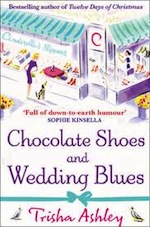
Trisha Ashley.
(Avon, May 2012.)
Tansy Poole inherits a run –down shoe shop in the village of Sticklepond – Cinderella’s Slippers is soon established, stocking the footwear to make any fairy-tale wedding come true.
If only Tansy’s personal life was as heavenly. With a fiancé trying to make her fit into a size eight wedding dress as well as the discovery of shocking family revelations, Tansy soon takes shelter in the shops success.
A link to her past also moves in next door, in the shape of ex fling, the actor Ivo Hawksley who is there to nurse his own broken heart.
Soon they discover that secrets shared begin to forge a special bond between them. Continue reading

 by
Trisha Ashley – Process between the first draft and finished manuscript.
Trisha Ashley, the author of Chocolate Shoes and Wedding Blues, The Magic Of Christmas and Wedding Tiers takes over our blog and tells us about her process between the first draft and finished manuscript.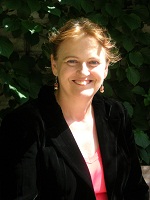
I write directly onto the computer, touch-typing, though I need to see my words in print on paper before the world I am writing about becomes real to me, so I print everything out. This can also be useful if your computer loses the chapter and you forgot to back up onto a memory stick or whatever.
My first drafts are usually somewhere between eighty and a hundred thousand words long and written in the stream-of-consciousness style made popular by James Joyce, since I just pour the words out onto the page and don’t always bother with the punctuation or typos. If I’m too tired to think creatively in the afternoon, though, I will often go back and tidy up the work I did in the morning. Continue reading

 by
Book Corner : May’s Book
 The Chaperone by Laura Moriarty
On a summer’s day in 1922 Cora Carlisle boards a train from Wichita, Kansas, to New York City, leaving behind a marriage that’s not as perfect as it seems and a past that she buried long ago. She is charged with the care of a stunning young girl with a jet-black fringe and eyes wild and wise beyond her fifteen years. This girl is hungry for stardom and Cora for something she doesn’t yet know. Cora will be many things in her lifetime – an orphan, a mother, a wife, a mistress – but in New York she is a chaperone and her life is about to change. It is here under the bright lights of Broadway, in a time when prohibition reigns and speakeasies with their forbidden whispers behind closed doors thrive, that Cora finds what she has been searching for. It is here, in a time when illicit thrills and daring glamour sizzle beneath the laws of propriety that her life truly begins. It is here that Cora and her charge, Louise Brooks, take their first steps towards their dreams.

 by
NK Chats To.... : Elle Amberley
Elle is the author of the novel Nowhere Left To Hide and her latest novel, Lost In Your Time has just been released in e-book format by Indio Press and is available via the amazon kindle store. Read our interview with Elle here.
Describe your typical writing day.
Oh, I’m a messy writer, and a very busy one with that. No day is the same. If however I’m in the middle of writing a first draft, the world could collapse around me and I’d still be typing away furiously. This is when my husband brings me little treats, as I forget to eat, along with cups of coffee.
When I’m revising and editing I need more peace and have to work in chunks, carefully crafted around my children.
Any other day will see me scribbling away on bits of paper, notebooks, anything. I’ve been known to stop the car so I could jot something down. Other times I might spend all night on my laptop.
How do you approach planning before beginning a book?
Ah, this is interesting because a while ago I would have told I don’t really plan. However I’ve realised that’s not so true. The planning takes place in my head, hence the very fast first draft, I only have to sit down and type. It’s like a film in my head.
That said, very often I get more ideas for other projects and file them until I can go back to them.

 by
Book Club
Recent Comments