Book Extract & NK Chats To… A.M. Soliman
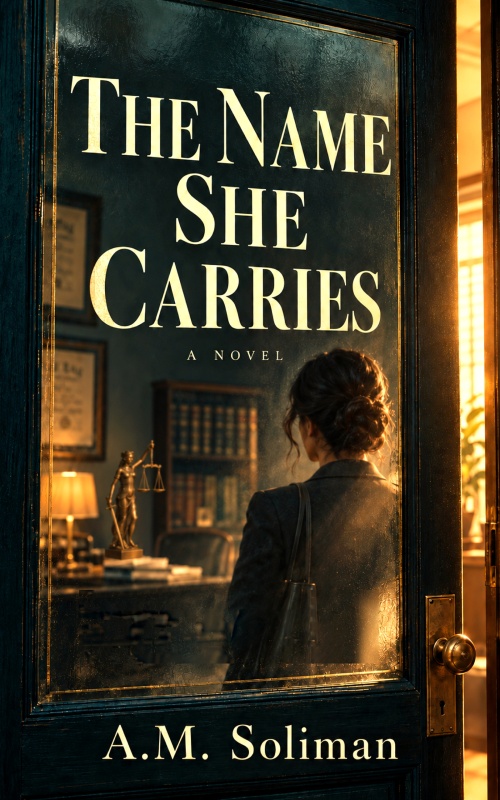 It’s a pleasure to be welcoming A.M. Soliman to Novel Kicks as we shine a light on his latest book, The Name She Carries
Some inherit a name. She had to earn hers.
Mary Adel learned the law watching her father command courtrooms. Now Zach Adel — the legend who taught her everything — is running out of time, and the case of his career has just passed into her hands.
The clients don’t want money. Aisha Reynolds was dismissed in an ER triage line — four words typed into her chart, possible drug-seeking behavior — and her family wants the truth spoken in open court. No settlement. No sealed record.
It’s the kind of case that made Zach’s name. Now it will test Mary’s. Alone at counsel table, against the hospital’s lawyers and her own firm’s doubts, she must decide what kind of lawyer — and what kind of daughter — she is going to be.
Below, we chat to A.M. Soliman but first, he’s shared an extract from The Name She Carries. We hope you enjoy.
*****beginning of extract*****
Aisha Reynolds had spent most of her life keeping time for other people: pickups, drop-offs, lunch schedules, and closing hours. Time meant order. If you arrived on time, you were seen in order.
The clock above triage read 10:42 p.m. on the night of February thirteenth. She stood at the intake desk with one hand pressed lightly against her right side. She was fifty-one, dark-skinned, and composed. The kind of posture shaped by decades of lifting other people’s children without complaint. Her dark hair was pulled into a low twist, early silver at the temples catching the fluorescent light. A thin gold cross rested against her collarbone, half-hidden beneath her coat.
The pain had begun as pressure that afternoon. By the evening it sharpened. By ten o’clock it had begun to move, downward, inward, and deep enough to make her pause mid-sentence.
“I’ve had worsening abdominal pain for about six hours,” she said carefully. “It’s getting severe.”
The triage nurse looked up.
Her badge read:
Karen Whitfield, R.N.
“Pain scale?”
“I would say eight.”
Whitfield’s eyes lifted briefly.
“You drove yourself?”
“Yes, because my husband is traveling.”
“Any vomiting?”
“Yes, once earlier.”
Whitfield typed before looking at Aisha again.
“You’re standing fine.”
“I’m trying to.”
Whitfield paused before responding.
“We don’t prescribe narcotics without evaluation,” Whitfield added evenly.
Aisha considered her response before giving it. “Ma’am, I didn’t ask for narcotics.”
“You’d be surprised how often that’s where this goes,” she said. “Just so you know, we’re very full tonight.”
“I understand.”
Whitfield keyed an acuity code into the triage field without lingering on it, then typed the following notes:
Ambulatory. No visible distress. Pain score 8/10 inconsistent with presentation.
Patient appears anxious. Monitor. Possible drug-seeking behavior.
She clicked save.
“Have a seat. We’ll call you.”
At 10:50, a young white woman holding her stomach was taken back within minutes. Six minutes after that a man with a swollen ankle was triaged and escorted behind the double doors.
The doors swung closed with a hydraulic sigh as Aisha remained seated. She told herself there were clinical differences she could not see. She had always believed in giving professionals the benefit of the doubt.
The pain tightened, folding inward like something wringing itself out inside her. At 11:03, she returned to the desk.
“It’s worse,” she said.
Whitfield rolled her eyes and then glanced at the monitor.
“We’ll get to you.”
“It’s getting harder to stand.”
“We’ll get to you.”
Aisha sat down again. At 11:15, the pain shifted. It was no longer something she could breathe through. It was sharp enough to interrupt thought. She bent forward, elbows on her knees, and a tear slipped down her cheek before she could stop it. She wiped it away quickly.
Across the room, the television murmured. A commercial about insurance played to no one listening. At 11:18, she stood again.“Ma’am, please. I need to be seen,” she said. Her voice sounded unfamiliar to her, thinner and strained.
Whitfield did not turn fully around.
“Vitals were stable at intake.”
“Ma’am, my pain isn’t stable.”
“Pain is subjective.”
Aisha maintained eye contact.
“I know that.”
Whitfield typed something into the chart. Aisha stood there one second longer than necessary. She had learned, long ago, to measure her reactions. To stay calm, keep her tone even, and never give anyone reason to confirm what they already believed.
Another Black woman exaggerating. Another patient seeking something. She returned to her chair. This time she did not wipe the tears away. She wished her husband Jeffrey was with her instead of in Chicago on business.
At 11:27, her breathing grew shallow. The young woman who had arrived after her was discharged with instructions and a prescription. She left slowly, seemingly relieved. Aisha watched her walk out.
At 11:31, Aisha slid sideways in her chair. The room narrowed, and her skin turned ashen beneath its deep brown tone. The man across the room stood.
“Hey,” he called. “She’s not okay.”
Whitfield approached more quickly now. “Aisha,” she said, reading from the wristband. “Can you sit up?”
Aisha tried to answer, but the room tilted, and her abdomen seized with a pain so sudden it stripped her ability to speak.
Whitfield’s expression shifted — not dramatically, but just enough.
“Okay. Let’s get her back.”
In the treatment bay, the resident pressed gently on Aisha’s abdomen. Aisha cried out and he frowned.
“When did this begin?” he asked.
“Seven hours ago.”
He glanced at the intake note.
Ambulatory. No visible distress. Pain score 8/10 inconsistent with presentation.
Patient appears anxious. Possible drug-seeking behavior. He looked from the note to the acuity code at the top of the chart, and his frown deepened, as if the two had been written about different patients. There was nothing anxious about her now. Only pain. He pressed again and she recoiled sharply.
“Rebound tenderness,” he murmured.
He ordered labs and a CT.
Twenty minutes later, the attending physician reviewed the scan.
“Acute appendicitis,” she said. “Advanced and likely perforated.”
She checked the timestamps.
Arrival: 10:42 p.m.
Bed placement: 11:38 p.m.
Imaging ordered: 11:52 p.m.
Fifty-six minutes had passed between the front doors and a bed. She read the intake note again.
Pain score 8/10 inconsistent with presentation.
Her eyes went briefly to the triage field, then back to the timestamps, like someone rechecking arithmetic that refused to resolve. She closed the chart without comment.
In the operating room, the surgeon worked quickly. The appendix had ruptured, and infection had begun to spread.
“She came just in time,” someone said.
At 2:58 a.m., Aisha lay in recovery, pale but stable.
“You’re fortunate,” the attending told her. “Another hour and the infection could have become systemic.”
Aisha stared at the ceiling. “I was here,” she said.
She didn’t raise her voice. She didn’t need to. The attending hesitated.
“I know.”
She marked the chart and left the room, and the recovery ward went quiet around her. Aisha lay still, with stitches pulling against her skin, replaying in her memory the clock above triage when she first arrived.
10:42 p.m.
Her eyes filled, and the tears came.
*****end of extract*****
 Hello. Thank you so much for joining me today. Can you tell me about your book, The Name She Carries, and what inspired it?
Thank you for having me. The Name She Carries is a legal novel about a young lawyer, Mary Adel, who inherits her father’s last case whenhe becomes ill. The case is on behalf of a Black woman named Aisha Reynolds, who went to an emergency room in severe pain and was sent to the waiting room instead of a bed. Four words were typed into her chart that night, and the hospital is betting that no jury will call them what they were. Mary has to see the case through while standing up to her own firm, and the book is really about the difference between carrying a name and earning it.
It was inspired by two things. I’m a trial attorney in New Jersey, and my practice includes civil-rights work, so I’ve spent years sitting across from people whose accounts had been doubted by the institutions that were supposed to help them. And I have a daughter. At some point the two ideas met: what if the lawyer who took this case were a woman, and what if she were my daughter, twenty years from now? That question gave me Mary, and it gave the book its emotional spine. It’s a courtroom drama, but first and foremost it’s a love letter to daughters from a father.
What are the challenges you faced when writing your book?
The biggest was learning to write fiction at all. Before the law I was a newspaper columnist and a documentary film director, so I knew how to write to length and how to build an argument. Neither of those is a novel. A column tells you what to think; a novel has to let you watch and decide for yourself. It took me a long time, and a lot of books about craft, to stop explaining and start showing.
The second challenge was the law itself. I know far too much about how a case like this actually works, and almost none of it belongs on the page. Every draft was partly an exercise in taking out what I knew and keeping only what the reader needed to feel.
What is your typical writing day like? Do you have any rituals like needing coffee, silence or a specific place to write?
There is no typical day, because I still practice law full time. Fiction happens late, when the house is sleeping. Sometimes I have stretches of productivity, then stretches of distraction from my other commitments. Especially when I have to do a jury trial.
What is your favourite word and why?
Truth. Everything I have done in my career, from newspapers to documentary films to being a trial attorney has the common thread of seeking, distilling, and displaying the truth. It’s the first duty of all of those jobs, and truth is something society seems to be getting away from. Truth is a common element in my novels, especially how governments, the media, and corporations can shape a false narrative and the importance of fighting for truth and justice.
What’s your writing process like, from idea, research, planning, drafting, editing? When do you know when you’ve done enough planning and editing?
I plan everything before I draft, which I know is unfashionable. I start with the opening and the ending, build a three-act structure, break each act into chapters and key scenes I envision, and only then do I write. My background in journalism and documentaries probably explains it: you don’t start filming without knowing what the film is about.
And then I revise, revise, and revise again. Then again.
If you were creating a playlist for The Name She Carries, which songs would you include?
Rise Up by Bruce Springsteen; Goodbye My Friend by Linda Ronstadt; and Because You Loved Me by Celine Dion.
What type of scene do you find the hardest to write?
The quiet ones between people who love each other and can’t say it. Courtroom scenes come easily; I’ve lived in those rooms. A father and daughter at a kitchen table, with him trying to protect her by not telling the truth yet is the scene I rewrote most, because the temptation isalways to have one of them say something out loud, and the moment they do, it’s gone.
Do you have any advice on how to overcome writer’s block?
Write down the shit, even if you think it’s terrible. The process will get your ideas flowing, and reading it later will help you revise, revise, and revise again until you make it better.
What comes first for you, characters or plot?
The idea/concept of the book, which leads to the plot, which leads to the characters. For The Name She Carries, it was the first novel I wrote, even though it’s my second novel release (the first was “Brothers in Service”). The Name She Carries was started during Covid. I decided to use the extra time to tackle my bucket list, starting with writing a novel. At the time, biased medical treatment for minorities was a hot issue, and since we should write what we know, the idea was to write a legal drama about a medical discrimination case. This led to the idea of having the attorney not be a man, but the case primarily done by the man’s daughter. This led to the characters.
What are you currently working on?
A third novel, at the beginning stages. That’s all I will say about it.
Not including your books, is there a book you wish you could forget just so you have the pleasure of discovering it again?
Shit My Dad Says by Justin Halpren. It was laugh-out-loud hilarious.
What was your route to publication like and what advice would you give to someone looking to pursue a similar path?
I published both books independently this year, after writing them both first. I’m a trial lawyer in my fifties with a practice to run; I didn’t have two years to spend querying, and I wanted to control the timing. Brothers in Service came out in September to mark the 25th anniversary of 9/11, which is the setting of that novel, and I couldn’t miss it. The Name She Carries followed in November, even though it was written first. And just as I like having my own firm, I like controlling my own novels.
My advice is to try. Like the advice my father gave me at thirty, when I was afraid I was too old for law school, which takes three years full time and I felt it was too late because I would be 33 by the time I finished. He said “you’re going to be thirty-three anyway; do you want to be thirty-three with the degree or without it?” Whatever you’re putting off, the years pass either way. And once you’ve started: revise, revise, and revise again, and then find readers who will tell you the truth.
Would you rather –
Have magical powers here on earth or live in a magical place without powers?
Powers here. I like it here, and I have a list.
Would you rather have the ability to communicate telepathically or know every single language on the planet?
Telepathy. What lawyer wouldn’t want to read a person’s mind?
Be able to have a one-minute conversation with your past self or future self?
Past self, and I’d tell him exactly what my father told me. Only sooner.
Live in a world where it is constantly snowing or always raining?
Rain. The older I get, the more I hate the cold.
Live in a world without music or movies?
I would give up the music because I can’t give up the movies of my kids when they were little.
Take part in a dating show or a survival show?
Survival. My wife would insist.
About A.M. Soliman –
 A.M. Soliman is a trial attorney in New Jersey whose practice includes civil-rights litigation.
Before entering the law he was a journalist: a newspaper reporter, a columnist for The Record, a commentator on CNN and NPR, and the director of the PBS documentary Born in the USA: Muslim Americans. He writes upmarket literary fiction about courtrooms, families, and the institutions that decide who gets believed. His novels are Brothers in Service and The Name She Carries, a Kirkus Reviews “Get It” pick. He lives in New Jersey, with his wife and two children.
Say hello to A.M. Soliman via his website, Bookbub, Goodreads and Facebook.
The Name She Carries was released in November 2026. Click to buy on Amazon UK and Amazon US.




 by


I'm Laura. I started Novel Kicks back in 2009 as I wanted a place to discuss books and writing - two loves of my life. As someone who has anxiety, these two things give me, and I am sure countless others, a much needed escape.
There is a monthly book club, writing exercises, prompts, reviews, author interviews, competitions and guest posts. I cover many genres and I hope there is something for everyone.
I grew up by the sea in Dorset and currently live in Poole with my husband, Chris and three cats. I love writing and have a BA (Hons) in Creative Writing from Falmouth University. I am writing my first book. If only I could stop pressing delete. Chris has threatened to stop it from working. Haha.
I have always loved creative writing since I was in first school and would very much like to meet my teacher, Miss Sayers, to say thank you for all the encouragement she gave me then.
When not writing, I love reading, cats, Disney, singing (I can't sing but this doesn't stop me,) and falling into a good TV show or film. If I could step into any fictional world, it would be amongst the characters in ABC's Once Upon a Time.
I love reading many genres and discovering new authors.
Book Club
Leave a Reply