NK Chats To & Extract: Noah Christopher
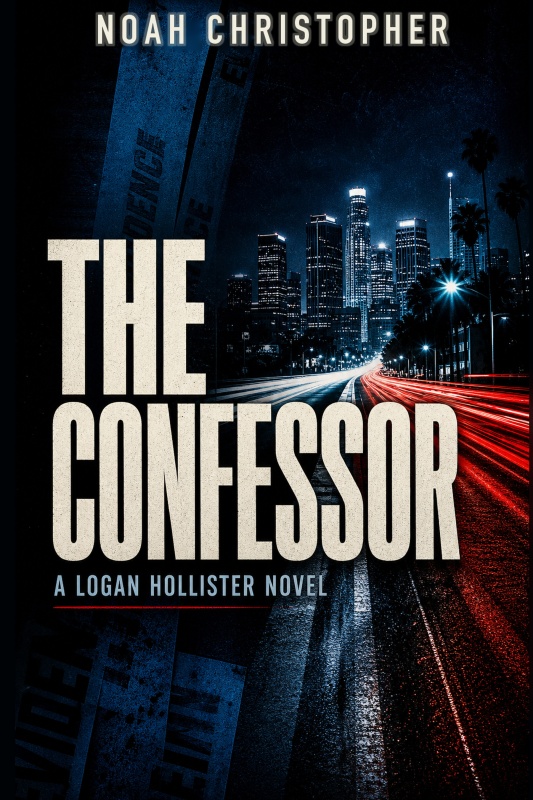 Hi Noah, thank you so much for joining me today. Can you tell us about your book, The Confessor?
Absolutely! I’ve always had in the back of my head that it would be fun to write a book one day, and after years of thinking about it “one day” finally became “today” and I just jumped in. My favorite author has always been John Sandford ever since I first read Rules of Prey many years ago. I love the alternating POV chapters between hero and villain, so I knew I wanted to use a similar concept while still making the book my own and something truly unique.
That eventually became The Confessor. The book started when I came up with the concept for the killer, a man who is tired of all the injustice in the world and starts making people confess to their crimes before he kills them. Then, as I wrote on the dedication page, I wanted our hero to feel like a distant cousin of Lucas Davenport from Sandford’s Prey series, with a healthy dose of myself thrown in as well. Those were the building blocks, and everything else fell in around them.
The hero and the killer, oddly enough, start to feel like two sides of the same coin, and the line that divides them starts to blur towards the end. It’s a book that weighs some pretty deep questions of morality and justice…and who gets to make those decisions. My goal is that it’s fun to read and takes you on a wild ride, but then sticks with you a bit after you’ve finished it.
What are the challenges when writing in a series? What are the most important things you need to consider?
The first challenge wasn’t writing a series—it was figuring out how to write a book in the first place! I’ve always been a writer by trade in many different mediums, but I’d never written a full book. The whole thing was a massive learning curve. I just had to learn as I went, and as I wrote, I gradually found the rhythm of the book and became much more confident in what worked.
I also have the first six chapters of Book 2 in the series written, and I may be biased, but I think it’s even better than Book 1. Now the challenge is keeping the continuity straight, advancing the characters and raising the stakes while still making each book satisfying on its own. I’m learning and growing as I go, and that’s half the fun of it.
What is your typical writing day like? Do you have any writing rituals like needing coffee before you begin? Needing silence to write—that sort of thing?
I had to learn and develop this as I went too, but eventually the pattern I fell into, which I really enjoyed, was working in 2-3 hour blocks about two or three times a day. Any longer and I found I needed to clear my head, but any shorter and I found it hard to really get into the zone and hit a creative groove.
I like to go for a run or walk or swim in between, and those are often some of my most creative times. More ideas for this book came to me while out on a run or while swimming than at any other time. I often found I couldn’t put the book down, couldn’t get it out of my head, so while swimming I’d constantly be trying to solve dead ends I had reached, or figure out how to shift the plot in the direction we needed to go in a realistic way.
And yes, I need pure silence to write. I am definitely not one of those background-noise people, and I could never write somewhere like a Starbucks. It’s home in my quiet office for me. My final routine came at the end of the day. After I’d worked on the book, I would put it down, clear my head, go for a walk, eat dinner, do whatever else was going on with the family, and then, after I’d fully reset and cleared my mind, I would read with fresh eyes the new section I’d produced that day before going to bed. That was always a real treat. Then…rinse and repeat the next day until the book was finally finished.
What’s your favourite word and why?
Great question! I don’t think I have a favorite word, but I do have an obsession with picking the right word for the right sentence. You can have two words that might mean virtually the same thing, but one works in a given sentence much better than another. That could be due to pacing, to rhythm, or to all sorts of other things. Often it’s just a “feel,” and you know it when you eventually find the right word. I would probably be embarrassed to admit how much time I sometimes spend crafting a sentence before I feel like it has exactly the right word.
What has your route to publication been like and what advice would you give to someone who is looking to go down a similar path?
Again here, I started with no knowledge of the industry at all, except I knew that self-publishing through Amazon had become a much better and more viable route. I didn’t have any big publishers knocking down my door, so my plan was simply to publish using Amazon KDP and then work as hard as I could to get the book in front of as many people as I could and let the chips fall where they may—which is what led me to connect with you!
My advice would be to start before you feel completely ready, be willing to learn every part of the process, and don’t wait for someone else to give you permission. So far, it seems to be working pretty well. You can’t please everybody, but the reviews have been overwhelmingly positive, and I collect them here: amazonbooks.wltlh.com.
If you were putting together a playlist for The Confessor, which songs would you include?
Another great question, and this is a tough one. The Confessor himself is dark, deliberate and relentless, so it would need to be something on the darker side. There’s an old song by Bright Eyes called “Lover I Don’t Have to Love,” and ignoring the lyrics, I think the music would be a pretty solid fit for how I view The Confessor.
But the book isn’t all dark. It’s Los Angeles, after all—bright and sunny—and Logan and Curt bring a much different tone, so they’d definitely bring some high-energy songs to the playlist.
 What comes first for you, plot or characters?
I created Logan Hollister before anything else, so in that sense it would be the characters. Then I built The Confessor himself in parallel with mapping out the core plot. For these books, the killer and the plot go hand in hand. From there, most of the other characters get formed along the way to serve the plot.
What kind of scene do you find the hardest to write?
The violent scenes were probably the hardest to write. The plot naturally involves multiple people getting killed, so finding the proper level of restraint—and figuring out what I should show in the book versus what I should move off-page—was pretty important.
The most fun chapters to write are the high-energy, fast-moving chapters with a lot going on. The energy from the book translates to the writing process. But the book can’t fly at that pitch forever, so you need to change pace at the appropriate times.
When I was deep in the middle of writing the book, I found myself thinking more and more like a director, and I’d watch a movie or TV show and find myself less entertained by the plot and more fascinated with how and why they structured the scenes the way they did. I even paused a TV show I was watching with my wife to say, “Did you see how they chose to move that entire conversation offscreen? You can complete the whole scene in your head. They didn’t need to shoot it. I know why they did that!” That got to be pretty fun, seeing things through a new lens.
Oh, and romantic scenes, I imagine, might add some difficulty. At some point, Logan will need a love interest, so that will be an interesting bridge to cross when we come to it.
Not including your novels, which book would you like to forget just so you’d have the pleasure of discovering it again?
As I wrote on my dedication page, there was just something magical about reading John Sandford’s Rules of Prey for the very first time and then being introduced to his full catalogue. For me, that’s the top of the list.
I’m also a big fan of Michael Crichton and John Grisham. A little more classically speaking, if I think back to books read in school, I was a big fan of Salinger’s The Catcher in the Rye and Joseph Heller’s Catch-22. And no list would be complete without George Orwell’s 1984 and Animal Farm. I think I may have failed to answer your question, but there’s my book playlist.
How do you approach the writing process from idea to first draft, to editing, to submission? How do you know when you’ve done enough research and editing?
I usually start with the core idea, then build the central characters and map out the major turns of the plot. From there, I draft in the 2-3 hour blocks I mentioned earlier, reread each day’s work with fresh eyes that night, and keep revising as the story takes shape. Once the full draft is working, I move through broader story and continuity edits before getting down to sentence-level polishing. Because I self-published, “submission” for me was really the process of preparing the final manuscript and cover for Amazon KDP.
One of the things that made this book possible—and turned my dream of someday writing a book into the reality of actually writing one—was the advancement of the leading AI models. This is my book, and I wrote it with a lot of blood, sweat and tears, but I don’t think it would have been possible without AI. Let me explain.
I didn’t have a publisher or an editor. I didn’t have a team to bounce ideas off of or brainstorm with. It was just me. But I was able to use AI as an editor, a researcher and a sounding board—some of the support an established author might get from a publisher. That was especially valuable for the research. I put extensive effort into making sure the landmarks and streets were true to life; you can literally go drive this book and see it in Los Angeles right now. The same was true of the legal aspects, police procedure and all the other small details in each scene. AI helped me condense what could have been months of research, while I cross-checked important details against reliable sources.
I knew I was getting close when the changes stopped being about fixing the story and became mostly about finding the right word or polishing a sentence. At some point, you have to trust the work and let it go.
I doubt whether anyone will ever want to read a book fully written by AI, but just as the typewriter made writing easier than doing it by hand, and the PC improved upon the typewriter, I think we’re living in a tremendous time when AI gives people research and editing tools that make something like this possible. The same is true for things like the cover of the book. Until recently, I would have had to hire an illustrator and spend big money to get the cover just right. With AI, I had a vision in my head, and we probably went through more than 100 variations until it was exactly the way I wanted it. That was possible before, but it was cost-prohibitive and a huge barrier to entry. The democratization of the tools we now have at our disposal is incredible to me.
Quick-fire questions
 Have the ability to see into the future or be able to visit the past?
Another really tough one, and it’s really tempting to pick the past, but I like looking forward, so I’ll take seeing into the future. And then of course we’ll go buy some stocks and crypto with that skill!
Can move things with your mind or read minds?
Move things with my mind. I don’t doubt that our capacity is far greater than what we currently tap into—or at least that’s what I learned from Stranger Things.
Would you rather have magical powers here on Earth or live in a magical place without powers?
I’m a pretty big fan of Earth, so I’ll take Earth with superpowers!
Would you rather have the ability to communicate telepathically or know every single language on the planet?
Communicate telepathically.
Be able to have a one-minute conversation with your past self or future self?
Future self.
Live in a world without music or movies? There’s something special about music, I’m keeping the music.
Take part in a dating show or a survival show? Ah, wow—neither!
*****
Noah has kindly shared an extract from The Confessor with us today. We hope you enjoy.
About The Confessor –
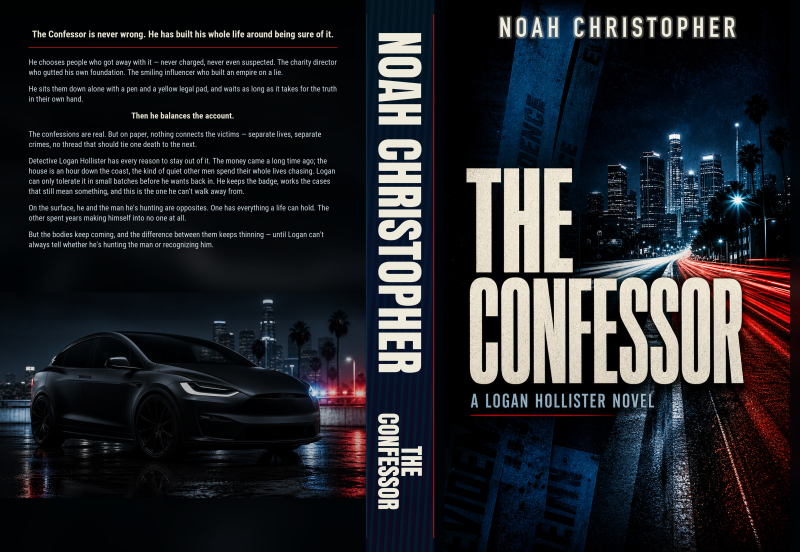
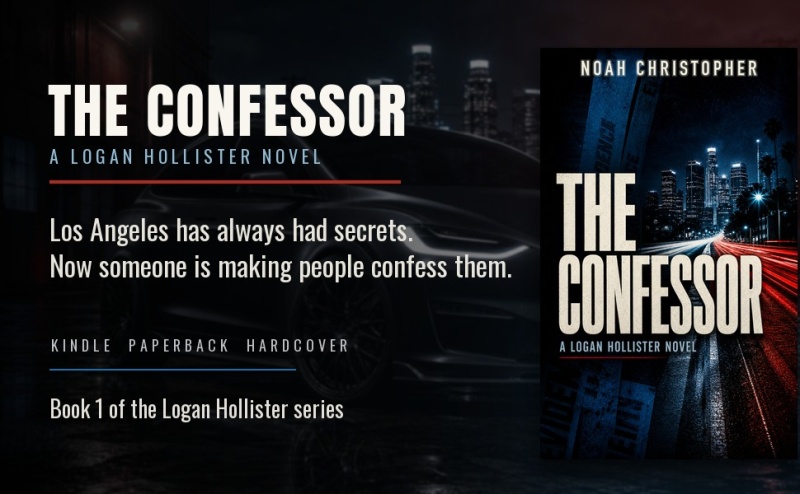 A killer is making Los Angeles confess.
The Confessor is never wrong. He has built his whole life around being sure of it.
He chooses people who got away with it — never charged, never even suspected. The charity director who gutted his own foundation. The smiling influencer who built an empire on a lie.
He sits them down alone with a pen and a yellow legal pad, and waits as long as it takes for the truth in their own hand.
Then he balances the account.
The confessions are real. But on paper, nothing connects the victims — separate lives, separate crimes, no thread that should tie one death to the next.
Detective Logan Hollister has every reason to stay out of it. The money came a long time ago; the house is an hour down the coast, the kind of quiet other men spend their whole lives chasing. Logan can only tolerate it in small batches before he wants back in. He keeps the badge, works the cases that still mean something, and this is the one he can’t walk away from.
On the surface, he and the man he’s hunting are opposites. One has everything a life can hold. The other spent years making himself into no one at all.
But the bodies keep coming, and the difference between them keeps thinning — until Logan can’t always tell whether he’s hunting the man or recognizing him.
*****beginning of extract*****
Nobody called him The Confessor yet. That would come later, after the police found the pattern and the media found the name. For now, he was just a man standing near a window with the blinds drawn, laying down the next card.
“October 14. Check number 4471. $62,000 to Pacific Ridge Consulting for program evaluation and strategic planning.” He paused. “Pacific Ridge Consulting has never evaluated a program or planned a strategy in its life. Pacific Ridge Consulting is a shell company owned by Coastal Venture Holdings, LLC.” Another pause. “Coastal Venture Holdings has one member. You.”
David Kirsch didn’t say anything. His hands were flat on the desk, pressing down, as if the surface might hold him in place. He’d been behind that desk for forty minutes now — still wearing the white button-down from tonight’s donor dinner, the collar dark with sweat, his blue blazer draped over his chair. His silver hair, always camera-ready, had been raked through more than once. The practiced face — the warm eyes, the fundraiser smile — was all gone. What was underneath it looked older and smaller. Not much to look at, once you peeled the label off.
The desk lamp threw a circle of warm light across the office and caught the edge of a framed photograph: Kirsch shaking hands with the mayor at last year’s Veterans’ Day gala. Beyond the light, shadow. Plaques on the walls. Commendations. The kind of awards they give out at luncheons where everybody claps and nobody checks the math. Half the frames were crooked. The building was empty, the HVAC off, and the silence had a weight to it — the particular quiet of a place built for daytime noise that now had none.
“November 9. Another check. $41,000. This one to Meridian Group Advisors — community impact assessment.” The Confessor watched Kirsch’s face. “Meridian Group Advisors has never assessed anything. Same ownership chain. Same destination. You used different company names because you thought it would look less obvious than repeat payments to the same vendor.” He let that sit. “Your controller processes sixty invoices a month at a foundation that practically runs itself. She doesn’t check. She’s never had a reason to. You knew that when you hired her.”
Kirsch’s jaw tightened, but his eyes stayed on the desk.
The Confessor had been going through the file for twenty minutes, and the numbers filled the room like something physical. Specific dates. Specific amounts. Account numbers that Kirsch had probably never heard spoken aloud by another human being. The foundation had taken in just under $4 million in the last three fiscal years — donations, corporate sponsors, two federal grants — and roughly $600,000 of it had been rerouted through fabricated invoices from companies that didn’t exist. All owned by a holding company that existed only to catch the money and move it along. From there: a brokerage account, a money market, and a two-bedroom condo in Palm Springs deeded to Coastal Venture Holdings but with David Kirsch’s golf clubs in the closet and his reading glasses on the nightstand.
He knew all of it. Every dollar. Every date. Every lie the numbers told.
Kirsch had come to the office tonight on his own, the way he always did after donor events. The Confessor had been watching him long enough to know the pattern. The dinners ran until nine, sometimes nine-thirty. Then Kirsch would drive here — not home, here — and let himself into the empty building to do the work he couldn’t do with staff around. Building the next round of fake invoices. Updating the books for companies that didn’t exist. Reconciling the money as it moved from the foundation through the shells and into his own pocket. The careful architecture of his second life. Careful was generous — a halfway competent auditor would have found it in a month.
Tonight The Confessor had been inside the building for three hours before Kirsch arrived, sitting in the dark of the back hallway, listening to the building settle. The building had no security cameras. A frugal foundation serving homeless veterans didn’t spend donor money on surveillance systems, and the irony of that was not lost on him.
Copyright © 2026 Noah Christopher. All rights reserved.
*****end of extract*****
 About Noah Christopher –
Noah Christopher is the author of The Confessor and The Rival, the first two novels in the Logan Hollister crime-thriller series.
His fiction blends Los Angeles police procedure, psychological suspense, impossible crimes, and morally complicated investigations.
The Confessor is book one in the Logan Hollister series and was released in July 2026. Click to buy The Confessor on Amazon UK and Amazon US.
Connect with Noah on Goodreads.



 by
by 

I'm Laura. I started Novel Kicks back in 2009 as I wanted a place to discuss books and writing - two loves of my life. As someone who has anxiety, these two things give me, and I am sure countless others, a much needed escape.
There is a monthly book club, writing exercises, prompts, reviews, author interviews, competitions and guest posts. I cover many genres and I hope there is something for everyone.
I grew up by the sea in Dorset and currently live in Poole with my husband, Chris and three cats. I love writing and have a BA (Hons) in Creative Writing from Falmouth University. I am writing my first book. If only I could stop pressing delete. Chris has threatened to stop it from working. Haha.
I have always loved creative writing since I was in first school and would very much like to meet my teacher, Miss Sayers, to say thank you for all the encouragement she gave me then.
When not writing, I love reading, cats, Disney, singing (I can't sing but this doesn't stop me,) and falling into a good TV show or film. If I could step into any fictional world, it would be amongst the characters in ABC's Once Upon a Time.
I love reading many genres and discovering new authors.
There is a monthly book club, writing exercises, prompts, reviews, author interviews, competitions and guest posts. I cover many genres and I hope there is something for everyone.
I grew up by the sea in Dorset and currently live in Poole with my husband, Chris and three cats. I love writing and have a BA (Hons) in Creative Writing from Falmouth University. I am writing my first book. If only I could stop pressing delete. Chris has threatened to stop it from working. Haha.
I have always loved creative writing since I was in first school and would very much like to meet my teacher, Miss Sayers, to say thank you for all the encouragement she gave me then.
When not writing, I love reading, cats, Disney, singing (I can't sing but this doesn't stop me,) and falling into a good TV show or film. If I could step into any fictional world, it would be amongst the characters in ABC's Once Upon a Time.
I love reading many genres and discovering new authors.
Book Club
Leave a Reply