NK Chats To…Rachael Brown
 A lovely big welcome to Rachael Brown today. Thank you for chatting to me. Your book is called Trace: who killed Maria James? Can you tell me a little about it and what inspired the novel?
The novel Trace; who killed Maria James? is the story behind my now two-and-a-half year investigation into a 1980 murder cold case. Maria James was stabbed to death at the back of her Melbourne bookshop, the very day she was set to confront her parish priest about the sexual abuse of her younger son, Adam. I learned a witness had seen this priest covered in blood on the day of her murder, and had given a statement to police, but nothing ever came of it. And then I learned exhibits and documents are missing.
So my deep-dive into Maria’s case was born out of two questions; Was the Catholic Church involved in her death? Has Victoria Police – either unwittingly or deliberately – been involved in its cover-up? I reported my investigation through the Australian Broadcasting Corporation’s first true-crime podcast, Trace.
While I was convinced my investigation would be betterfirstserved as a podcast series – because its interactivity could help solve the case – the constraints of this medium left much unsaid. So Scribe’s book details the anatomy of my meticulous investigation. Through the dead-ends and discoveries, the tears and the triumphs, I show readers the gritty toll on all those caught up in, and consumed by, this case. And remarkably, despite the darkness, or maybe because of it, this book also says a lot about hope, and humanity’s warmth.
What’s your writing process like? Which part was the easiest, hardest and challenging to write?
I found the process excruciating, both because of the dark material and structural challenges. I fortunately had already completed a lot of the research and transcripts (for the podcast), so much of the heavy lifting was done in 2016. But how to fashion this monster of an investigation into a compelling and clear narrative for readers? I decided to leapfrog between timelines – between detective Ron Iddles’ investigation in 1980, and mine in 2016/17 – planting seeds in each timeline that would be fleshed out in the other. This was the best way to help this 38-year-old case career along, and to highlight its strengths and flaws.
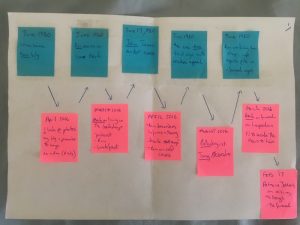 I was a post-it fiend. Blue for Ron’s investigation, and pink for mine. When I looked at my initial structure, the pink was too dense in the middle. This section was a weighty series of accounts of sexual abuse, which I worried might be too depressing for readers. But these accounts needed to be in the book, to bare witness to history. So I introduced green post-it notes, representing the podcast episodes and subsequent audience engagement. This was a great way to bring some light into the darkness, and also, to allow readers a glimpse into the mechanics of the podcast medium.
These sections are also testament to my skilled production team, including Jesse Cox, the podcast’s series producer, who passed away in December. Jesse wanted to change the world, and he did, in helping bring people’s creative dreams to life, so these green post-its allowed such personal tributes to be interwoven. Also, I’m told Traceis the first Australian podcast to be turned into a book, of which I’m also incredibly proud.
Continue reading


 by

Book Review: The Memory Collector by Fiona Harper


Heather Lucas lives her life through other people’s memories.
Heather doesn’t want to remember her childhood, not when her mother’s extreme hoarding cast her family life into disarray.
For Heather’s mother, every possession was intimately connected to a memory, so when Heather uncovers a secret about her past that could reveal why her mother never let anything go, she knows there’s only one place she’ll find answers – behind the locked door of her spare room, where the remains of her mother’s hoard lie hidden.
As Heather uncovers both objects and memories, will the truth set her free? Or will she discover she’s more like her mother than she ever thought possible?
Heather had a difficult childhood mainly down to her mother and the hoarding habit. The only normal memories she has are when she went on holiday with her Auntie. Now as an adult, she is still experiencing the ripple effect that started when she was little and it’s beginning to control her as much as it did her mother.
Heather is quite a complicated character. All she remembers from her childhood are the piles of things her mother had filled their house with; it all invisible to anyone beyond the front door.
She is dealing with a lot of emotions. She, like her mother has the makings of a hoarder. She has a room full of things including some that she has obtained through shoplifting.
She knows that she should clear out the spare room and her mother’s belongings before it gets worse, but whenever she tries, she finds reasons not to.
Any mental health condition is hard to put across in fiction and Fiona does this with much sensitivity. I felt so much empathy for Heather. I found her very relatable and what she goes through in the book broke my heart. I’ll hold my hand up…. I did cry.

 by
Book Extract: Keep Her Silent by Theresa Talbot
T he blog tour train rolls in today for Keep Her Silent, the new novel by Theresa Talbot.
Ooonagh O’Neil is back with another dark and chilling investigation… ͚Do that which is good and no evil shall touch you͛ That was the note the so-called Raphael killer left on each of his victims. Everyone in Glasgow – investigative journalist Oonagh O’Neil included – remember the murder of three women in Glasgow which sent a wave of terror through the city. They also remember that he is still at large…
When the police investigation into the Raphael killings reopens, Oonagh is given a tip off that leads her straight to the heart of a complex and deadly cover-up. When history starts to repeat itself, it seems the killer is closer than she thinks.
Could Oonagh be the next target…? Authentic and gritty, Keep Her Silent is a gripping and page-turning thriller that will leave you breathless.
Theresa and her publisher Aira have shared an extract with us today. Enjoy.
****** start of extract*****
Oonagh drove north along the coast road, the same one her dad took her on as a kid.
Maidens beach stretched out to her left, white horses crashing against the shore; the silhouette of Culzean Castle perched on the hilltop contrasted against the early evening sunlight. She turned left onto a single-track road and eased her car through the woodland area until she got to the clearing. It didn’t matter how many times she’d visited, the sight of the castle always made her catch her breath. Nestled in the crook of the Ayrshire coastline, the gardens enjoyed an almost tropical micro-climate from the Gulf Stream.
She’d arranged to meet Maura Rowinson at seven. The estate was part of a National Trust property, but Maura had assured Oonagh she could access the castle after closing as she had rented an apartment.
Oonagh followed the road round to the right of the main castle to the luxury holiday apartments and parked in the courtyard. There was only one other car there, an MG, British racing green. Oonagh parked alongside and switched off the engine.
She caught a brief glimpse of someone at the window, but her arrival would have been obvious for several minutes given the length of the drive. As she got out of the car a slight flutter of nerves played on her chest, but she’d left Gerry, her production assistant, in a pub less than three miles away with a mobile phone, access to a landline and instructions to call the cops if she didn’t check in within the hour.
A middle-aged woman with blonde hair tied back in a ponytail came out to greet her. She looked familiar, but Oonagh couldn’t place her. ‘Oonagh.’ She stretched out her hand; Oonagh smiled.
‘Maura? Good to meet you. In person,’ she added and allowed herself to be led inside and through to the main room, which looked out onto the Firth of Clyde.
There wasn’t much that still impressed Oonagh, but this view did. She stood at the window.
‘Wow, this is magnificent.’
‘Not bad, is it?’

 by
Cover Reveal: The Foyles Bookshop Girls at War by Elaine Roberts
 The Foyles Bookshop Girls at War by Elaine Roberts is the second book in the Foyles Girls series.
I am excited to be part of the cover reveal for The Foyles Bookshop Girls at War. Here is a bit about it…
Swapping books for the bomb factory takes courage – and could be dangerous.
Working at the Foyles bookshop was Molly Cooper’s dream job. But with the country at war she’s determined to do her bit. So Molly gathers her courage, and sets off for the East End and her first day working at Silvertown munitions factory…
It’s hard manual labour, and Molly must face the trials and tribulations of being the ‘new girl’ at the munitions factory, as well as the relentless physical work. The happy-ever-afters Molly read about in the pages of her beloved books have been lost to the war. And yet the munitions girls unite through their sense of duty and friendships that blossom in the most unlikely of settings…
So, here is the cover. Ready?

 by
NK Chats To: Laura Briggs
 I am so happy to be welcoming Laura Briggs to the blog today. Hello. Thank you so much for joining me. Your book is called A Wedding in Cornwall. Can you tell me about it and what inspired it?
Hi Laura! Thanks so much for letting me share with your readers about my series of books. This all begin in 2016 when I penned the romance novella A Wedding in Cornwall about an American event planner who finds a new life—and true love—when she moves across the Pond to work at a beautiful Cornish manor house. Readers were so enthusiastic for my heroine Julianne’s adventures in Cornwall that the series ended up continuing for a total of twelve books! Now, as the series celebrates its second year anniversary, readers can buy novellas 7-12 in one special book bundle.
What are the challenges and best bits about being a writer?
Hmm…the challenges for me would be getting the words I type to match the idea in my mind. When I first think of a plot for a book it’s kind of like seeing a movie trailer—all the highlights are easy to picture in that moment. But then, when I get into the finer details and the actual writing it can be hard to find the idea’s full potential sometimes. So that’s definitely a big challenge in my writing. As for the best bits? Connecting with book bloggers and fellow authors and hearing that readers enjoy my work!
What’s your step by step process when planning a novel?
I almost always make an outline. It can be detailed with scene by scene descriptions or it can be as simple as just a list of events that need to happen in the story. But I hardly ever just wing it—I need to have at least a rough idea where I’m going!
What elements do you feel need to be there to make a good novel?
Engaging characters are pretty important to me as a reader. Even if they aren’t the most likeable or sympathetic type, I do need to find them interesting!
What’s your approach to editing?
I usually try to put aside the finished manuscript for a few days. Then, I try to look at it from a reader’s point of view. It’s not easy to see your own work objectively, of course, but it does help to find initial problems with the story.

 by
Book Club