Matthew Redford Talks About His Approach To Writing Short Stories
 I’m pleased to welcome Matthew Redford to Novel Kicks today. His festive food related crime investigation short story is due for release by Clink Street Publishing in paperback and electronically own 6th December.
Tenacious carrot, detective inspector Willie Wortell is back to reveal the deviously delicious mind behind the crime of the festive season in this hugely entertaining, and utterly unconventional, short story.
When Mitchell the Mince Spy is horrifically murdered by being over baked in a fan oven, it falls to the Food Related Crime team to investigate this heinous act. Why was Mitchell killed? Who is the mysterious man with a long white beard and why does he carry a syringe? Why is it that the death of a mince spy smells so good?
Detective Inspector Willie Wortel, the best food sapiens police officer, once again leads his team into a series of crazy escapades. Supported by his able homo sapiens sergeant Dorothy Knox and his less able fruit officers Oranges and Lemons, they encounter
Snow White and the seven dwarf cabbages as well as having a run in with the food sapiens secret service, MI GasMark5.
With a thigh slap here, and a thigh slap there, the team know Christmas is coming as the upper classes are acting strangely – why else would there be lords a leaping, ladies dancing and maids a milking?
And if that wasn’t enough, the Government Minister for the Department of Fisheries, Agriculture and Rural Trade (DAFaRT) has only gone and given the turkeys a vote on whether they are for or against Christmas.
Let the madness begin!
Matthew has joined me today to talk about his approach to writing short stories…
When I was asked to draft an article on my approach to writing a short story, I thought this would be a doddle. I mean, after all, I have written a short story – Who Killed the Mince Spy? – which is coming out in December 2016. Well, how wrong I was.
How do I approach writing a short story? Well, that is a really interesting question and it is not one which I have thought about before and I don’t recall having been asked the question before either. And when I sat down with the iPad in front of me ready to write my answer, I realised I didn’t know where to start!
So let’s go back to basics. How do I come up with my ideas? Well, I write about food sapiens, those walking, talking food items which live and work along us all. There are some famous food sapiens such as the musicians Polenta Faith and Fizzy Pop Gillespie. And with that in mind, I think about all of the different food items and try to come up with story titles which I think are either topical, interesting or, hopefully, both.
Let’s take Christmas. Mince pies are a staple Christmas food item. Simply switch the word, pie to spy and you’ve a living, breathing food sapiens creature which you can take on a creative journey. Or in my case, straight into a fan oven where the poor little blighter is horrifically murdered.


 by

Phillipa Ashley Shares Her Favourite Christmas Scenes
 I am delighted to be welcoming Phillipa Ashley back to Novel Kicks today. Phillipa’s latest book is very much festive themed and is called Christmas at The Cornish Café. It’s the second novel in the Cornish Café series and was released by Maze.
Christmas will be slightly less turbulent than summer, won’t it? Demi certainly hopes so.
She and Cal are keeping their fledgling relationship under wraps for now. But then Kit Bannen, a hunky, blond – and somewhat mysterious – writer arrives at Kilhallon Resort, and not everyone is charmed. Cal is sure that Kit is hiding something. But is he the only one guarding a secret?
Demi is busy baking festive treats for the newly opened Demelza’s cafe, but when Cal’s ex Isla arrives to shoot scenes 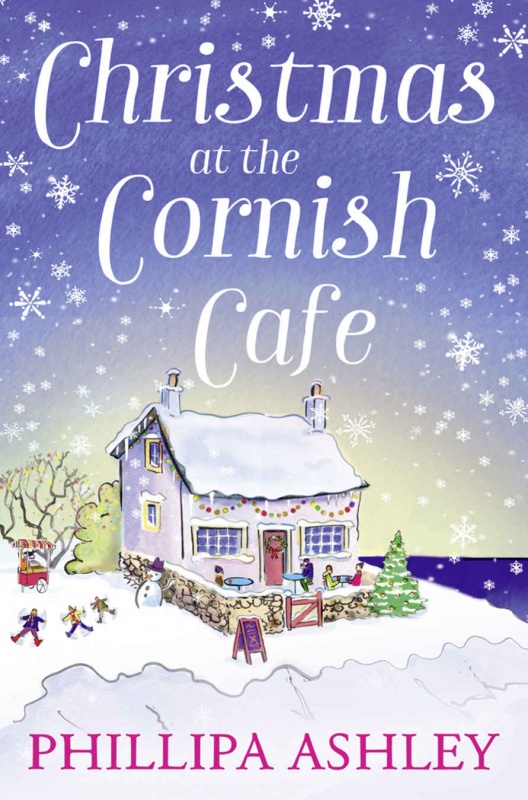 for her new drama, Demi can’t help but worry that things aren’t quite over between them. Kit flirts with both women, fuelling Cal’s suspicions that Kit has hidden motives for staying on at Kilhallon. Then Cal has to go to London, leaving Demi and Kit to decorate the cafe for Christmas . . . all by themselves.
A storm is brewing in more ways than one. As surprises unfold and truths are uncovered, can Demi and Cal finally open up to each other about their feelings?
As it is nearly Christmas, Phillipa has shared some of her favourite Christmas scenes. Over to you, Phillipa…
Believe it or not, after 16 books and over a decade of writing, Christmas at the Cornish Café is my first ‘Christmas’ novel. Even though my debut novel, Decent Exposure, was made into the Lifetime movie, 12 Men of Christmas, it was never written as a Christmas book.
It was important to me that Christmas at the Cornish Café truly reflected the challenges my characters and the community might face in a small Cornish fishing village – and how people might pull together to help each other against all the odds. I hope you enjoy reading it. Now, here are some of my favourite scenes from seasonal books, films and TV.
The Carrs’ Christmas Box – What Katy Did at School

 by
Blog Tour: Amanda Brooke Talks About Her New Novel, The Affair
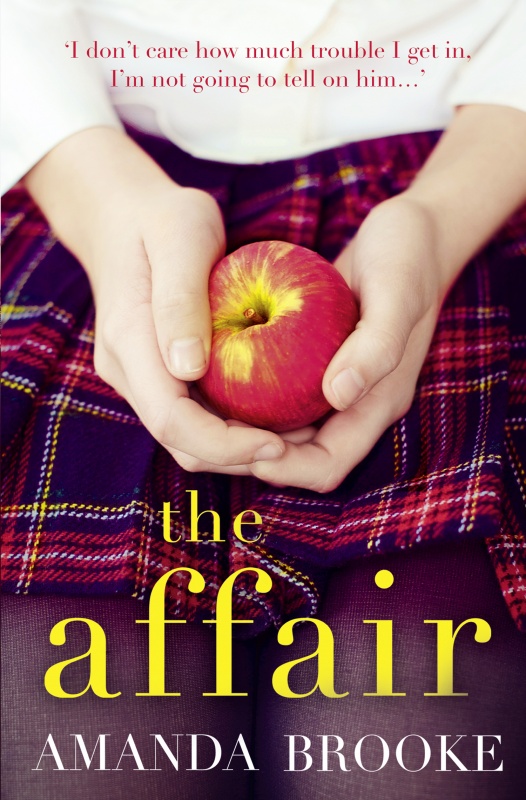
 Today, I am welcoming Amanda Brooke and the blog tour for her latest novel, The Affair which was released by Harper on 10th November in electronic form with the paperback release due for 12th January.
A shocking story about a fifteen-year-old girl and the man who took advantage of her
“You might as well know from the start, I’m not going to tell on him and I don’t care how much trouble I get in. It’s not like it could get any worse than it already is.
I can’t. Don’t ask me why, I just can’t.”
When Nina finds out that her fifteen-year-old daughter, Scarlett, is pregnant, her world falls apart. Because Scarlet won’t tell anyone who the father is. And Nina is scared that the answer will destroy everything.
As the suspects mount – from Scarlett’s teacher to Nina’s new husband of less than a year – Nina searches for the truth: no matter what the cost.
Hello Amanda. Thank you so much for joining me on Novel Kicks today. Your new book is called The Affair. Can you tell me a little about it and how the idea originated?
Thank you for inviting me on to Novel Kicks, it’s lovely to be here again! The Affair begins with the news that fifteen year old Scarlett is pregnant to a married man. She won’t say who it is, but the two likely candidates are her stepfather and her teacher. The story is told from the point of view of the men’s wives; Scarlett’s mum, Nina and teacher’s wife, Vikki. I also introduce Scarlett’s voice as a narrator, and she describes the early days of her relationship and how she feels when the accusations start to fly. I’m not sure how much I can say about how the idea originated without giving too much away. I had a scene in my head of a schoolgirl watching from the periphery while other people’s lives fell apart. She wasn’t meant to be the focal point of the book, other than perhaps a final reveal, but after long chats with my editor, the premise of the story morphed into something quite different, and it was both a pleasure and a challenge to write.
Can you describe what your typical writing day is like? Any rituals like needing tea or writing in silence?
You’ve asked that question at a very exciting time, because I gave up work this month to write full-time. I’ve spent thirty-one years in local government and for the last five I’ve been juggling two careers, fitting in my writing around the day job. I can tell you what I plan to do, which is to concentrate on my writing in the morning, which allows me to spend the rest of the day thinking about what I’ve written and where I need to take the story next. I’m conscious that working from home will be quite sedentary, so I’ve had my treadmill adapted, with a small desk that fits on top of the handlebars. My first hour of writing will be spent walking and typing so I can wake up my body and brain at the same time. As I’ve said, that’s only the plan so you might need to ask me again in a year’s time to see if I’ve kept to it.
 How do you approach writing your novels? Are you much of a planner and need to know your characters well and plot inside out? Do you edit as you go?
When I have an idea for a story, I like to mull it over in my head for a while before I commit to paper. The starting point is a two page synopsis, which doesn’t necessarily cover sub-plots or minor characters but should be enough to capture the essence of the story. My next task is to cut up the synopsis into about twelve sections, which in theory will be the chapters and, if nothing else, it gives me some reassurance that I have enough of a story for a full length manuscript. When I’m ready to start writing, I tend to have a very clear idea of the opening and final scenes, but the rest of the book remains relatively fluid. I enjoy getting to know my characters and they’re the ones who fuel my imagination as I go along, creating situations and conflict I never could have imagined from the start. In terms of editing, I see that first draft almost as a test run, it’s only during the subsequent rewrites that I really get to know the story.

 by
Playing FTSE Author, Penelope Jacobs Talks About Balancing Work and Family
 Playing FTSE by Penelope Jacobs was released by Ipso Books in digital format yesterday (24th November)
When Melanie Collins joins an investment bank as a young graduate, she quickly discovers that femininity is an invaluable asset. But it must not be abused.
She witnesses other women falling victim to office affairs and is determined to be taken seriously. In an industry where abilities are rewarded handsomely, she rises rapidly through the ranks. But her increased profile attracts the attention of a senior colleague and she is ill-equipped to handle his advances.
Balancing a demanding job with a confusing personal life proves difficult and soon their relationship threatens to jeopardise her career. As events move beyond control, her glamorous world becomes tainted by betrayal and bitterness.
One of the themes in the book explores the issues the main character Melanie has with balancing her personal life with her professional one.
The author of Playing FTSE, Penelope Jacobs is joining me today to talk about her thoughts on balancing work and family and why we can’t have it all. Over to you, Penelope.
Achieving a work-life balance is not always possible and certainly requires sacrifices.
Marriage and, more specifically, babies seem to be the tipping point, when life can sometimes spiral out of control. As noted by the National Health Interview Survey, 30-44 year olds report the largest “work-lifestyle imbalance”. During this period, many high-powered career women have simply piled far too much onto their plates. On top of a highly pressurised job, they suddenly have to cope with the demands of small children, a husband and running a household. Not to mention find a little time for themselves.
The Mental Health Foundation states that “the pressure of an increasingly demanding work culture in the UK is perhaps the biggest and most pressing challenge to the mental health of the general population.” In addition, “many more women report unhappiness than men (42% of women compared with 29% of men), which is probably a consequence of competing life roles and more pressure to ‘juggle’.”
Why are we accepting this burden from society? In my opinion, it is not possible to “have it all” and at the same time seamlessly achieve a wonderful work-life balance.
Every woman I know has made some type of sacrifice which, by definition, means they do not have it all. At one extreme, some high-powered women consciously choose not to have children and, at the other, an enormous number leave their brilliant careers permanently to raise a family. In both cases, the costs are high.

 by
Novel Kicks Fiction Friday: The Call
 Fiction Friday is our weekly writing prompt. The aim is to write for a minimum of five minutes and then keep going for as long as you can. Once you’ve finished, don’t edit, just post in the comments box below.
Today’s prompt: The Call.
You are trying to get to sleep. Your phone rings. It’s from an unknown number but because you’re half asleep, you answer it when you normally wouldn’t.
You answer and say ‘hello.’
There is a pause.
‘We need you,’ is the response before the caller hangs up and you are left with a dial tone.

 by
Book Club