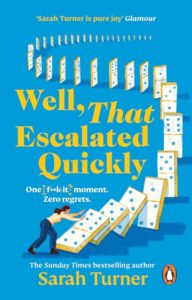
Book Extract: The Last Thing She Told Me by Linda Green
 Hello and welcome to Linda Green. Her novel, The Last Thing She Told Me has been released today.
Even the deepest buried secrets can find their way to the surface…
Moments before Nicola’s grandmother dies, she whispers in her ear that there are babies at the bottom of the garden.
Nicola’s mother claims she was talking nonsense, however when a bone is found in the garden, it’s clear that something sinister has taken place and there’s a family secret to be unearthed that has the power to tear the family apart.
This is an incredibly emotional and page-turning novel set in Yorkshire, bridging the gap between domestic noir and up-lit that deals with generations of families and the secrets they keep.
To celebrate publication day for The Last Thing She Told Me, Linda and Quercus have shared a chapter. Enjoy.
(content warning. Potentially distressing for some readers.)
***** beginning of extract*****
For all the women and girls who have been made to feel shame
It was the shame, you see. The shame I brought on my family. Sometimes it is easier not to believe than to accept something so awful could have happened. That is why people bury things far beneath the surface. Deep down, out of sight and out of mind. Though not out of my mind. I carry the shame with me always. The shame and the guilt. They do not go away. If anything, they weigh heavier on me now than they did back then. Dragging me down, clawing at my insides. And when people say that what’s buried in the past should stay there, they mean they don’t want to have to deal with it. They’re scared of the power of secrets to destroy lives. But keeping secrets can destroy you from the inside. Believe me, I know. And even the best-kept secrets have a habit of forcing their way to the surface.
1
The house appeared to know that its owner was about to die, shrouded, as it was, in early- morning mist, the downstairs curtains closed in respect, the gate squeaking mournfully as I opened it.
If there was such a thing as a nice house in which to end your days, this certainly wasn’t it. It was cold, dark and draughty, perched high on the edge of the village, as if it didn’t really want to be part of it but was too polite to say so. Behind it, the fields ‒ criss-crossed by dry-stone walls ‒ stretched out into the distance. Beyond them, the unrelenting bleakness of the moors.
I shivered as I hurried up the path and let myself in.
‘Grandma, it’s me.’ The first thing I thought when I didn’t hear a response was that maybe I was too late. She’d been weak, drifting in and out of sleep when I’d left the previous night. Perhaps she hadn’t made it through till morning.
But when I entered the front room – in which she’d lived, eaten and slept for the past year – she turned her face to give me the faintest of smiles.
‘Morning,’ I said. ‘Did you manage to get some sleep?’
She nodded.
‘It’s not too late to change your mind, you know. We could get you to hospital, or the hospice
said we could call them at any time.’
She shook her head. She’d remained adamant she would leave the house only in a coffin. She’d also refused medication to relieve the pain. It was as if she thought she somehow had a duty to suffer.
‘Well, at least let me stay over tonight. I hate the thought of you being on your own.’
‘I won’t be here tonight.’ Her words were faint and difficult to understand. She’d taken her teeth out several weeks previously and refused to put them back in since.
‘Come on. You’ve been saying that for weeks.’
‘I’m tired. It’s time to go now.’
There was something about the look in her eye as she said it that told me she meant it. I sat
down on the end of her bed and took her hand. Her skin was paper-thin, revealing the bones and blue veins beneath it. She’d once said she liked me coming to visit because I was the only one who let her talk about death without getting upset or pretending it wasn’t going to happen.
‘Is there anything I can get to make you more comfortable?’
She shook her head again. We sat there for a while saying nothing, listening to the ticking of the clock and her shallow breaths. I tried to imagine what it must be like knowing you are about to die. I would want my family around me, I knew that.
‘Do you want me to give Mum a call?’ I asked. She managed to raise her eyebrows at me. It was as near as I’d get to a telling off at this point. She had always been very accepting of their distant relationship. It was me who struggled with it.
‘I could ask James to bring the girls over.’
She shook her head again and whispered, ‘I don’t want to upset them. They’re good girls. Anyway, I’ve got them with me.’


 by

NK Chats To: Roxie Cooper
 Hi Roxie, it’s a pleasure to welcome you to Novel Kicks today. Your book is called The Day We Met (released today. Yay.) What’s it about and what inspired it?
Hi, thanks for having me! The Day We Met is novel about meeting the right person at the wrong time and it asks the question; what happens if you meet your soulmate when you’re just about to marry someone else? Stephanie and Jamie are both happy with other people when they meet each other, but they can’t ignore the strong connection and chemistry between them. Unwilling to slip into a typical affair, they decide to meet on the same weekend every year, as friends. The novel spans a ten-year period and we see how the relationship affects them, their marriages, and careers.
I wanted to write a different kind of love story, one which reflected modern times and attitudes. I’ve always been intrigued by people’s varying opinions on physical and emotional infidelity; is one worse than the other? How do emotional affairs start and just how damaging are they? It’s a huge grey area which sparks monumental discussion and, as a former lawyer, they’re something I love exploring. But it was when I heard Paloma Faith’s Only Love Can Hurt Like This one day that the novel became fully alive in my mind. I knew this had to be an epic love story about two people who couldn’t be together but couldn’t be apart either. That was also the moment I decided that the novel would have to be set to music.
What’s your typical writing day like, where do you like to write, do you prefer silence and is there something you need to do/have before you begin writing (coffee for example?)
Sorry to be really awkward, but I have different routines for different stages of the writing process! When I’m writing the actual book, I adopt a fairly strict routine but it’s carried out in a nice environment. So, I’ll drop both my kids at school then dash to a coffee shop on my local high street. Both of my previous books were written there. I don’t stop until I’ve written at least 1000 words and I need my iPod on with people walking around. I like being in the middle of the hustle of it all and I stay there until it’s time to pick the kids up again. Once I move onto edits, however, everything changes. I lock myself in the house and have the TV on at a barely audible volume – I need a tiny amount of white noise. I have to drink coffee in the morning, switching to tea in the afternoon. I turn into a complete recluse in this period, I don’t see my friends for months. It’s very extreme but it works for me!
Which author or book has most influenced you?
I’ve read so many books by authors I’ve admired, but in terms of ones who have influenced my career, I’d have to say Adele Parks. I read her novel, Playing Away, in my 20s and thought it was such a standout, brave debut. I researched the author and discovered that she, too, was from Teesside – I couldn’t believe it! That was the moment I thought ‘Wow – if someone from Boro can become an author, there’s hope for any of us.’ It was around this time I started to have ideas about a novel of my own but hadn’t started writing it yet (that book turned out to be my debut The Law of Attraction), but each time I read another of Adele’s books, it cemented my ambition.
What made you first realise that you wanted to be a writer?
I’ve always loved reading, but I was never one of those kids who wanted to write – or an adult, for that matter. The idea came to me after I became disillusioned with my former career as a criminal barrister. I come from a very working class background and would tell all my friends about the outrageously silly traditions and rituals I had to participate in at the Bar. Coming from Teesside, I’d tell the stories through a very unimpressed ‘Boro lens’ and they’d all say to me “You need to write a book about this!” I also got so fed up with people saying to me “You really don’t look like a barrister!” so in 2009 I started writing my debut novel The Law of Attraction – a book about a blonde, working class, intelligent, sassy girl from Teesside who is propelled into the posh world of barristers. I hadn’t even considered writing a book before I was 31 years old.
What’s your route to publication?
I did a lot of research before I submitted my debut novel to agents. My first novel was the only book I’d ever written and took me about 16 months to write. When I felt it was polished enough to allow an agent to read, I sent it off to three I had my eye on (which was terrifying!). Sarah Hornsley from The Bent Agency requested a full manuscript within 24 hours. I was a nervous wreck! Sarah called me and we had the most amazing chat. I knew then that she was the right agent for me. She made suggestions on how I could improve the manuscript (which I did) and six weeks later she offered representation. The next step was submitting the novel to publishers. I had offers from two publishing houses and The Law of Attraction was eventually published in June 2017 with the Harper Collins imprint, HQ Digital.

 by
Book Review: The Newcomer by Fern Britton
 I can’t hold in the excitement I feel to be welcoming Fern Britton to Novel Kicks today and the blog tour for her new novel, The Newcomer which has been released today. Happy publication day, Fern.
She arrived in the village on the spring tide and hoped to be at the heart of it, knowing its secrets and weathering its storms.
It was to be a new beginning…
It’s springtime in the Cornish village of Pendruggan and as the community comes together to say a fond farewell to parish vicar, Simon, and his wife, Penny, a newcomer causes quite a stir…
Reverand Angela Whitehorn came to Cornwall to make a difference. With her husband, Robert, by her side, she sets about making changes – but it seems not everyone is happy for her to shake things up in the small parish, and soon Angela starts to receive anonymous poison pen letters.
 Angela has always been one to fight back, and she has already brought a fresh wind into the village, supporting her female parishioners through good times and bad. But as the letters get increasingly more personal, Angela learns that the secrets are closer to home.
With faith and friends by your side, even the most unlikely of new beginnings is possible.
I have become a fan of Fern’s novels and so I was looking forward to reading The Newcomer.
I wasn’t disappointed.
Throughout this book, I was glued. I was sneaking a page or a chapter in whenever I could.
Angela was a believable and relatable character who is trying to make a difference. The supporting characters are also great.
Whilst reading, I felt like I was by the water in this lovely Cornwall village and that is always good for the soul. The plot had many twists and turns and never quite went in the direction I was expecting it to.

 by
Novel Kicks Writing Room: Different Orders
 This week, I wanted to focus on how moving plot events around, you can change/improve the story.
Write down the following four plot points, each on a separate piece of paper. Put them into a jar or a hat and take them back out one at a time, lining them up.
This is the new order for the story. Write your own version using this order.
Cinderella is told she can’t go to the ball.
Cinderella meets the Prince.
Cinderella loses her shoe.
Cinderella gets married.
How does the story change once you’ve moved it around?

 by
My February Favourites
 Goodbye February and hello March.
Today, I wanted to share my February favourites. I love these kinds of posts. One, I am really nosy and secondly, I have discovered so many products through these kinds of posts.
My favourites this month include TV shows, a podcast, and a new diary.
What have you been loving this month? Let me know in the comments.
I am a little obsessed with diaries. I am always on the lookout for the perfect one and have already changed diaries twice this year.
Over the past couple of weeks, I have been using a Hobonichi Weeks mega edition for 2019.
Like the Moleskine diaries, this has space with a weekly view. On the opposing page, there is room for notes.
At the back, there are over two hundred blank pages. If you’re looking for something to begin a bullet journal, this would be a good book to use. Or, like me, if you want to combine a notebook and diary, this is perfect.
I have mostly been planning digitally when it comes to the blog and the daily tasks, events and appointments. I have an iPad Pro and apple pencil. I have been holding off planning my novel digitally. I love pen and pencil and I think I felt as though I wouldn’t be a proper writer if I didn’t use paper. I know, I am being ridiculous.
What I love about the digital notebook I’ve been using for novel notes is that I can have a book for the novel, another for general notes, one for Novel Kicks and it is all in the same place. The pencil allows me to handwrite on the tablet, so it means I have less to carry around. Less confusing and easier on the shoulder as my bag isn’t as heavy. I have found it’s the best of both worlds. This, along with the Hobonichi weeks is doing me just fine.

 by
Book Club