Book Extract: The Extremist by Nadia Dalbuono
 The Extremist by Nadia Dalbuono is the fourth novel in the Leone Scamarcio series and I am pleased to be part of the blog tour today.
When a group of terrorists carry out a series of attacks in Rome, Detective Leone Scamarcio gets an unexpected call ― the men, who appear to be Islamic extremists, say they will only negotiate with him.
Scamarcio is given just twenty-four hours to meet the terrorists’ demands, or their hostages will be killed, along with thousands more.
The only catch? He cannot involve the police or the security services.
Racing against both the clock and his own colleagues, Scamarcio must uncover the truth behind the attacks before it’s too late. But, as he begins to investigate, he finds that every question turns up five more … As usual for this son-of-a-Mafioso policeman, nothing is as it seems.
Nadia has kindly shared an extract from her new novel with us today. Here is a part of the first chapter. I hope you enjoy.
The boy enters the McDonald’s. It is a relief to escape the cloying heat and its undercurrents of summer drains and tourist sweat. He wipes his forehead with the back of his hand, shrugs the bag off his shoulder, and looks around. He counts fifteen people queuing at the tills, most of them teenagers — clutching backpacks and squinting at iPhones. To his left, nearly all the tables are full — more students and a cluster of Japanese tourists. He takes in a few young families, kids no more than four or five. Panic is stirring in his gut, turning it liquid. He tastes acid on his tongue and wants to retch. He swallows, tries to take a breath.
To his right, the place is a little emptier — only four of the tables are occupied. His eyes settle on a group of schoolgirls in uniform, their checked skirts too short, their laughter too loud. Behind the girls is a dishevelled old man, probably a vagrant. He’s tearing the wrapper from a meagre burger, his eyes darting furtively as if he’s afraid someone will swipe it.
The boy feels sweat running down the back of his neck; he notices a tremor in his leg. He turns and sees his three companions standing in the doorway. Just the sight of them makes his heart hammer. He swallows again: his throat dry, his tongue bulky. He wishes he’d taken something like they’d suggested.


 by

Cover and Chapter Reveal: The Things We Need To Say by Rachel Burton
 It’s a very good day here at Novel Kicks. I was very happy when I was asked to take part in an exciting cover and first chapter reveal for The Things We Need To Say which is the upcoming release from Rachel Burton.
Sometimes the things we never say are the most important.
Fran loves Will with all her heart. They had a whirlwind romance, a perfect marriage and a wonderful life. Until everything changed. Now Fran needs to find her way again and teaching a yoga retreat in Spain offers her just that. Leaving behind a broken marriage she has some very important decisions to make.
Will needs his wife, he needs her to open up to him if they’re to ever return to the ways things once were. But he may have damaged any possibility he had of mending their relationship and now Fran is in Spain and Will is alone.
As both Fran and Will begin to let go of a life that could have been, fate may just find a way of bringing them back together.
OK, first, the cover. Drumroll…….

 by
Book Review and Extract – Close To Home by Cara Hunter

 Close To Home is the new novel from Cara Hunter and her blog tour is stopping by Novel Kicks today.
HOW CAN A CHILD GO MISSING WITHOUT A TRACE?
Last night, eight-year-old Daisy Mason disappeared from a family party. No one in the quiet suburban street saw anything – or at least that’s what they’re saying.
DI Adam Fawley is trying to keep an open mind. But he knows the nine times out of ten, it’s someone the victim knew.
That means someone is lying…
And that Daisy’s time is running out.
I have reviewed the book below but first, Cara and Penguin have shared an extract from Close to Home. Enjoy!
Phone interview with David Connor
20 July 2016, 6.45 p.m.
On the call, Acting DS G. Quinn and (listening)
DC C. Gislingham
GQ: Thank you for phoning, Mr Connor, and our apologies for disturbing your holiday.
DC: No problem – I’m sorry I wasn’t able to get back to you before. It’s such a shock, hearing what’s happened. My wife saw it on BBC World News in the hotel room.
GQ: Were you aware that the flower costume your daughter wore at the party was the one Daisy Mason should have been wearing?
DC: I wasn’t but it seems my wife was. Millie had some of her friends round after school the afternoon before –
GQ: So Monday afternoon?
DC: Er, was it Monday? Sorry – I’m a bit jet- lagged. You’re right, it must have been Monday. Anyway, Julia says they all brought their fancy dresses over and tried them on. And then tried each other’s on – you know what girls that age are like. It seems that at some point in the ensuing chaos Daisy decided that she preferred Millie’s costume, and Millie said they could swap.
GQ: Do you know if Daisy’s mother was aware the costumes had been switched?
DC: I have no idea. Let me ask Julia . . . [muffled noises] Julia says Daisy assured her that her mother wouldn’t mind. But obviously she doesn’t know if Daisy actually spoke to her about it.
GQ: We found the tights in a bin on the estate but the blood on them doesn’t match Daisy’s
DC: Ah yes, sorry about that. Millie fell over and as it was getting late and she was a bit whiny we decided to call it a day. The tights were a write-off so we just ditched them. Apologies if it caused you a problem.
GQ: What costume was your daughter originally going to wear, Mr Connor?
DC: A mermaid, so my wife tells me. I never saw it but apparently it had a flesh- Coloured top thing and a tail with shiny blue and green scales.
GQ: And any sort of headdress or mask?

 by
Book Extract and Review: That Girl by Kate Kerrigan
 Hello and welcome to Kate Kerrigan and the blog tour for her new novel, That Girl which was released by Head of Zeus on eBook on 1st January 2018.
You can escape a place. But you can’t escape yourself.
Hanna flees the scene of a terrible crime in her native Sligo. If she can just vanish, re-invent herself under a new name, perhaps the police won’t catch up with her. London seems the perfect place to disappear.
Lara has always loved Matthew and imagined happy married life in Dublin. Then comes the bombshell – Matthew says he wants to join the priesthood. Humiliated and broken-hearted, Lara heads to the most godless place she can find, King’s Road, Chelsea.
Matthew’s twin sister, Noreen, could not be more different from her brother. She does love fiance John, but she also craves sex, parties and fun. Swinging London has it all, but without John, Noreen is about to get way out of her depth.
All three girls find themselves working for Bobby Chevron – one of London’s most feared gangland bosses – and it’s not long before their new lives start to unravel.
I’ve reviewed the book below but first, Kate and her publishers have kindly shared an extract from That Girl. I hope you enjoy!
A year passed and Hanna turned from thirteen to fourteen. She became more independent and began to speak her own mind. She was glad that her mother had Dorian to focus on, instead of just her, and she came to trust him. While she knew her stepfather would never be a replacement for the father she so deeply loved, Hanna grew fond of him as time went by. Dorian Black loved her mother, there was no doubt about that, and he made her happy. Hanna also understood that he had been kind and generous regarding her as well. As the nuns pointed out to her in school, ‘It’s not every man would take on another man’s child.’
Dorian never patronised her, or talked to her like she was a poor child, as so many people did since her father died. He treated her as an equal, and she liked that. Dorian allowed her to call him by his first name. When she first did it, her mother tutted, insisting she call him father to show him proper respect. But Dorian had been on Hanna’s side. ‘Don’t push the child, Margaret,’ he said. ‘I am not her natural father. There is no reason she should look on me as such. Hanna is old enough to make up her own mind about the role I play in her life.’
Margaret became worried that Hanna was moving away from her, that she was losing her. Dorian was as wise and reassuring as ever. ‘Hanna is becoming a fine young woman,’ he told her. ‘She is not your little girl any more, Margaret. Sooner or later you’ll have to accept that she’s an adult.’
Margaret pursed her lips and remained silent on the subject. Hanna could tell she didn’t like it but it was important that her mother understood she wasn’t a child any more. Dorian was right, she was becoming a ‘young woman’ and her mother just had to get used to it. United in that understanding, a bond grew between stepfather and stepdaughter that felt to Hanna like friendship, or maybe even love.
Then, as Dorian and Margaret Black were coming up to their second wedding anniversary, Margaret came down with a nasty bout of flu. At first it seemed not to be serious but then her symptoms worsened with lethargy and headaches. Weeks passed and Margaret remained bedridden. With little appetite and no energy to lift herself from the bed, it appeared that there was something more serious underlying the illness. Hanna was worried and asked Dorian if there was anything more they could do. He reassured her that her mother’s recovery was just around the corner.
‘It’s only a virus,’ he promised.

 by
From Non-Fiction to Thrillers, Review and Extract: White Bodies by Jane Robins
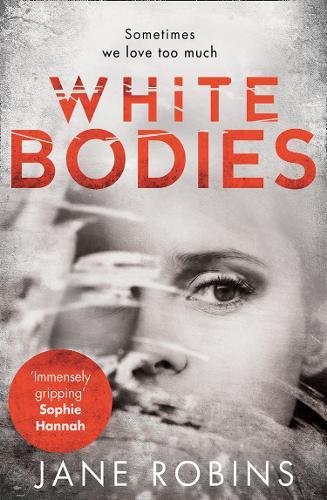 White Bodies is the new novel from author, Jane Robins and is due to be released by HQ on 28th December 2017.
‘He’s so handsome and clever and romantic. I just wished he hadn’t forced Tilda under the water and held her there so long.’
Callie loves Tilda. She’s her sister, after all. And she’s beautiful and successful.
Tilda loves Felix. He’s her husband. Successful and charismatic, he is also controlling, suspicious and, possibly, dangerous. Still, Tilda loves Felix.
And Callie loves Tilda. Very, very much.
So she’s determined to save her. But the cost could destroy them all…
Sometimes we love too much.
I’ve reviewed the book below and we also have an extract but first, Jane joins me to chat about going from narrative non-fiction to psychological suspense. Thank you for joining me, Jane. Over to you.
When I was young (just out of university young) I thought ‘one day I’ll write a book’ and I think I had in mind a novel, though I’m not sure what type of novel. Then I shelved the idea for twenty years because, like most of us, I had to make a living. I became a journalist and worked for some great organisations including The Economist, the BBC, and The Independent. It was only when I found myself, in my early 40s, with a small child and wanting to work from home, that I allowed that dream of writing a book to resurface. At that stage I didn’t feel able to write fiction because I couldn’t afford two years or so, with no income, writing something that might sell for a very low sum, or not at all. It was simply too risky. With non-fiction you sell your book to a publisher on the basis of a proposal, and get a chunk of money up front.
Writers rarely talk about the financial side of their careers – the filthy lucre. But the truth is that most of us are not prepared to starve in a garret for our art. It’s not that we lack commitment, I think. It’s rather that we’re not convinced that we have a talent so almighty that it’s worth sacrificing everything else. Not just our income, but duties to our friends and families and duty to be a reasonably productive member of society.
So, when I was offered a contract to write historical non-fiction, I was thrilled. Money up front! Working from home! Over the following years I unlearned my punchy journalistic writing style and tried to write in a more relaxed and lyrical way, hoping that the reader would be happy to stay in my company over hundreds of pages. I found it a very different craft from that required to hold someone’s attention for a mere 600 or 800 words – the length of a newspaper article.
From the beginning, I thought a lot about structure and how to present my historical facts in such a way that the story had a strong narrative pull. I wanted to introduce as much suspense and tension as possible without distorting the underlying, factual story. All three of my non-fiction books have a natural narrative arc – ending in dramatic trials. The first is about the crazy life of Queen Caroline who was put on trial for adultery by her husband, King George IV (the silly Prince Regent in Blackadder.) The other two are about serial killers – George Smith, The Brides in the Bath murderer, who faced trial in 1915, and Dr John Bodkin Adams, an Eastbourne family doctor accused of killing hundreds of his patients. He was tried at the Old Bailey in 1957.
It took ten years to write these three books, and by the end I felt sufficiently confident of my storytelling skills to attempt a novel. At last! Money was still a problem, but with my son now a teenager at secondary school I was able to take a part-time job teaching at the London School of Economics. With that income in the bank, I could spend my spare time writing White Bodies.

 by
Book Club