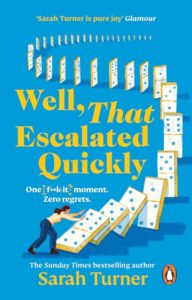
Blog Tour: Julia Chapman Discusses What’s in a Name?
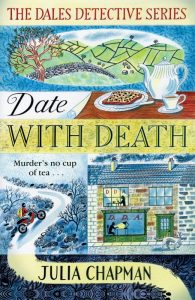 Huge hellos today to Julia Chapman and the blog tour for her new novel, Date with Death which is part of the Dales Detective Series, released by Pan on 9th March. Here’s a bit about it….
Murder’s no cup of tea.
Samson O’Brien has been dismissed from the police force, and returns to his hometown of Bruncliffe in the Yorkshire Dales to set up the Dales Detective Agency while he fights to clear his name. However, the people of Bruncliffe aren’t that welcoming to a man they see as trouble.
Delilah Metcalfe, meanwhile, is struggling to keep her business, the Dales Dating Agency, afloat – as well as trying to control her wayward Weimaraner dog, Tolpuddle. Then when Samson gets his first case, investigating the supposed suicide of a local man, things take an unexpected turn, and soon he discovers a trail of deaths that lead back to the door of Delilah’s agency.
With suspicion hanging over someone they both care for, the two feuding neighbours soon realize that they need to work together to solve the mystery of the dating deaths. But working together is easier said than done . . .
To celebrate the release of her new novel, Julia asks, what’s in a name.

My novels are full of characters. But when you are creating a brand new person, where do you start? Usually, the physical characteristics come first for me. On the odd occasion, a character has emerged on the page complete with name from the very beginning. But that’s unusual.
On the whole, I create the people who populate my books from scratch. But sometimes the traits I give them come from real life. For example, I have a gorgeous Weimaraner called Tolpuddle in my new Dales Detective Series, a large grey dog who has a habit of leaning against people. I took that detail from a New Zealand Huntaway I once knew who was just like that. He would come up and lean into you, his weight heavy on your leg. But it wasn’t threatening. It was reassuring. As though he was letting you know he was there – in case you were in trouble.
I stole that characteristic and gave it to Tolpuddle. The rest of him is pure fiction. Especially his penchant for beer!
But perhaps the most essential part of any character, for me, is the name. It can tell you as much as any detailed physical description. More sometimes! We all know a Susie is different to a Susan. A Bill is going to be possibly less formal than a William. We can even deduce a person’s age simply from what they are called. Edith and Lucy – both live in Bruncliffe, the setting for the Dales Detective Series. Want to take a bet which one lives in Fellside Court retirement complex and which one runs the local cafe?
(Having said that, I do have a character called Titch who is massive. But then, if a bit of name inversion was good enough for Little John in Robin Hood then I’m happy to follow suit!)
How to choose this fundamental aspect of the people who will populate my books, then? By the time I reach the stage of assigning a label, the personality is usually fully formed. So I need the name to be right – it has to fit the person emerging from under my words like a glove. Consequently, it can take me a lot longer to christen my characters than to create them.
Take the landlord of the Fleece in Bruncliffe, the setting for the Dales Detective Series. He’s morose. A misanthropist.
He’s a reluctant host and suffers his customers only because they make him money.


 by

A Moment With Talli Roland: My Writing Process
 Starting a new novel is always so exciting. Everything feels shiny and fresh, and you just know it will be the best book you’ve ever written.
I love that moment, before the inevitable self-doubt sets in. I don’t have any particular rituals when I sit down to write a new book, but I always sketch out the obstacles my characters will face and how I want them to change and grow by the end of the book.
I also think about their backgrounds and their internal conflicts, either as a result of their history or character traits. I often don’t have a picture of my protagonist in my mind, but I do need to ‘know’ them: their fears, their likes and dislikes, and what they want out of life.
I’ve tried both exhaustive planning and ‘pantsing’, and I usually fall somewhere in the middle.

 by
Blog Tour: Amanda Brooke Talks About Her New Novel, The Affair
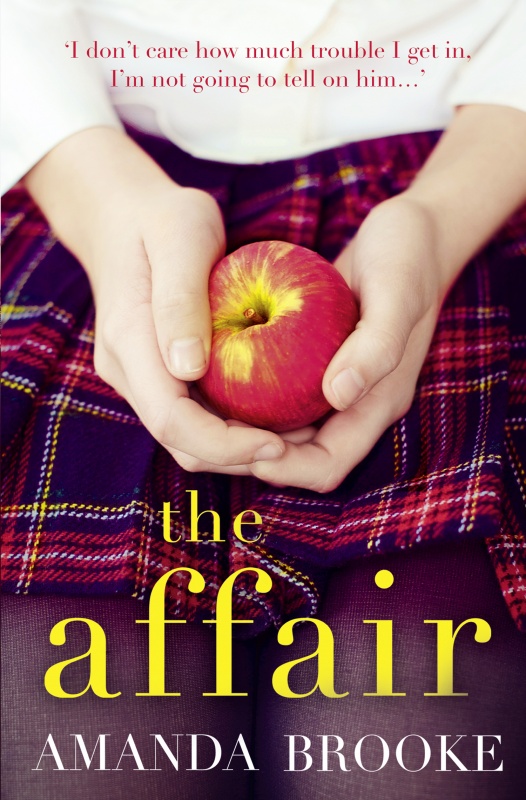
 Today, I am welcoming Amanda Brooke and the blog tour for her latest novel, The Affair which was released by Harper on 10th November in electronic form with the paperback release due for 12th January.
A shocking story about a fifteen-year-old girl and the man who took advantage of her
“You might as well know from the start, I’m not going to tell on him and I don’t care how much trouble I get in. It’s not like it could get any worse than it already is.
I can’t. Don’t ask me why, I just can’t.”
When Nina finds out that her fifteen-year-old daughter, Scarlett, is pregnant, her world falls apart. Because Scarlet won’t tell anyone who the father is. And Nina is scared that the answer will destroy everything.
As the suspects mount – from Scarlett’s teacher to Nina’s new husband of less than a year – Nina searches for the truth: no matter what the cost.
Hello Amanda. Thank you so much for joining me on Novel Kicks today. Your new book is called The Affair. Can you tell me a little about it and how the idea originated?
Thank you for inviting me on to Novel Kicks, it’s lovely to be here again! The Affair begins with the news that fifteen year old Scarlett is pregnant to a married man. She won’t say who it is, but the two likely candidates are her stepfather and her teacher. The story is told from the point of view of the men’s wives; Scarlett’s mum, Nina and teacher’s wife, Vikki. I also introduce Scarlett’s voice as a narrator, and she describes the early days of her relationship and how she feels when the accusations start to fly. I’m not sure how much I can say about how the idea originated without giving too much away. I had a scene in my head of a schoolgirl watching from the periphery while other people’s lives fell apart. She wasn’t meant to be the focal point of the book, other than perhaps a final reveal, but after long chats with my editor, the premise of the story morphed into something quite different, and it was both a pleasure and a challenge to write.
Can you describe what your typical writing day is like? Any rituals like needing tea or writing in silence?
You’ve asked that question at a very exciting time, because I gave up work this month to write full-time. I’ve spent thirty-one years in local government and for the last five I’ve been juggling two careers, fitting in my writing around the day job. I can tell you what I plan to do, which is to concentrate on my writing in the morning, which allows me to spend the rest of the day thinking about what I’ve written and where I need to take the story next. I’m conscious that working from home will be quite sedentary, so I’ve had my treadmill adapted, with a small desk that fits on top of the handlebars. My first hour of writing will be spent walking and typing so I can wake up my body and brain at the same time. As I’ve said, that’s only the plan so you might need to ask me again in a year’s time to see if I’ve kept to it.
 How do you approach writing your novels? Are you much of a planner and need to know your characters well and plot inside out? Do you edit as you go?
When I have an idea for a story, I like to mull it over in my head for a while before I commit to paper. The starting point is a two page synopsis, which doesn’t necessarily cover sub-plots or minor characters but should be enough to capture the essence of the story. My next task is to cut up the synopsis into about twelve sections, which in theory will be the chapters and, if nothing else, it gives me some reassurance that I have enough of a story for a full length manuscript. When I’m ready to start writing, I tend to have a very clear idea of the opening and final scenes, but the rest of the book remains relatively fluid. I enjoy getting to know my characters and they’re the ones who fuel my imagination as I go along, creating situations and conflict I never could have imagined from the start. In terms of editing, I see that first draft almost as a test run, it’s only during the subsequent rewrites that I really get to know the story.

 by
Playing FTSE Author, Penelope Jacobs Talks About Balancing Work and Family
 Playing FTSE by Penelope Jacobs was released by Ipso Books in digital format yesterday (24th November)
When Melanie Collins joins an investment bank as a young graduate, she quickly discovers that femininity is an invaluable asset. But it must not be abused.
She witnesses other women falling victim to office affairs and is determined to be taken seriously. In an industry where abilities are rewarded handsomely, she rises rapidly through the ranks. But her increased profile attracts the attention of a senior colleague and she is ill-equipped to handle his advances.
Balancing a demanding job with a confusing personal life proves difficult and soon their relationship threatens to jeopardise her career. As events move beyond control, her glamorous world becomes tainted by betrayal and bitterness.
One of the themes in the book explores the issues the main character Melanie has with balancing her personal life with her professional one.
The author of Playing FTSE, Penelope Jacobs is joining me today to talk about her thoughts on balancing work and family and why we can’t have it all. Over to you, Penelope.
Achieving a work-life balance is not always possible and certainly requires sacrifices.
Marriage and, more specifically, babies seem to be the tipping point, when life can sometimes spiral out of control. As noted by the National Health Interview Survey, 30-44 year olds report the largest “work-lifestyle imbalance”. During this period, many high-powered career women have simply piled far too much onto their plates. On top of a highly pressurised job, they suddenly have to cope with the demands of small children, a husband and running a household. Not to mention find a little time for themselves.
The Mental Health Foundation states that “the pressure of an increasingly demanding work culture in the UK is perhaps the biggest and most pressing challenge to the mental health of the general population.” In addition, “many more women report unhappiness than men (42% of women compared with 29% of men), which is probably a consequence of competing life roles and more pressure to ‘juggle’.”
Why are we accepting this burden from society? In my opinion, it is not possible to “have it all” and at the same time seamlessly achieve a wonderful work-life balance.
Every woman I know has made some type of sacrifice which, by definition, means they do not have it all. At one extreme, some high-powered women consciously choose not to have children and, at the other, an enormous number leave their brilliant careers permanently to raise a family. In both cases, the costs are high.

 by
Blog Tour: Lesley Downer Talks About Writing Her Novel, The Shogun’s Queen
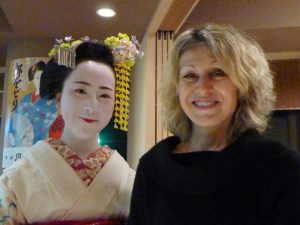
Me in Japan with a maiko (trainee geisha)
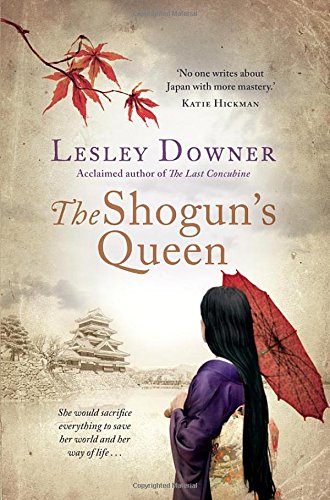
A big welcome today to Lesley Downer and the blog tour for her latest novel, The Shogun’s Queen which was released by Bantam Press on 3rd November.
Japan, and the year is 1853. Growing up among the samurai of the Satsuma Clan, in Japan’s deep south, the fiery, beautiful and headstrong Okatsu has – like all the clan’s women – been encouraged to be bold, taught to wield the halberd, and to ride a horse.
But when she is just seventeen, four black ships appear. Bristling with cannon and manned by strangers who to the Japanese eyes are barbarians, their appearance threatens Japan’s very existence. And turns Okatsu’s world upside down.
Today, on the last day of the tour, Lesley has joined me to talk about writing The Shogun’s Queen. Over to you, Lesley…
 Hello, Laura. Thank you for allowing me to post on your blog today! I greatly appreciate it.
I’ve had a love affair with Japan all my life, and when I decided to move from non-fiction to fiction ten years ago, it was obvious that was where my stories would be set. I’m also mad about research. I love any excuse to go to Japan and I also love scouring old books written by Victorian travellers who were there in the nineteenth century. If I could live my life again it would be in old Japan, the Japan of the great woodblock print artists Hokusai and Hiroshige – and a reasonable second best is reading about it and being there in my mind and taking my readers there as I write about it.
Somehow – I forget how – I came across the Women’s Palace, a sort of harem where three thousand women lived and only one man, the shogun (the military ruler of Japan), could enter. To me the most surprising thing was that I’d spent so long in Japan and read so much about it yet in all those years hadn’t come across the Women’s Palace before. I decided to set my first novel there and so The Last Concubine was born. There was literally nothing in English about the palace. I had to struggle through a book written in Victorian-era Japanese with the help of a Japanese friend. My story took place at the very end of the era of the shoguns and my heroine fled the palace early on in the book.
I went on to write two more novels following on in time after the events of The Last Concubine.
Somewhere along the way I heard of Atsu’s heart-rending story and couldn’t get it out of my mind. It haunted me. Telling her story would mean going back to the Women’s Palace and I’d been feeling for a long time that I hadn’t finished with it – or rather it hadn’t finished with me.

 by
Book Club