A Moment With: Laura Elliot
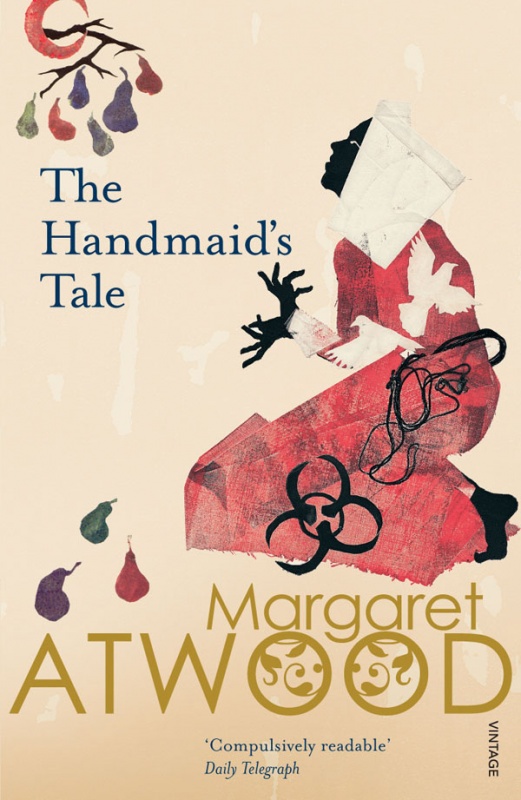
Vintage: New Ed Edition, July 1996
The Enduring Memory of a Handmaid’s Tale
I like books that scare me. The ones that keep my heart racing and my finger compulsively turning the pages – or, in in this era of Kindle, twitching on the next-page command. Such books usually conjure up a grim, dystopian world and leave me wondering if they could actually materialise as science advances and technology reaches further and further into our personal lives.
It must be twenty years since I read The Handmaid’s Tale by Margaret Atwood yet I can still bring the details of that story vividly to mind. Briefly, it’s about a totalitarian society that reforms after a nuclear explosion lays most of the United States to waste. The land is contaminated and many of the women who survived the catastrophe have become infertile. In this new, male dominated society these women are sent to clear up the nuclear waste and suffer obvious consequences as a result. The only ones to avoid this fate are the wives of the men in power –these men are known as The Commanders –and the ‘handmaids,’ young women like Offred, the narrator, who have remained fertile and are capable of producing children to populate this new world order.
The self-imposed belief in The Republic of Gilead is that only women are infertile, men remain fertile. This, of course, is untrue so many of these handmaids are unable to conceive and live in dread of being sent to the contaminated wastelands. Their babies, if they do conceive, will belong to The Commanders and their wives.


 by

Blog Tour: Writing Rituals and Inspriations by Rachel Abbott
 Hello Rachel, thank you for joining us. We’re delighted to be part of your blog tour. Your new novel is called Stranger Child. What’s it about and what inspired it?
If I had to find one word which sums up what Stranger Child is about, it would have to be revenge – but that nowhere near covers it.
Emma Jacobs met David – now her husband – several years ago, but they lost touch when she went to Australia. When she came back, she was horrified to learn that David’s first wife had been killed in a car accident, and his six-year-old daughter had disappeared from the scene. Now, six years later, Emma and David have put the past behind them and are happily married with a new baby, Ollie.
And then a stranger walks into their lives, and their world falls apart.
Emma discovers things about her own past that shock her, and when she contacts her old friend DCI Tom Douglas for help, their pursuit of the truth sets in motion a series of terrifying events that neither of them could have imagined.
Emotions run high in this book, and each of the main characters has to face a dilemma that nobody should ever have to deal with.
Can you tell us a little about your route to publication?
I am extremely fortunate in having an amazing agent who really looks after me well. I start with an idea of the story and the characters, and I send it to her. She mulls it over and comes back with the things she likes and the things she hates, and somehow or other we knock the outline into shape.
And then I write. I do nothing else – just sit at my desk and write. I love it, but the first draft is always pretty dire. However, it creates the framework, and from there I can go back and work out the detail.
When I’m happy, it goes for first edit – and I know that there will be lots of changes to be made. These are structural – sometimes quite major – but always good. There are a couple of rounds with the editors, and then it goes to line edit where we argue about the detail. Is this sentence necessary? Would we lose anything if we chopped out this paragraph? Then finally the copy edit – when I’m always surprised at the little details that I’ve missed.
We have Advance Review Copies prepared in paperback – this is something we have started with Stranger Child – and my publicists send out copies to anybody who is keen to review the book.
And as an independent author, I also have to think about the marketing, the cover, the blurb – it’s very much a full time job at every stage.

 by
Guy Mankowski on Writing How I Left The National Grid
 The writing process for How I Left The National was so distinct from that of my two previous novels, that it was almost like learning to play the keyboard after you’ve been playing guitar. This seems an apt, if somewhat pretentious description, given that this novel follows the story of an eighties post-punk musician, Robert Wardner. Wardner vanishes after a particularly controversial appearance on Top Of The Pops. During this performance he commits a shocking act which, during the more buttoned-up era of 80s Britain, causes enough of an impact that he never recovers.
My first novel, The Intimates, was mostly written over an intense eight-week period when I was 21. I lived and breathed the novel every single day almost in a hallucinogenic way. My second novel, Letters from Yelena, was written over a year and a half, and its writing coincided with a research trip to Russia in which a great deal of information about the world of Russian ballet was absorbed. This novel was set mainly in 80s Manchester, only a few hours away from me.
Somehow, it took over three years.

 by
A Moment With Jacqueline Harvey
 My writing day varies depending on where I am in the world. When I’m at home in Sydney I usually work in my study. It looks out onto two sunny courtyards and across to the upper storey of a beautiful Queen Anne style home. Some days if I’m editing I might walk up to one of the local coffee shops and work there – I like to be around the hum of people depending on what stage of the writing process I’m at.
I start my day with a skinny latte but try to limit myself to one coffee, so after that I’ll have one or two cups of tea.
I’m usually at my desk by 8am and often work until 6pm. I’ve only been writing full-time for two years and one thing I’ve found problematic is my lack of movement! I have to make sure that I get up and walk every half hour or so. To that end I investigated a brilliant standing desk arrangement last year. It has a large flexible arm to hold the computer screen and keyboard so you can adjust it to a sitting position and then push it up so you can stand. The negative impact of sitting for long periods is frightening, apart from the inevitable weight gain, so I hope the standing desk will work for me.

 by
Carla Curuso’s Five Writing Tips
 Carla Curuso lives in Adelaide and as well as being the author of Catch of the Day, Mommy Blogger and Unlucky for Some, she is also involved in the Adelaide Chick-Lit Book Club and the Life, Love & Laugh blog. Her novel, A Pretty Mess is available on Amazon and Pretty Famous will be available on 1st February 2015.
Carla shares her five writing tips…
1. Don’t follow trends.
2. Be yourself and find your own unique voice.
3. Write every day – it’s the best way to keep ‘inside the head’ of a story/character and stay excited by it. Even if you only write 300-600 words a day, it’s amazing how the word count builds up overtime. I find I can only write in a few-hour blocks anyway, then I’m not inspired anymore! It’s a marathon not a sprint. Plus, you’ll have a better story if you have ‘creative thinking time’ in between, pushing the novel in different directions you might not have thought of earlier.
4. Write the kind of book you’d feel excited to pick up from a shelf. (Sophie Kinsella said something like that and it’s so true!)
5. Write your ‘own’ story. Your life experience might seem boring to you, as compared to, say, Gwyneth Paltrow’s life, but it’s actually a goldmine. Nobody has experienced exactly the same kind of things as you have – the people you’ve met, the places you’ve been, the emotions you’ve felt. Draw on it and you’ll write authentically and keep people captivated!
Read our interview with Carla.
Find Carla at www.carlacaruso.com.au and information about her latest works at http://www.harpercollins.com.au
The Adelaide Chick-Lit Book Club is on Facebook and the Life, Love and Laughs blog can be found at http://www.lifeluvnlaughs.blogspot.com.au/

 by
Book Club