Novel Kicks Fiction Friday: Decisions Decisions
 Fiction Friday is our weekly writing prompt. The aim is to write for a minimum of five minutes and then keep going for as long as you can. Once you’ve finished, don’t edit, just post in the comments box below.
You are at a three way fork in the road. You can go left, right or straight ahead. There is no option to go back the way you came.
One road involves a journey into a dense forest that is said to be haunted.
One road will involve a pack of wild wolves which is the animal you are most afraid of.
The last road is said to pass a community of witches and magic.
You don’t know which road is which but all of them eventually lead to the information you need to get home.
Pick a path as your setting and just start writing.
Have fun!


 by

Novel Kicks Writing Room: Combining Characters
 For today’s writing room, I thought it would be fun to combine characters that up until this point have had nothing to do with one another.
Write a short piece of fiction (max. 1,500) involving your favourite hero/heroine and your favourite villain.
They don’t need to be from the same original story.
A couple of suggestions: Pip from Great Expectations and President Snow from The Hunger Games, Elizabeth Bennett and Voldermort.
The characters meet under stressful circumstances and begin a conversation.
How do they react in this environment? How do they react to one another?

 by
NK Chats To…Rachael Brown
 A lovely big welcome to Rachael Brown today. Thank you for chatting to me. Your book is called Trace: who killed Maria James? Can you tell me a little about it and what inspired the novel?
The novel Trace; who killed Maria James? is the story behind my now two-and-a-half year investigation into a 1980 murder cold case. Maria James was stabbed to death at the back of her Melbourne bookshop, the very day she was set to confront her parish priest about the sexual abuse of her younger son, Adam. I learned a witness had seen this priest covered in blood on the day of her murder, and had given a statement to police, but nothing ever came of it. And then I learned exhibits and documents are missing.
So my deep-dive into Maria’s case was born out of two questions; Was the Catholic Church involved in her death? Has Victoria Police – either unwittingly or deliberately – been involved in its cover-up? I reported my investigation through the Australian Broadcasting Corporation’s first true-crime podcast, Trace.
While I was convinced my investigation would be betterfirstserved as a podcast series – because its interactivity could help solve the case – the constraints of this medium left much unsaid. So Scribe’s book details the anatomy of my meticulous investigation. Through the dead-ends and discoveries, the tears and the triumphs, I show readers the gritty toll on all those caught up in, and consumed by, this case. And remarkably, despite the darkness, or maybe because of it, this book also says a lot about hope, and humanity’s warmth.
What’s your writing process like? Which part was the easiest, hardest and challenging to write?
I found the process excruciating, both because of the dark material and structural challenges. I fortunately had already completed a lot of the research and transcripts (for the podcast), so much of the heavy lifting was done in 2016. But how to fashion this monster of an investigation into a compelling and clear narrative for readers? I decided to leapfrog between timelines – between detective Ron Iddles’ investigation in 1980, and mine in 2016/17 – planting seeds in each timeline that would be fleshed out in the other. This was the best way to help this 38-year-old case career along, and to highlight its strengths and flaws.
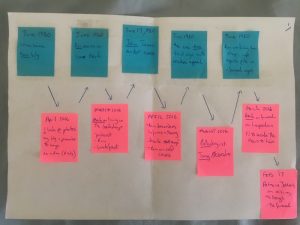 I was a post-it fiend. Blue for Ron’s investigation, and pink for mine. When I looked at my initial structure, the pink was too dense in the middle. This section was a weighty series of accounts of sexual abuse, which I worried might be too depressing for readers. But these accounts needed to be in the book, to bare witness to history. So I introduced green post-it notes, representing the podcast episodes and subsequent audience engagement. This was a great way to bring some light into the darkness, and also, to allow readers a glimpse into the mechanics of the podcast medium.
These sections are also testament to my skilled production team, including Jesse Cox, the podcast’s series producer, who passed away in December. Jesse wanted to change the world, and he did, in helping bring people’s creative dreams to life, so these green post-its allowed such personal tributes to be interwoven. Also, I’m told Traceis the first Australian podcast to be turned into a book, of which I’m also incredibly proud.
Continue reading

 by
NK Chats To: Laura Briggs
 I am so happy to be welcoming Laura Briggs to the blog today. Hello. Thank you so much for joining me. Your book is called A Wedding in Cornwall. Can you tell me about it and what inspired it?
Hi Laura! Thanks so much for letting me share with your readers about my series of books. This all begin in 2016 when I penned the romance novella A Wedding in Cornwall about an American event planner who finds a new life—and true love—when she moves across the Pond to work at a beautiful Cornish manor house. Readers were so enthusiastic for my heroine Julianne’s adventures in Cornwall that the series ended up continuing for a total of twelve books! Now, as the series celebrates its second year anniversary, readers can buy novellas 7-12 in one special book bundle.
What are the challenges and best bits about being a writer?
Hmm…the challenges for me would be getting the words I type to match the idea in my mind. When I first think of a plot for a book it’s kind of like seeing a movie trailer—all the highlights are easy to picture in that moment. But then, when I get into the finer details and the actual writing it can be hard to find the idea’s full potential sometimes. So that’s definitely a big challenge in my writing. As for the best bits? Connecting with book bloggers and fellow authors and hearing that readers enjoy my work!
What’s your step by step process when planning a novel?
I almost always make an outline. It can be detailed with scene by scene descriptions or it can be as simple as just a list of events that need to happen in the story. But I hardly ever just wing it—I need to have at least a rough idea where I’m going!
What elements do you feel need to be there to make a good novel?
Engaging characters are pretty important to me as a reader. Even if they aren’t the most likeable or sympathetic type, I do need to find them interesting!
What’s your approach to editing?
I usually try to put aside the finished manuscript for a few days. Then, I try to look at it from a reader’s point of view. It’s not easy to see your own work objectively, of course, but it does help to find initial problems with the story.

 by
A Moment With…Dean Mayes
 A big Novel Kicks welcome today to Dean Mayes. His novel, The Artisan Heart is due to be released by Central Avenue Publishing on 1st September.
“Hayden Luschcombe is a brilliant pediatrician living in Adelaide with his wife Bernadette, an ambitious event planner. His life consists of soul-wrenching days at the hospital and tedious evenings attending the lavish parties organised by Bernadette.
When an act of betrayal coincides with a traumatic confrontation, Hayden flees Adelaide, his life in ruins. His destination is Walhalla, nestled in Australia’s southern mountains, where he finds his childhood home falling apart. With nothing to return to, he stays, and begins to pick up the pieces of his life by fixing up the house his parents left behind.
A chance encounter with a precocious and deaf young girl introduces Hayden to Isabelle Sampi, a struggling artisan baker. While single-handedly raising her daughter, Genevieve, and trying to resurrect a bakery, Isabelle has no time for matters of the heart. Yet the presence of the handsome doctor challenges her resolve. Likewise, Hayden, protective of his own fractured heart, finds something in Isabelle that awakens dormant feelings of his own.
As their attraction grows, and the past threatens their chance at happiness, both Hayden and Isabelle will have to confront long-buried truths if they are ever to embrace a future.”
Dean is himself an Intensive Care nurse and he is with us today to talk about how he portrays Medicine in fiction.
It is often said that, as a writer, our best writing comes from what we know. I’ve tried to buck that trend over the course of my published works, but there’s an inevitable truth I’ve come to accept – that maxim definitely holds true.
Having been an Nurse for over two decades now – with most of my career focused in Intensive Care – both Adult, pediatric and Neonates – along with Accident & Emergency – I’ve seen things and gained experiences as a clinician that translate well into the realm of gritty fiction. There’s compelling character moments to be found and situations that offer high drama. At the same time, I have to be mindful that I’m writing for a general audience who may not be well versed in the minutiae of medicine. There’s definitely a high wire act to master in writing engaging scenes.
My soon to be released novel “The Artisan Heart” is probably the most comprehensive example of me using my career experience to craft characters and situations.
In the story, we are introduced to Hayden Luschcombe, a brilliant pediatric emergency doctor who has an uncanny ability in diagnosing his patients quickly, efficiently and accurately. He has saved many lives as a result and, as a clinician, he is held in high regard – even if, as a person, he is seen as socially awkward and “on the spectrum” as some colleagues point out in their interactions with him. In one scene, early in the novel, Hayden’s acute sense of observation proves to be life saving for a new-born baby who presents with a stricture of the intestine. In another powerful moment, further on, Hayden correctly suspects a child has been deliberately scalded in boiling water by her parents. During the scene there is a highly charged confrontation between the child’s step father and Hayden that serves to illustrate the variation in presentations to the department and the dramatic circumstances that can spill off from those presentations.
While I won’t blow my own trumpet here and compare myself to Hayden Luschcombe, I did I craft Hayden as an amalgam of my own clinical experiences, working in a busy, inner city children’s emergency department. There are probably two or three other doctors in Hayden, medicos who I’ve worked alongside and watched over the past 10 years. The two examples I cited above are based on real clincial presentations, the latter of which was indeed as emotionally charged as it appears in the novel.

 by
Book Club