Novel Kicks Writing Room: A Character Q&A
 Welcome back to the Novel Kicks Writing Room.
Today, I thought it might be good to revisit a previous exercise and look at getting to know your character. However, we won’t be talking to your character in their present day, for this, they are 16 years-old.
Get into the head of your character by answering the following questions. Remember, in this scenario, they are sixteen. Think about how differently they would answer compared to how an adult would answer. Maybe you could try answering from the point of view of different genders and see how the answers differ?
- What did you want to be when you were five? What do you want to be now?
- What scares you?
- What is your biggesr secret?
- Who is your best friend?
- Who has betrayed you?
- If you needed to save one thing from your house, what would you save?
- What is in your bedside table?
- Where would you like to visit and why?
- Why did your Dad leave?
- Are you happy?
Let me know how you get on in the comments below. How did you find answering the questions? Which one was hardest to answer? Which answer suprised you? Did you learn anything about your character that has now further informed the piece of writing they feature in?


 by

A Moment With… Lucy Kaufman
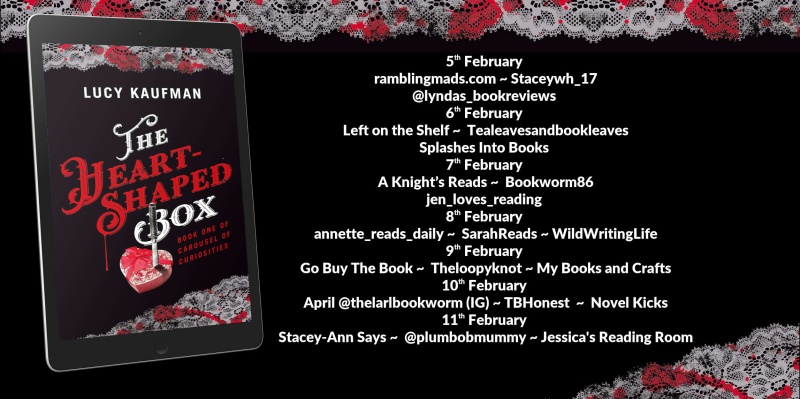
 Lucy Kaufman is bringing the blog tour for The Heart-Shaped Box to Novel Kicks today. Welcome.
The page-turning psychological thriller novella about infatuation, revenge and the lengths we will go to for love.
“She pressed her nose gingerly to the glass, peering unblinking through the viscous liquid at her gift.”
Victorian, rural Sussex. When headstrong daughter of a rector, Constance Timothy, receives a flurry of gifts in pretty little boxes from the charming, smouldering student doctor Smith Williams, her whole family anticipates a future betrothal.
Yet beneath the exquisite pastel lids and satin bows lie macabre secrets that entice Constance into a private world of obsession and darkness, where morality becomes blurred, loyalties are tested and unthinkable acts are possible.
One secret will shake the genteel world she knows to the core…
The first book of The Carousel of Curiosities series, this haunting novella is perfect for readers of Sarah Waters, Laura Purcell, and Angela Carter.
To talk about how much she loves Novellas and why you might too, it’s over to you, Lucy.
 Like many schoolkids in the UK, the first novella I read was Of Mice and Men. Short enough to read over a term in a classroom and engaging enough a story for even the most book-phobic child to be drawn into its emotional world, it’s obvious why Steinbeck’s 30,000-word masterpiece has become an all-time classic as well as a Literature syllabus perennial.
There are clues in that thin-spined book as to what makes a great novella: one strong storyline pushing forward to an inevitable climax and conclusion, unforgettable characters, vivid description that puts us right there with Lenny and George in Soledad, and an emotional tangle at its heart that has a deep sense of how things should go in an ideal world but – in this book at least – don’t.
I read recently how a novella is akin to other short forms such as flash, the short story and even poetry in that a novella cannot afford to waste a single word. For this reason, they may be short, but they are rich and refined, the good ones often polished to perfection like precious stones until they gleam.

 by
NK Chats To… Kathleen Jeffrey
 Hi Kathleen. Thank you so much for joining us today and for bringing the blog tour for Katie’s Really Bad Day: A Story About Test Anxiety to Novel Kicks. What’s a detail, theme, or clue in your book that most readers might miss on the first read—but you secretly hope someone notices?
Empathetic, concerned faces of Katie’s teacher, Mom & Dad, and her classmates when Katie is upset. No one is making fun of her.
When did this story or idea “click” into place for you—was there a single moment you knew you had to write it?
During critique group sessions with a long manuscript, I discovered I actually had two books to write. The first became Katie’s Really Bad Day: A Story About Test Anxiety, to identify Katie’s character with school & test anxiety, which is based on my personal story I had to tell for authenticity. The second book will feature Katie once again and will be illustrated sometime this year.
Which character or real-life person surprised you the most while writing this book, and why?
Katie’s sidekick Finn turned out to be quite the entertaining cut up as well a very concerned and empathetic friend.
If your book had a soundtrack, what three songs would be on it and what scenes or moments would they pair with?
“Inside Out” by Michael Giacchino, (From joyful school yard to Katie’s sudden test anxiety.)
“When I Breathe” by Stephanie Leavell (Learning belly breathing with Miss Julie and later with the class.)
“When I’m Nervous” (A song for kids about overcoming anxiety.) Overall story wrap up. Would play at the end of the book.
What’s one belief, question, or emotional truth you hope readers carry with them long after they finish your book?

 by
Novel Kicks Writing Room: One Sentence In Different Genres
Welcome back to the Novel Kicks Writing Room.
It’s all about trying different genres today.
We are going to begin with this one sentence –
He/She/They/I walk into a room. Everything stops. Silence falls.
Starting with that one sentence, we are going to write something within four different genres.
Historical Fiction
Crime Fiction
Contemporary Fiction and/or Romance
Horror
We are going to write at least three hundred words in all four of the genres above.
Try not to think about the quality of what you’re writing. Just write and see.

 by
A Moment With… Elaine Spires
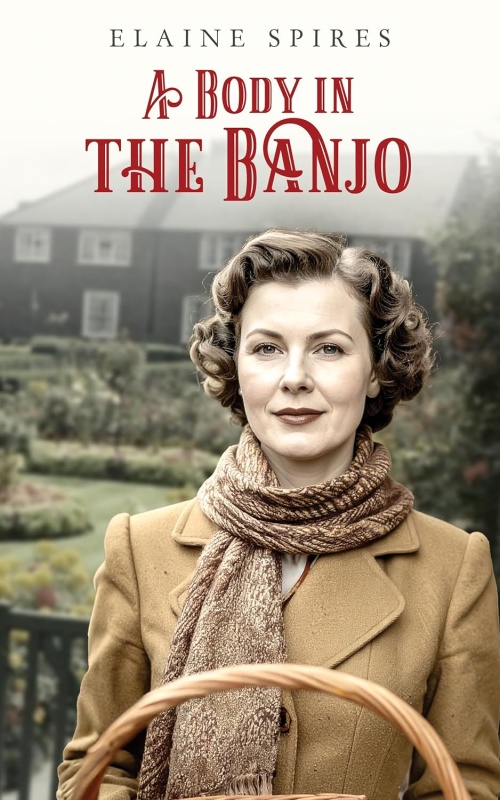 We are saying hello to Wednesday and welcoming Elaine Spires as she brings the blog tour for her book, A Body in the Banjo to Novel Kicks.
It’s November 1958 and Dagenham is excitedly awaiting Bonfire Night. Cissie Partridge isn’t too keen on fireworks but she generously donates to the local children doing Penny for the guy. Cissie is content with her lot. She loves her husband Harold.
She shops, she cooks, she reads at every opportunity and she volunteers at the Dockland Settlement. Observant and sharp, she gets on with all her neighbours.
Then, one morning, she finds a body…
To tell us about more about The Body in the Banjo’s main character, Cissie, it’s over to you, Elaine.
Mrs Cissie Partridge
As a writer I have often struggled to classify my novels. Romance? Well… there is romance in them but they certainly don’t fall into the typical enemies-to-lovers or friends-to-lovers formats of most romantic novels. Contemporary Fiction? Some are. Sagas? Sort of. Women’s Fiction? Getting warmer! All of my books feature strong women. But all the years I have been writing there was one genre that I’d always wanted to attempt: cozy mysteries.
When I went to live in Spain as a 19-year-old holiday rep — or courier as we were known in those days — clients would often offer me their paperbacks when they were leaving. I’ve always been a voracious reader and I was extremely grateful for their generosity. Thus I discovered so many authors, Jackie Collins, Harold Robbins, Sidney Sheldon, Mario Puzo, Alistair Maclean to mention just a few. However, there was one author’s name I was always delighted to see on my gifted books: Agatha Christie.
I devoured her books and fell into every trap, followed every red herring as the Queen of Whodunnits totally blindsided me. I never once guessed who the murderer was. I’ve also watched all the TV Miss Marples over the years, my favourite being Geraldine McEwan and I must have seen every episode of David Suchet as Poirot a dozen times. From time to time over the years I would ask myself “Can I write a murder mystery?”

 by
Book Club