Book Review: Healing Hearts at the Forever Cottage by Jill Steeples
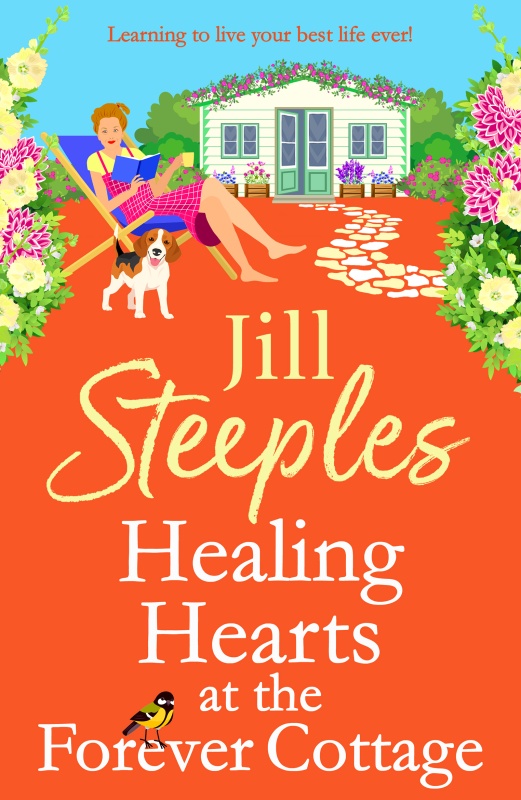 Please join me in welcoming Jill Steeples back to Novel Kicks. She’s here with the blog tour for her latest book, Healing Hearts at the Forever Cottage.
The winds of change are sweeping through the idyllic Cotswold village of Lower Leaping.
After a tumultuous few months, Tess Alexander is ready to welcome her first guests to The Garden Retreat, a beautiful lodge in the grounds of Hollyhocks Cottage.
With her daughter Hannah home from her travels in Australia and her mother, Marjorie, acting out of character, Tess has to juggle many demands on her attention. Even her flourishing relationship with dashing Rob Templeton is put to the test when he faces an emotional dilemma from his past and Barney, her beloved beagle, has her at her wits end.
Tess can weather most storms with the unbridling support of her close friends Dilly, Gina and Suzy but when a passing remark in the local pub causes her to question one of those friendships, she wonders who can she really trust?
Can Tess overcome the obstacles in her path to find the happy ending she truly deserves?
*****
Tess has begun to really settle into her life post separation from her husband. Her new relationship with Rob is going well, her daughter seems to be getting better after going through an ordeal and her beloved garden annexe is ready for its first guest. Is everything starting to go right or is there more upheaval around the corner?
It’s so marvellous to be back in Lower Leaping and Hollyhocks Cottage. This book is book two of the series. Having read book one, I couldn’t wait to escape into this gentle world that Jill Steeples has created. If this novel will be your introduction to this series, don’t fear. I felt that reading book one enriched book two, but both can stand alone.


 by

A Moment With… Rachel Debrave
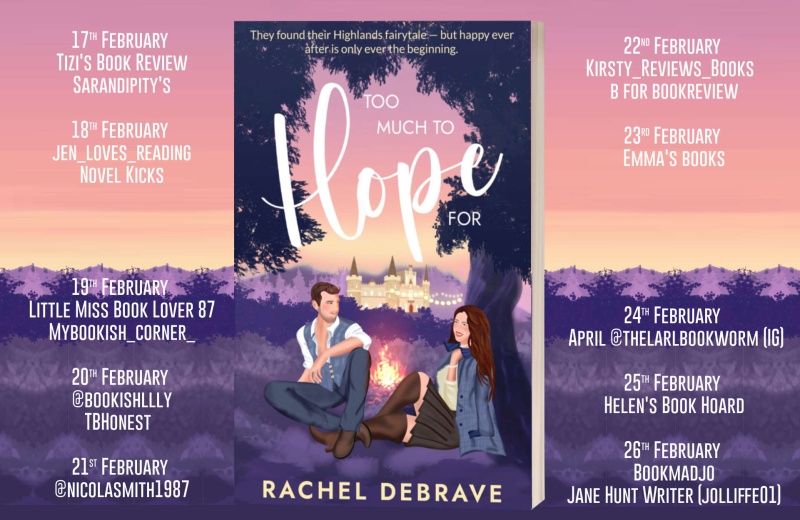
 It’s so wonderful to be welcoming Rachel Debrave to Novel Kicks and the blog tour for her book, Too Much to Hope For.
Scarlett Hope has found a surprising rhythm at Haddon House. Just months into life with Laird Edward Cameron-Reid, their chemistry is electric, and the future feels full of promise – but something inside her is stirring. She’s traded city charm for estate calm yet still feels caught between worlds.
Then Harry shows up. A famous music producer – and a blast from Scarlett’s past – he’s in town to film with a renowned band. His arrival is magnetic, disruptive, and the last thing she ever expected. Scarlett loves Edward, but Harry’s presence reawakens the version of herself she thought she’d left behind.
When Edward’s daughter announces she’s pregnant and moves in full-time, the pressure only grows. And when Scarlett meets Sophie, a young woman struggling to make a home for her unborn child, one small act of kindness turns into something far bigger – a project that might just change everything. But as tragedy strikes, Scarlett faces a deeper choice – not between two men, but between who she was and who she’s becoming.
Too Much to Hope For is a high spice, emotionally layered story of love, legacy, and identity – about staying rooted in love while growing into something more. Perfect for readers who loved the emotional fire of A New Hope in the Highlands, the small-town heart of Things We Never Got Over, and the soul-deep reckoning of After I Do.
Without further ado, it’s over to Rachel.
When Chemistry Isn’t Enough – Writing Spice Without Losing The Story.
Readers and writers talk a lot about “spice” at the moment. How much is too much. Whether it’s necessary. Whether it adds anything at all. As both a reader and a writer of romance, I find the conversation fascinating – and occasionally a little heated.
 Because for me, the question isn’t really about how explicit something is. It’s about whether it matters.
I love chemistry. There’s nothing quite like that first charged exchange between two characters who just click. The dialogue sharpens. The air shifts. You can feel the pull before either of them admits it.
But chemistry on its own is easy.
What’s harder – and far more interesting – is asking what that chemistry is doing.
There’s a lot of conversation about ‘spice’ versus ‘smut’. I find it fascinating – and sometimes a little puritanical and/or judgemental – on either side of the fence. Some readers want closed-door romance. Others want very explicit, on-the-page intimacy. Neither is wrong, and let’s not yuk someone’s yum (as the cool kids are calling it!). But for me, the real question isn’t how graphic something is – it’s whether it means something.

 by
NK Chats To: A.M. Shine
 Thank you so much for joining me today and for inviting Novel Kicks onto your blog tour. Grace is steeped in Irish mythology and Gothic horror—what inspired you to blend these elements in this story?
An unhealthy obsession with horror and history is probably to blame for this one. I’ve always enjoyed the notion that the old lore was inspired by very real fears, and that there are horrors still existing in Ireland that we’d be wise not to disturb. For centuries we were an island of storytellers, gift-wrapping these terrifying warnings as tales and rooting them to the land, not merely to spook the children, but to keep them safe.
Growing up in a small village in the west of Ireland, I knew which trees were fairy forts and best avoided. There was even a rock that’d apparently been a witch once upon a time, and on the darkest nights she could be seen travelling as a passenger in the backseat of your car. I believed the stories then, and I still respect them now. Grace was inspired by my love of the gothic and Ireland’s wonderful inheritance of horror, and I’m exceptionally proud to carry on that tradition in the twenty-first century.
The island in Grace is described as “isolated and wilfully forgotten.” How did you go about crafting such a haunting and atmospheric setting? Was it inspired by a real place?
I’ve wanted to set a novel on an island for years now, as I can’t imagine a setting more cruel and isolating than a lonely rock out in the ocean. To make it suitably inhospitable, I drew on my own experiences of Ireland’s unique and ofttimes bleak west coast. I also visited the Aran Islands and Inishbofin to get a real feel for the isolation first-hand and to test out the local pubs (for research purposes, of course). There’s a feeling to these communities that I really wanted to infuse into my writing, not only to craft the horror, but to also capture their stark beauty. And Croaghnakeela, where Grace takes place, is actually a real island. Nobody lives on it, thankfully, so I didn’t feel too bad when I invented its own horrible history. But who knows, maybe this novel will inspire a few adventurous horror fans to visit it someday. I’d be happy to tag along with them.
What draws you to horror as a genre, and what do you think makes a truly terrifying story?

 by
Novel Kicks Fiction Friday: Pick Up From The First Line
 It’s Friday which means it’s time to start writing some fiction.
Fiction Friday is our weekly writing flash fiction prompt.
The aim is to write for a minimum of five minutes and then keep going for as long as you can.
Don’t edit, just write. Once you’re done, you’re welcome to share in the comments but there’s no obligation.
Today’s prompt is – pick up from the first line.
Using the first line below, create a story. The genre, the character and setting is up to you. The only rule is you have to use this first line…
‘Well, this is where I live.’
I am so excited to see what you do with this line. Remember, don’t worry about what you’re writing. The aim of this is to get the words down onto the page and to see where it takes you.
Have fun.

 by
Book Review: The Resistance Knitting Club By Jenny O’Brien
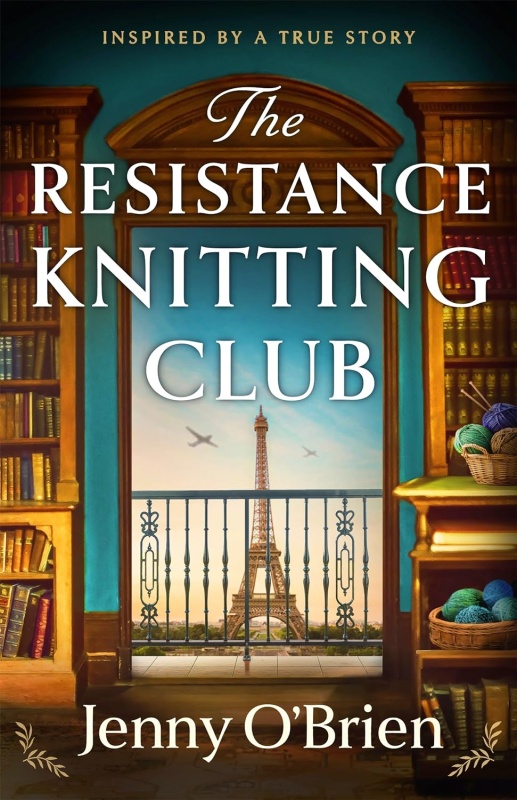 Please join me in welcomin Jenny O’Brien to Novel Kicks and the blog tour for her book, The Resistance Knitting Club.
Inspired by the true story of a woman who used knitting patterns to encode intelligence during World War Two.
Guernsey, 2010. After a stroke, an elderly woman shocks her family by speaking perfect French – a language they never knew she possessed. As her granddaughter unravels seventy years of silence, a hidden wartime story emerges…
Paris, 1941. After her brother is declared missing in action at Dunkirk, eighteen-year-old Lenny Gallienne vanishes into Churchill’s secret army. In a bookshop on Rue de la Pompe, she poses as a simple shop girl while encoding intelligence from Nazi headquarters into knitting patterns. Each sweater smuggled to prisoners contains flight paths. Each scarf holds radio frequencies. Each mistake means execution.
Fellow agent, Harry Dennison is the only person who knows her real name. But when the SS close in, Lenny faces an impossible choice in the Metro tunnels beneath Paris – one that will haunt her family for generations. Because in the resistance, the most dangerous secrets are the ones you keep from those you love most.
*****
It’s 2010. An elderly lady sits in a hospital bed and, out of nowhere, begins to speak French. This is a complete surprise to her family. It’s 1941, Lenny is grieving the loss of someone close to her. She decides to join the war effort by working at the war office. When this takes an unexpected turn, this will change the course of Lenny’s life forever.
I couldn’t be happier to be invited onto the blog tour for The Resistance Knitting Club. When I read the blurb for this book, there was something about this story that drew me to it.

 by
Book Club
Recent Comments